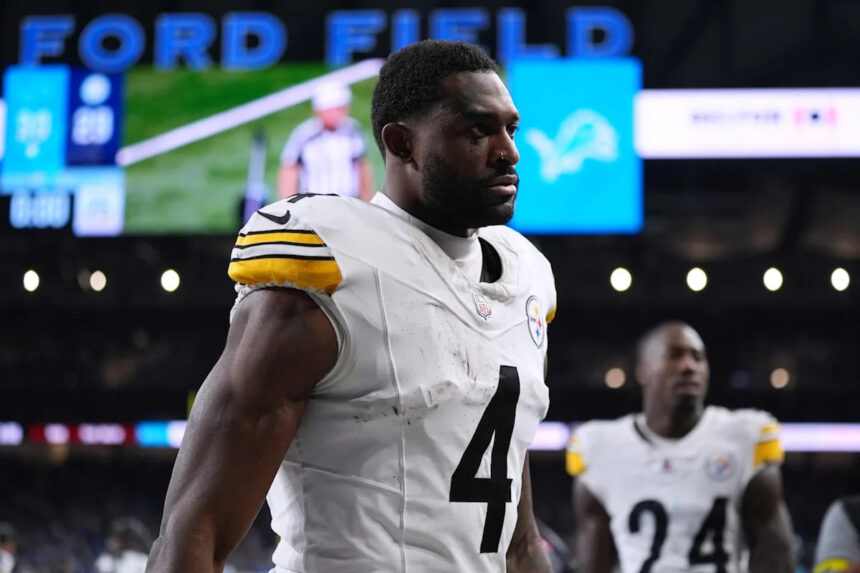
Lions Fan’s “Government Name” Jab Sparks Sideline Altercation with Steelers’ DK Metcalf
The Pittsburgh Steelers’ gritty 20-16 victory over the Detroit Lions on Sunday was a hard-nosed, physical affair on the field. But a brief, jarring moment on the sideline has stolen headlines and ignited a debate about the ever-shifting line between fan interaction and player conduct. In the second quarter, Steelers wide receiver DK Metcalf was captured on CBS broadcast appearing to throw a punch and grab a Detroit Lions fan who was leaning over the railing.
The fan, Ryan Kennedy, identifiable by his vibrant blue wig, spoke exclusively to the Detroit Free Press about the incident that left him “a little shocked” and “rattled.” The altercation, now under review by the NFL, raises complex questions about player discipline, fan provocation, and the intense, intimate environment of an NFL sideline.
The Sideline Spark: A “Government Name” and a Grabbed Jersey
According to broadcast reports and Kennedy’s account, the interaction was more personal than your typical fan heckling. Kennedy, holding a Steelers jersey with Metcalf’s name on it, engaged the receiver. The provocation wasn’t a string of expletives or generic insults, but something far more specific: DeKaylin Zecharius Metcalf.
“He doesn’t like his government name,” Kennedy told the Free Press. “I called him that and then he grabbed me and ripped my shirt.”
The use of a player’s full legal name—their “government name”—as a taunt is a nuanced dig, implying a familiarity or an attempt to strip away the professional persona of “DK.” In the heat of a competitive game, this personal jab clearly struck a nerve. Video shows Metcalf reacting swiftly, reaching over the railing to grab at Kennedy, with an apparent closed fist making contact. The incident was broken up quickly by stadium security and other personnel, but the image was indelible.
Expert Analysis: The Thin Line of the Sideline
From a sports psychology and league operations perspective, this incident sits in a gray area. The NFL has long cultivated an environment where fans are close to the action, but that proximity inherently creates friction points.
“The NFL sideline is a pressure cooker,” says Dr. Elena Rodriguez, a sports culture analyst. “Players are in a state of hyper-arousal, adrenaline is pumping, and their focus is singular. A fan cutting through that focus with a personalized, seemingly knowing insult can feel like a violation of their competitive space. It doesn’t excuse a physical response, but it explains the trigger.”
From a disciplinary standpoint, the NFL’s actions will be closely watched. The league’s personal conduct policy applies to interactions with fans, and physical altercations are taken seriously. However, the context of provocation will be a factor.
- Player Discipline: The NFL could fine Metcalf for unsportsmanlike conduct or actions detrimental to the league. A suspension seems less likely for a first-time, sideline incident of this nature, but a hefty fine is a strong possibility.
- Fan Consequences: While Kennedy was the apparent victim of a physical act, teams and the league also reserve the right to sanction fans for excessive harassment. His ticket privileges could be reviewed, though his specific taunt, while clever, may not cross the league’s threshold for banishment.
- Security Review: This incident will inevitably lead to internal reviews about sideline security protocols. The speed of the interaction highlights how difficult it is to prevent every fleeting exchange.
The Ripple Effect: Predictions for Metcalf and Fan Culture
This moment will have immediate and longer-term repercussions for all parties involved.
For DK Metcalf, this adds an unnecessary chapter to a game where his on-field performance (3 catches for 53 yards) was otherwise solid. Known for his intense, physical style of play, this incident risks framing that intensity as a lack of control. He will likely face questions from the media and the league this week. We predict Metcalf will be fined by the NFL, and the Steelers organization may handle additional discipline internally. His response moving forward will be critical; a composed, accountable statement could quickly defuse the situation.
For Fan Culture, this is a cautionary tale. The era of social media and personalized player knowledge has changed heckling. Fans now have access to personal details, family information, and past grievances, allowing for more targeted barbs. The “government name” taunt is a prime example. This incident may embolden some fans to seek similar viral moments, while it may prompt stadiums to more strictly enforce boundaries about fan encroachment and verbal abuse.
For the NFL, it’s another incident to manage in its ongoing effort to balance fan engagement with player safety and decorum. Don’t be surprised if, in the offseason, the league circulates memos to teams about reinforcing sideline buffer zones or clarifies policies on acceptable fan communication.
Beyond the Blue Wig: A Microcosm of Modern Fandom
Ryan Kennedy, the fan in the blue wig, encapsulated the complex aftermath in his statement: “Like everyone’s talking to me. I’m a little rattled, but I just want the Lions to win, baby.” His primary identity remains that of a loyal Lions fan, even as he’s thrust into a national story. He achieved a form of fan notoriety—getting under the skin of an opposing star—but at the cost of a physical confrontation.
This event is a microcosm of modern sports fandom, where the desire to be part of the narrative can sometimes override traditional spectator boundaries. The quest for a viral interaction, a memorable jab, or a moment of recognition carries new weight. Conversely, players, constantly mic’d up and under ultra-HD scrutiny, are expected to maintain superhuman composure in the face of deeply personal provocations from mere feet away.
The altercation between DK Metcalf and Ryan Kennedy is more than a bizarre sideline scuffle. It is a collision of intensity, identity, and the invasive nature of today’s sports environment. It underscores that an NFL sideline is not just a boundary line on a map, but a psychological frontier. As the league reviews the tape and deliberates on consequences, the incident serves as a stark reminder: in the high-stakes, emotionally charged arena of professional football, sometimes the most explosive plays happen not between the lines, but just outside them. The final whistle may have blown on the game, but the discussion on this clash between player and fan is just beginning.
Source: Based on news from Yahoo Sports.