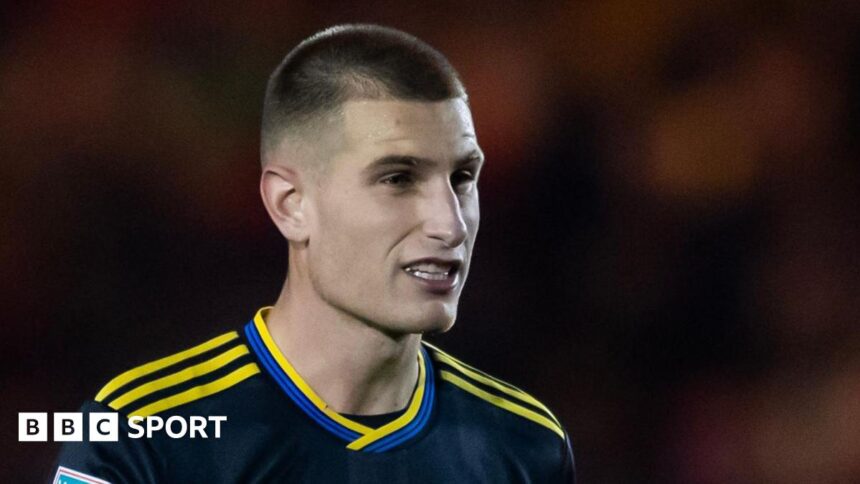
‘Just Reach Out’: Rhys Bennett’s Powerful Message on Loss, Legacy, and Mental Health
Rhys Bennett bounds into the media room at Manchester United’s Carrington training ground, a vortex of youthful energy that seems to fill the space. At 22, the tall, lean defender embodies the physical pinnacle of a professional athlete, save for the knee he’s diligently rehabbing. His handshake is firm, his smile easy, and he speaks enthusiastically about his developing skills as a DJ. This is the face of a young man in control, on the cusp of a promising career. Yet, beneath this vibrant exterior lies a story of profound loss, resilience, and a mission born from the darkest of moments: the suicide of his father, Steve.
A Captain’s Strength Forged in Personal Tragedy
Bennett’s journey at Manchester United is one of quiet dedication. As captain of the club’s last FA Youth Cup-winning team in 2022, he demonstrated leadership qualities that extended far beyond tactical organization on the pitch. Last season, a successful loan stint at Fleetwood Town in League One proved he could handle the physical and mental demands of senior football. He returned to Carrington with his stock risen, poised for the next step.
But the foundation of Rhys Bennett’s character was built long before he lifted youth trophies. It was forged in the devastating aftermath of his father’s death when Rhys was just 14. The confident young man we see today has navigated a grief that reshapes a life. “It’s something that will never leave me,” Bennett admits, his usual buoyancy tempered by reflection. “It’s part of my story. But I’ve learned it doesn’t have to define your future. It can define your purpose.”
That purpose has crystallized into a relentless advocacy for mental health awareness, particularly among young men. Bennett’s key message, the one he hammers home with the conviction of a captain’s team talk, is deceptively simple yet critically urgent: Just reach out.
The ‘Just Reach Out’ Philosophy: Breaking the Stigma
In the hyper-competitive, masculinity-fuelled world of professional football, showing vulnerability has historically been seen as a weakness. Bennett is at the forefront of a new generation determined to rewrite that script. He speaks not from a textbook, but from lived experience—from the haunting questions of “what if?” that follow a loss to suicide.
“People think reaching out is a sign you can’t cope,” Bennett explains, leaning forward. “But it’s the opposite. It’s the strongest thing you can do. Telling a teammate, ‘I’m struggling,’ or calling a friend and saying, ‘I need to talk.’ That takes courage. Real courage.”
His advocacy focuses on practical steps, dismantling the fear around conversation. He emphasizes that reaching out isn’t about having the perfect solution; it’s about connection.
- Normalize the Conversation: Talk about mental health as you would physical fitness. Check in on your friends’ wellbeing, not just their job or game.
- Use Your Platforms: As a footballer, even a young one at United, Bennett knows his voice carries weight. He uses interviews and social media to share resources and his own story.
- Listen Without Judgment: “Sometimes, people don’t want advice, they just want to be heard,” he notes. Being a present, patient listener can be a lifeline.
- Know the Resources: Bennett actively promotes charities like Mind and the Campaign Against Living Miserably (CALM), ensuring those in need know where to find professional help.
Expert Analysis: Bennett’s Impact On and Off the Pitch
From a footballing perspective, Bennett’s maturity is a significant asset. Sports psychologists consistently note that players who develop emotional resilience and self-awareness often show greater consistency and handle pressure better. The tools Bennett has learned through coping with grief—compartmentalization, perspective, seeking support—are directly transferable to navigating a missed penalty, a costly error, or the uncertainty of a loan move.
His experience at Fleetwood was about more than defending. It was about living independently, managing the highs and lows of a grueling season, and being a professional in a high-stakes environment. The fact he thrived speaks volumes about his mental fortitude. This isn’t a player who will be easily shaken.
Furthermore, his leadership role is evolving. He is becoming a dressing room catalyst for a healthier culture. In an era where clubs are increasingly investing in mental wellbeing staff, a peer like Bennett, who speaks with authenticity and empathy, can be more effective than any official seminar. He normalizes the struggle, making it safer for others to speak up.
The Road Ahead: Predictions for Legacy and Career
As Bennett works through his knee rehabilitation, aiming for a League One loan move next month, his path is twofold. On the pitch, the prediction is for a steady, purposeful climb. He has the technical foundation from United’s academy, the physical attributes, and now the proven league experience. The next loan is crucial. If he can secure regular minutes and impress, he positions himself either for a future at United or a strong career in the Football League.
Off the pitch, his legacy is already being written. Rhys Bennett is poised to become one of English football’s most prominent and relatable mental health advocates. His story is not one of celebrity endorsement, but of personal tragedy channeled into public good. We can predict:
- Increased Ambassador Roles: Formal partnerships with mental health charities are a natural next step.
- A Voice for the Academy System: He can guide the next wave of youth players on balancing immense pressure with personal wellbeing.
- Influencing Club Culture: His presence at United, even if his long-term future lies elsewhere, contributes to a more open and supportive environment at Carrington.
Conclusion: More Than a Footballer
Rhys Bennett leaves the media room as energetically as he entered, but the impression he leaves is far deeper than that of a talented young defender. He represents a shift. In sharing his pain over his father’s suicide, he has weaponized his vulnerability into a force for protection. His mission—to get just one person to talk, to reach out—transcends football.
His story is a powerful reminder that strength isn’t about suppressing emotion; it’s about confronting it, sharing it, and using it to help others carry their load. As Bennett continues his journey, battling for a place in football’s demanding world, he is already a champion in a far more critical arena. The final whistle on his career is decades away, but his impact, echoing his simple, vital plea—just reach out—will resonate long after he hangs up his boots.
If you or someone you know is struggling with mental health, you are not alone. Please reach out to a trusted person or contact organizations like Mind (www.mind.org.uk) or the Campaign Against Living Miserably (CALM) (www.thecalmzone.net).
Source: Based on news from BBC Sport.