Amateur Jordan Smith Stuns Sinner, Wins A$1 Million in Australian Open’s One-Point Spectacle
The hallowed grounds of Rod Laver Arena have witnessed legends cement their legacies over grueling five-set epics. But on a sun-drenched Melbourne afternoon, it was the ultimate sporting lottery that delivered a moment of pure, unscripted magic. Jordan Smith, a complete amateur, etched his name into Australian Open folklore not over a fortnight, but in a combined total of seconds, stunning two-time defending champion Jannik Sinner and walking away with A$1 million in the revolutionary ‘Million Dollar One Point Slam.’
The Format That Redefined the Impossible
In a bold move blending high-stakes drama with crowd-pleasing accessibility, Tennis Australia introduced a format never before seen at a Grand Slam. The premise was deceptively simple, yet psychologically monumental: amateur qualifiers and invited celebrities would face top professional players in a single point to decide a match. Win, and you advance. Lose, and your million-dollar dream is over in a heartbeat. The format eliminated the physical endurance of the sport and amplified its mental cliffhangers and technical precision to an unbearable degree.
For the professionals, it was a perilous exhibition. For amateurs like Jordan Smith, a 28-year-old club player from Brisbane, it was a once-in-several-lifetimes opportunity. “My goal was to not trip over my own feet,” Smith later admitted. “I would have been happy winning just one point against any of these legends. The thought of actually winning the whole thing never, ever crossed my mind.”
A Cinderella Run Against the Titans of Tennis
Smith’s path to immortality was as improbable as the format itself. His first-round draw was nothing short of brutal: Jannik Sinner, the world number two and the man who had dominated this very court for the past two years. The contrast was cinematic: Sinner’s fluid, powerful groundstrokes versus Smith’s competent but unmistakably amateur technique. As they approached the net for the coin toss, the 10,000-strong crowd sensed a massacre.
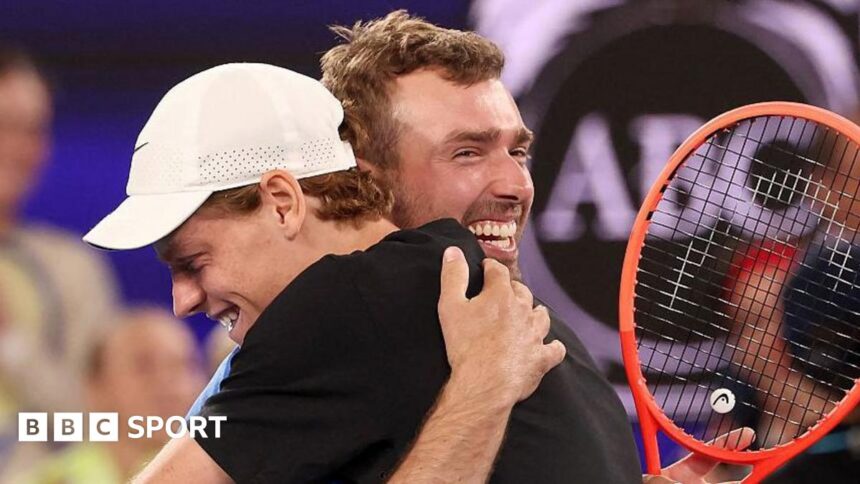
What happened next silenced all preconceptions. Smith, playing with the ultimate nothing-to-lose mentality, executed a deep, aggressive return. Sinner, perhaps caught between instinct and exhibition, sent a forehand just wide. The stadium erupted. The defending champion was out, and an amateur had his first seismic upset. “It was one point,” a gracious Sinner remarked. “But all the pressure was on me. He swung freely and got the reward. That is why this format is so dangerous and so exciting.”
Emboldened, Smith then faced women’s world number four Amanda Anisimova. Leveraging a powerful serve that belied his amateur status, he pressured Anisimova into a netted backhand. The fairy tale was alive. Meanwhile, in the other bracket, a parallel shock was unfolding. Joanna Garland, the world number 117 from Taiwan, pulled off her own staggering double, dismissing men’s world number three Alexander Zverev and the mercurial Nick Kyrgios to set up a final against Smith that no algorithm could have predicted.
Key Upsets in the Million Dollar Slam:
- Round 1: Jordan Smith (Amateur) def. Jannik Sinner (World No. 2)
- Round 1: Joanna Garland (World No. 117) def. Alexander Zverev (World No. 3)
- Semi-Final: Joanna Garland def. Nick Kyrgios (Former Wimbledon Finalist)
- Semi-Final: Jordan Smith def. Amanda Anisimova (World No. 4)
The Million-Dollar Point: Pressure Under a Microscope
The final was a unique pressure cooker. For Garland, a touring professional, this was a chance at life-changing prize money far exceeding her typical tournament earnings. For Smith, it was a surreal continuation of a dream. The point began with both players showing visible tension. A medium-length rally ensued, each player cautious not to make the fatal error. Smith, channeling the same aggressive intent that toppled Sinner, stepped into a forehand and aimed for the corner. Garland stretched but could only deflect the ball into the tramlines.
A moment of stunned silence was followed by a deafening roar. Jordan Smith, the amateur, collapsed to the blue hard court. He had just turned approximately 15 seconds of cumulative play into a A$1 million payday. The victory was less a triumph of superior skill—Garland is undoubtedly the more complete player—and more a monumental testament to nerve, opportunity, and the chaotic beauty of a single point.
Expert Analysis: What This Means for Tennis
The success of this event cannot be understated. From a sporting purist’s perspective, it proved that the psychological dimension of tennis is as critical as the physical. The pros, despite their superior tools, were operating in a no-win situation where expectation was sky-high and margin for error was zero. For the amateurs, the complete absence of expectation was their greatest weapon.
From a commercial and fan engagement standpoint, the ‘Million Dollar One Point Slam’ was a masterstroke. It generated global headlines, offered viral moments, and presented the sport in a new, hyper-condensed, and utterly unpredictable format. It democratized the spectacle, allowing fans to genuinely imagine themselves in that position. The question now is not if we will see it again, but how it will evolve.
Predictions for the future of the format include:
- Global Expansion: Expect similar events at other majors and on the ATP/WTA tour calendars as standalone spectacles.
- Charity Integration: Future editions may partner professionals and amateurs for split prizes, with significant portions donated to charity.
- Enhanced Qualification: Wider open qualifiers could be held globally, deepening the pool of “everyday” participants and the narrative potential.
- Increased Stakes: While A$1 million is monumental, even larger prizes could be on the horizon to amplify the drama further.
Conclusion: A Legacy Defined in Seconds
Jordan Smith returns to his normal life A$1 million richer and with a story that will be told for generations. He didn’t win a major title, but he won a major moment—a moment that encapsulates why we love sports: for its capacity for the unbelievable. He defeated a reigning king of the sport and outlasted a field of giants, all by mastering a handful of seconds under the most intense glare imaginable.
The Australian Open’s innovative gamble paid off spectacularly, proving that tennis’s heart can beat just as fiercely in a single point as it does over five sets. It reminded the world’s best that pressure is the great equalizer, and it gave every club player a new daydream. In Melbourne, history wasn’t made over hours; it was made in an instant, and an amateur named Jordan Smith became a permanent part of the Australian Open’s rich tapestry.
Source: Based on news from BBC Sport.