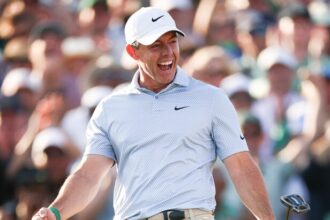
Rory McIlroy’s Stark Assessment: LIV Golf’s Signing Spree Fails to “Move the Needle”
The narrative surrounding LIV Golf has always been one of seismic disruption, fueled by billion-dollar contracts and the defection of major champions. Yet, as the league enters its third season, a counter-narrative is gaining traction, articulated most bluntly by one of the game’s most influential voices. Rory McIlroy, the four-time major champion and PGA Tour loyalist, has delivered a stark verdict: even a headline-grabbing, nine-figure re-signing of a star like Bryson DeChambeau won’t fundamentally alter LIV’s standing in the sport. In McIlroy’s view, the breakaway tour has yet to sign anyone who truly “moves the needle.” This isn’t just casual criticism; it’s a profound challenge to LIV’s entire value proposition and a claim that cuts to the heart of golf’s ongoing civil war.
The “Needle” Metric: Beyond Cheques and Championships
To understand McIlroy’s point, we must first define what “moving the needle” means in modern golf. It transcends tournament wins and driving distance. Moving the needle is about cultural impact, global recognition, and the ability to drive viewership, sponsorship, and fan engagement irrespective of final leaderboard position. It’s a blend of athletic prowess, marketability, and intangible star power.
Historically, golf’s needle-movers are rare. Tiger Woods, of course, is the archetype. In the contemporary era, McIlroy himself fits the bill, alongside young phenoms like Jordan Spieth and, increasingly, Scottie Scheffler. These are players whose presence in a tournament field changes its gravity. LIV Golf, for all its financial might, has largely pursued a different profile: aging legends (Phil Mickelson, Lee Westwood) and talented but niche disruptors (DeChambeau, Brooks Koepka). As McIlroy suggests, signing a major winner like Jon Rahm was significant, but it replicated an existing pattern rather than creating a new paradigm.
- Brand Transcendence: Does the athlete’s fame exist outside golf circles?
- Audience Driver: Do TV ratings and digital engagement measurably spike when they play?
- Narrative Control: Do they consistently command the spotlight and define the sport’s storylines?
By this metric, McIlroy argues LIV’s roster, while undeniably skilled, functions more as a high-profile exhibition collective than a league built around transformative, needle-moving stars. The spectacle is the team format and the funding; the individuals, despite their resumes, are not pulling the wider sporting world’s focus toward LIV in a sustained way.
The DeChambeau Paradox: A Case Study in Needle Theory
Bryson DeChambeau is the perfect test case for McIlroy’s hypothesis. His 2020 U.S. Open win was a revolutionary display of power. He is a compelling, polarizing figure who genuinely innovates and attracts attention. Re-signing him would be a coup for LIV, denying a key asset back to the traditional tours. Yet, McIlroy’s point stands: would it change LIV’s fundamental trajectory?
DeChambeau’s “needle-moving” peak arguably coincided with his PGA Tour tenure and his duel with Brooks Koepka. His move to LIV, while lucrative, has partially muted his impact. He wins LIV events, but within a closed ecosystem that still struggles for mainstream visibility. His YouTube channel thrives, but that’s a personal brand success, not necessarily a LIV Golf success. The competitive legitimacy that amplifies a star’s achievements—the deep fields, the historic venues, the weight of tradition—remains, in the public perception, more firmly attached to the majors and the PGA Tour.
Spending “hundreds of millions” to retain DeChambeau, therefore, looks like an expensive exercise in maintaining the status quo for LIV. It prevents erosion but doesn’t catalyze growth. It’s a defensive, not offensive, play. It signals that LIV’s model remains reliant on poaching and retaining talent with astronomical sums rather than organically creating stars who draw fans to its unique product.
The Unsignable Stars and LIV’s Existential Ceiling
McIlroy’s commentary hints at a deeper, more existential issue for LIV. The players who truly move the needle in golf today appear to be unsignable for the Saudi-backed league, not just due to loyalty, but due to legacy.
Tiger Woods was never a realistic target. Rory McIlroy has become the tour’s staunchest defender. Jordan Spieth and Justin Thomas are deeply embedded in the PGA Tour’s fabric. The new guard—Scottie Scheffler, Viktor Hovland—seem motivated by legacy and competition over pure finance. This creates a ceiling for LIV. They can assemble a league of major champions and characters, but they cannot seem to attract the specific, young, globally iconic stars who are currently writing the sport’s history and shaping its future on the other side.
This leads to a critical bottleneck: audience acquisition. Without needle-moving stars to force casual fans to seek out its broadcasts, LIV remains a curiosity for most golf fans, not a destination. The league’s move to a television deal with The CW Network has provided a platform, but not breakthrough ratings. The product itself—team golf, shotgun starts, music—was meant to be the star. McIlroy’s analysis suggests that, in a sport so deeply connected to individual heroics, that concept has its limits.
The Road Ahead: Merger Talks, Majors, and Measuring Success
Where does this leave LIV Golf? McIlroy’s comments come amidst ongoing, fragile framework agreement talks between the PGA Tour, DP World Tour, and LIV’s financier, the Public Investment Fund of Saudi Arabia. His stance can be seen as a powerful piece of positioning in those negotiations. It downplays LIV’s sporting achievement and reinforces the PGA Tour’s claim to hosting the world’s most relevant competition.
Looking forward, LIV’s success may need to be measured differently. Its strategic disruption has already succeeded in forcing unprecedented change and player compensation on the PGA Tour. Its legacy might be that of a catalyst, not a permanent rival. Furthermore, LIV players’ continued success in the majors—the one arena where all sides collide—is vital for their relevance. A DeChambeau or Koepka winning another major while on the LIV roster is the ultimate needle-moving event for the league.
However, the prediction stemming from McIlroy’s logic is clear: unless LIV can unearth or develop a transcendent star from within its own ranks—a near-impossible task without a traditional competitive pathway—or somehow shatter expectations by landing a current, undisputed needle-mover, it will remain a compelling, wealthy, but ultimately niche tour. It will be defined by who it paid, not by who it created.
Conclusion: A Battle for Golf’s Soul, Measured in Impact
Rory McIlroy’s statement that LIV Golf hasn’t signed a needle-mover is more than a rival’s barb. It is a concise, expert analysis of the league’s core challenge. Golf, for all its changes, remains a star-driven sport. The hundreds of millions spent to date have bought LIV a roster of champions and characters, but not, as McIlroy sees it, a transformative cultural force. The re-signing of a Bryson DeChambeau would be a testament to LIV’s financial endurance, but not necessarily proof of its sporting ascendancy.
The true “needle” in golf points toward legacy, history, and sustained relevance. For now, McIlroy is betting—and his words suggest he believes—that those commodities are still primarily forged on the fairways of the PGA Tour and the hallowed grounds of the major championships. Until LIV can change that fundamental equation, it may continue to make noise, but, in the eyes of one of its most prominent critics, it will not move the meter.
Source: Based on news from ESPN.
Image: CC licensed via armedforcessports.defense.gov