Killjoy or Correct? The VAR Decision That Stole Manchester City’s Late Drama at Anfield
The final whistle at Anfield had blown, but the storm was just beginning. In a cauldron of noise and narrative, Manchester City had just pulled off a stunning late comeback against Liverpool, only to have its most dramatic exclamation point scrubbed from history by a cold, digital eye. The question now echoing from the Kop to the Etihad isn’t just about the result, but about the soul of the game itself: did VAR, in its relentless pursuit of technical correctness, act as a killjoy to one of the Premier League’s greatest spectacles?
A Narrative of Chaos and Comeback
For 99 minutes, the titanic clash between Liverpool and Manchester City lived up to its seismic billing. It was a game of relentless intensity, tactical chess, and individual brilliance. Liverpool, fueled by Anfield’s roar, had seized the initiative. Manchester City, champions in poise and patience, weathered the storm and launched their inevitable fightback. The late goals that brought them level, and then ahead, were the stuff of legend—a testament to their unwavering belief.
Then came the moment that should have been the definitive climax. In the dying embers of stoppage time, a goalmouth scramble saw the ball trickle agonizingly over the Liverpool line. Bedlam ensued. City players erupted in celebration, believing they had sealed a monumental 3-1 victory with the last kick of the game. The narrative was perfect: the champions, written off in the furnace of Anfield, showing their champion heart. But football’s new reality had other plans.
The Intervention: Law vs. Spirit
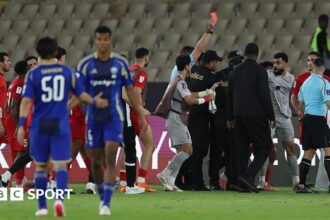
As the celebrations began, the silent, omnipresent specter of the Video Assistant Referee went to work. On the pitch, the goal had been given. In a dimly lit room miles away, officials began their forensic examination. Replays focused not on the ball crossing the line, but on the moments preceding it. The spotlight fell on Manchester City’s Manuel Akanji and Liverpool’s Alexis Mac Allister.
The key question was one of impeding an opponent. Did Akanji, in his attempt to reach the ball, unfairly block Mac Allister’s path? The VAR, David Coote, saw enough contact and obstruction to recommend an on-field review. After a long look at the monitor, referee Michael Oliver concurred. The goal was disallowed for a foul in the build-up. The stadium, moments earlier a vortex of conflicting emotions, united in a shared sense of bewildered anti-climax.
This is the modern VAR dilemma incarnate:
- By the letter of the law: If the referee deems the obstruction a foul, it is a foul. The sequence leading to the goal is therefore illegal. The process, however painstaking, was technically followed.
- In the spirit of the game: The contact was minimal, part and parcel of a frantic goal-box melee involving multiple players from both sides. To disallow a last-second, potentially decisive goal in a fixture of this magnitude for such an incident felt, to many, like an over-application of the rules, sterilizing the raw emotion that defines football.
The term “clear and obvious error“—the supposed threshold for VAR intervention—felt stretched to its limit. Was Michael Oliver’s initial decision to award the goal a *clear* error? Or was it a subjective judgment call suddenly subjected to a paralyzing level of scrutiny?
Expert Analysis: The Unwinnable War of Perception
From a purely analytical standpoint, the decision hinges on interpretation. Former professionals and pundits are divided, a sure sign of its subjectivity. Some argue that Akanji’s movement, while not malicious, clearly impedes Mac Allister from potentially clearing the ball. In the modern game, especially following directives to protect players from blocking off, it is a foul.
Others, however, point to the context. This was not a cynical, shirt-pull on a breakaway. It was a chaotic, congested, physical scramble where similar contacts were going unpunished all game. The consistency of officiating is again called into question. Would the goal have been disallowed if the teams were reversed? Would it have been reviewed at all in the 50th minute? The lack of a definitive, universally understood standard for such incidents is VAR’s greatest weakness.
Furthermore, the decision highlights the unintended consequence of VAR’s forensic lens. The system was designed to correct egregious mistakes, but it increasingly finds itself adjudicating on 50/50 moments where the human eye of the on-field referee could reasonably see it either way. In seeking to eliminate controversy, it often simply relocates it, with higher stakes and a more clinical, dissatisfying aftermath.
Predictions and Ramifications: A Lingering Shadow
The immediate fallout is a bittersweet victory for Manchester City and a reprieve for Liverpool, though the point felt like an afterthought amidst the controversy. But the longer-term implications are more profound.
For the title race: The point keeps the race tantalizingly close, but the psychological impact is complex. City may feel aggrieved and hardened, a dangerous mentality for a champion squad. Liverpool may feel a sense of injustice from earlier decisions, but also relief at a narrow escape. The incident adds another fiery chapter to their rivalry, ensuring the return fixture will be charged with even greater intensity.
For the future of VAR: This incident is a textbook case for the “football’s gone soft” brigade and will fuel the ongoing debate about the technology’s role. It will increase pressure on lawmakers (IFAB) and the PGMOL to refine the protocol, particularly around the “clear and obvious” standard and the review of attacking phase build-ups. Could we see a time limit on how far back VAR can look? Or a higher threshold for disallowing goals for fractional fouls in crowded boxes? This decision will be cited in those conversations for years to come.
Conclusion: The Cold Truth of Perfection
So, was VAR a killjoy? In the pure, visceral sense of robbing fans and players of a moment of unadulterated, last-gasp drama, the answer is an undeniable yes. It took a storybook ending and replaced it with a legal footnote. The spirit of chaotic, emotional, sometimes imperfect football was undeniably dampened.
But was it right? Within the current, flawed framework of the laws and their interpretation, it was a defensible, if brutally clinical, application of the rules. The pursuit of perfect decision-making is a noble aim, but this incident proves that perfection often comes at the cost of soul. The beautiful game’s most memorable moments are born from human triumph, human error, and raw, unfiltered feeling. In its quest to erase one of those elements—error—VAR risks sanitizing the other two. The late drama at Anfield wasn’t just a goal that wasn’t; it was the starkest illustration yet that in football, what is correct is not always what feels right, and the game is forever wrestling with which of those ideals matters more.
Source: Based on news from BBC Sport.