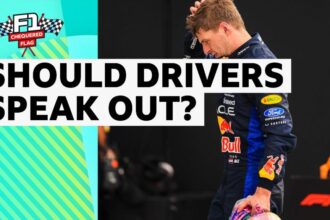
Max Verstappen’s Blistering Critique: Are F1’s New Cars “Formula E on Steroids”?
The roar of a Formula 1 engine has long been the soundtrack to ultimate motorsport performance—a visceral, unapologetic declaration of power and aggression. But according to the sport’s reigning dominator, that symphony is being rewritten into a complex, efficiency-driven algorithm. In a candid and explosive assessment, Red Bull’s four-time world champion Max Verstappen has labeled 2024’s new-generation cars “not a lot of fun” and, in a comparison that will sting traditionalists, “like Formula E on steroids.” This isn’t just driver grumbling; it’s a fundamental critique of Formula 1’s technical direction, sparking a crucial debate: is the pursuit of hybrid hyper-efficiency strangling the very soul of the sport?
The Heart of the Complaint: Energy Management Over Exhilaration
Verstappen’s frustration centers on the dramatically increased demands for energy management dictated by the latest hybrid power units. While the cars are physically potent, the rules have created a scenario where the engines are, in effect, “energy starved.” Drivers must now constantly juggle multiple recovery systems to keep the battery at an optimal charge level for peak power. The result, according to Verstappen, is a driving experience divorced from flat-out racing instinct. “It’s just not Formula 1,” he stated bluntly. The raw, pedal-to-the-metal aggression that defined eras past is being supplanted by a strategic, almost managerial role behind the wheel. The primary adversary is no longer just the driver in the next cockpit, but a complex energy budget.
This shift manifests in counter-intuitive and, for purists, jarring driving techniques:
- Lifting and coasting for performance: To harvest sufficient energy, drivers must lift off the throttle early and coast into braking zones, even on qualifying laps meant to be absolute maximum attack.
- Non-acceleration out of final corners: Imagine the final turn onto a long straight, and instead of stamping on the throttle, a driver momentarily hesitates to feed the battery. This is now a reality in the quest for optimal energy deployment.
- Strategic downshifting: Gear changes are no longer purely for cornering balance. Drivers are shifting down to lower gears mid-corner to increase engine braking and maximize energy recovery from the MGU-K.
These techniques represent a fundamental recalibration of the driver’s task. The art is becoming as much about resource accounting as it is about car control.
Formula E on Steroids: A Cutting but Apt Analogy?
Verstappen’s “Formula E on steroids” analogy is deliberately provocative, but it cuts to a core philosophical tension in modern motorsport. Formula E was founded on the premise of energy as a finite, strategic resource. Its entire racing format—from attack mode to regenerative braking—is built around managing a tight energy budget. Formula 1, historically, was about unlimited performance within a set of technical regulations. The comparison suggests that F1’s hybrid complexity has now pushed it into a similar conceptual space, albeit at vastly higher speeds.
The critical difference, and perhaps Verstappen’s point, is expectation. Fans tune into Formula E for a tech-forward, strategy-heavy energy duel. They tune into Formula 1 for the spectacle of the world’s best drivers operating at the absolute limit of machine and human capability, unleashing power with apparent abandon. When the spectacle begins to resemble a high-speed energy spreadsheet, a disconnect forms. The “steroids” part of his quote acknowledges the cars are monstrously fast, but implies the experience is artificially amplified yet constrained by an overriding efficiency mandate.
The Technical Tightrope: Innovation vs. Spectacle
From a technical standpoint, the current regulations are a masterpiece of engineering. The hybrid power units are the most thermally efficient internal combustion engines ever created, marvels of technology that push the boundaries of what’s possible. They are the vanguard of road-relevant innovation, a key pillar of F1’s modern identity. The sport is walking a tightrope, balancing its role as a laboratory for future automotive tech against its need to deliver visceral, engaging competition.
The question posed by drivers like Verstappen is: has the balance tipped too far? When the engineering challenge for the team in the garage begins to fundamentally compromise the driving challenge in the cockpit, the product may suffer. The skill set is changing. The new era rewards the metronomic, the calculating, the perfectly efficient—qualities Verstappen possesses in spades, but which he clearly feels come at too high a cost to the raw engagement of driving.
Predictions: Will the Sport Listen to its Star?
Verstappen is not just any driver; he is the face of Formula 1 in its current era. His voice carries immense weight. His public critique, likely echoed privately by other drivers, places significant pressure on the FIA and Formula 1’s decision-makers as they plan the next major regulatory shift, expected for 2026.
We can anticipate several potential outcomes:
- 2026 Rule Adjustments: The 2026 power unit regulations, already announced with a greater focus on electrical power and sustainable fuel, may see tweaks to address driver feedback. Simplifying the energy recovery process or adjusting the energy deployment windows could be on the table to return a sense of direct driver control.
- A Driver-Led Rebellion: As the star driver, Verstappen’s continued outspokenness could galvanize the Grand Prix Drivers’ Association (GPDA) to formally lobby for change, making “driveability” a key metric alongside safety and sustainability in future rules.
- A Spectacle Divide: In the short term, we may see these complex demands widen the gap between the best and the rest. Teams that can simplify the energy management task for their driver, through software or hardware integration, will grant them a crucial cognitive advantage on Sunday.
Conclusion: Preserving the Soul in the Age of Efficiency
Max Verstappen’s critique is a vital intervention at a crossroads for Formula 1. It is a reminder that while technological progression is non-negotiable, the sport’s essence must be protected. That essence is the unmediated contest between driver and machine, the spectacle of humans wrestling with monstrous power at the edge of adhesion. If the driver becomes primarily a systems manager, a crucial element of magic is lost.
The challenge for the sport’s architects is profound: to harness the incredible innovation of the hybrid era without neutering the primal thrill that made Formula 1 the pinnacle. The cars cannot go backwards, but perhaps the rules can evolve to once again put unfiltered driver skill at the forefront. Verstappen has thrown down the gauntlet, not just for faster cars, but for more fulfilling ones. The response from the powers that be will define whether Formula 1 remains a breathtaking sport, or becomes a breathtakingly fast science project.
Source: Based on news from BBC Sport.