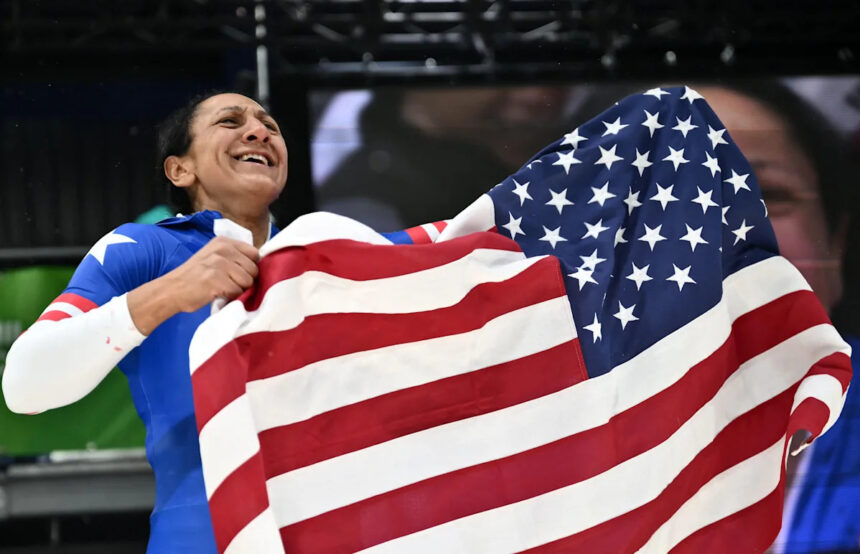
Elana Meyers Taylor Cements Legacy: A Historic Gold in a Fifth Olympic Act
The ice track at the Yanqing National Sliding Centre is a study in brutal physics, a twisting, g-force-laden gauntlet where victory is measured in hundredths of a second. On Monday, it became the stage for something far more profound: a coronation. At 41 years old, in her fifth Olympic Games, Elana Meyers Taylor of the United States did not just win the inaugural women’s monobob event. She authored a definitive chapter in the annals of Olympic perseverance, powering her sled to a gold medal that solidifies her as one of the most consequential athletes in American Winter Olympics history.
Meyers Taylor’s triumph was a masterclass in controlled aggression, beating Germany’s Laura Nolte by a decisive 1.54 seconds, with fellow American and three-time gold medalist Kaillie Humphries claiming bronze. But the time gap tells only a fraction of the story. This victory was the culmination of a two-decade journey marked by relentless evolution, heartbreaking near-misses, and a resilience that has now etched her name across the record books in indelible ink.
A Legacy Forged in Silver and Steel
To understand the magnitude of this gold, one must first appreciate the path of the podium. For years, Elana Meyers Taylor was the heir apparent, the consistent force always in the hunt. Her Olympic resume was a testament to elite longevity: silver in Vancouver 2010 (as a brakewoman), silver in Sochi 2014 (as a pilot), bronze in PyeongChang 2018, and another silver in the two-woman event just days before her monobob win in Beijing. She was, in many ways, the defining figure of American bobsledding excellence, yet the ultimate prize remained just out of reach.
“I’ve been so close so many times,” Meyers Taylor reflected after her victory. The monobob, a one-person sled introduced for these Games, presented a unique opportunity—a pure, unadulterated test between pilot and track. For an athlete whose career has been defined by partnership and teamwork, this was a solitary crucible. “This was my chance to go out there and just lay it all on the line, just me and the sled,” she said.
Her performance was a clinic. In a sport where experience navigating a track’s intricate nuances is paramount, Meyers Taylor’s five-Olympic wisdom was her superpower. Each run built upon the last, her lines growing sharper, her confidence radiating through the television screen. When she crossed the line on her final descent, the emotion was raw and immediate—a release two decades in the making.
By The Numbers: Historic Milestones Achieved
The statistics surrounding Meyers Taylor’s career are staggering. With Monday’s gold, she didn’t just add another medal to her collection; she shattered ceilings and forged new benchmarks for generations to come.
- Most Decorated U.S. Female Bobsledder: With five Olympic medals (1 gold, 3 silver, 1 bronze), she stands alone atop the American women’s bobsled pantheon.
- Most Medals by a Black Athlete in Winter Olympics History: This landmark achievement, confirmed by Team USA, underscores her role as a pioneering icon who has expanded the visibility and possibility within winter sports.
- Tied for Most Medals by a U.S. Winter Olympian (Female): Her five medals tie the legendary speed skater Bonnie Blair, a figure synonymous with American Winter Olympic glory.
- Oldest American Woman to Win Winter Gold: At 41 years and 18 days, she surpassed the previous record, proving that peak performance has no expiration date.
“What Elana has done transcends bobsled,” said former Olympian and sliding sports analyst John Morgan. “She has redefined the career arc for a winter athlete. Her ability to maintain this level of technical proficiency and competitive fire across five Olympic cycles, while also becoming a mother, is virtually unprecedented. She is the model of the modern, complete athlete.”
Analysis: The Perfect Storm for a Golden Moment
Several key factors converged to create this historic moment. The introduction of the women’s monobob was pivotal. It leveled the technological playing field—every athlete uses identical sleds—placing the emphasis squarely on driving skill and mental fortitude. For a technician like Meyers Taylor, this was a tailor-made opportunity.
Furthermore, her journey to Beijing was itself an Olympian feat. She, her husband, and their infant son Nico all contracted COVID-19 upon arrival in China, forcing her into isolation and causing her to miss the Olympic Opening Ceremony. She watched the first women’s bobsled events—the two-woman race she would eventually win silver in—from her hotel room. This adversity seemed to steel her resolve, making her monobob focus even sharper.
“The isolation, the uncertainty—it could have broken another athlete,” noted sports psychologist Dr. Leah Fischer. “But for a veteran like Meyers Taylor, it became a period of intense visualization and mental preparation. She transformed a setback into a strategic retreat. By the time she got to the monobob start line, she was not just ready; she was liberated.”
Her main rival, Kaillie Humphries, the dominant force in women’s bobsledding for the past decade, was also navigating a unique circumstance, competing for the first time for the U.S. after switching from Canada. This dynamic created a fascinating narrative within the U.S. team, but on monobob day, Meyers Taylor’s mastery was untouchable.
The Future and an Enduring Legacy
With this golden exclamation point, the inevitable question arises: what’s next? Meyers Taylor has spoken openly about the physical toll of the sport and her desire to spend more time with her young family. If Beijing marks her final Olympic run, she exits not with a whisper, but with a roar that will echo for decades.
Her legacy is multifaceted: a trailblazer for Black athletes in winter sports, a role model for mothers in athletics, and a testament to the power of longevity and grit. She has fundamentally altered the perception of a bobsledder’s prime. “She has shown that with the right mindset, training, and recovery, an athlete’s 40s can be their most powerful years,” said high-performance director Matt Roy.
For the sport itself, her victory is a massive boost. The compelling story of the monobob’s inaugural champion—a beloved veteran finally seizing her individual moment—is the kind of narrative that attracts new fans and inspires the next wave of sliders. Young athletes, especially young girls of color, now have a towering, gold-standard figure to look toward in a sport where they have been historically underrepresented.
Conclusion: More Than Gold
Elana Meyers Taylor’s gold medal in the monobob is far more than a piece of hardware. It is the culmination of a 20-year odyssey defined not by sudden glory, but by incremental excellence and unwavering belief. It is a victory for every athlete who has ever been told their time has passed, for every competitor who has stood on the podium but not at its top step, yearning for one more chance.
She arrived in Beijing as the greatest U.S. female bobsledder without an individual gold. She leaves as the most decorated, a historic figure who tied legends, broke barriers, and, at an age when most have long retired, drove with the ferocity of a rookie and the wisdom of a sage. On the ice of Yanqing, Elana Meyers Taylor didn’t just slide to a gold medal. She slid into immortality.
Source: Based on news from Yahoo Sports.