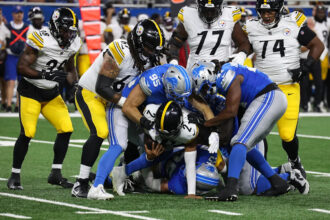
NFL’s Tush Push Survives: Why the Controversial Play Isn’t Going Anywhere Soon
The NFL’s most debated, dissected, and dominant short-yardage play has been granted a stay of execution. In a statement that will reverberate from Philadelphia to every opposing defensive meeting room, NFL Competition Committee co-chairman Rich McKay indicated Sunday that the league is not poised to outlaw the “tush push” or “brotherly shove” this offseason. This declaration, while not a permanent guarantee, signals a significant victory for innovation and a tacit acknowledgment that for now, the solution to stopping the play lies not in the rulebook, but on the field of battle.
The Official Word: McKay’s Statement and Its Implications
Rich McKay’s comments, delivered from the heart of the NFL’s decision-making apparatus, carry immense weight. As co-chair of the powerful Competition Committee, his anticipation of no ban proposal effectively extinguishes the immediate legislative threat to the play. The committee, tasked with reviewing all aspects of the game for competitive fairness and player safety, has clearly been monitoring the tush push phenomenon. Their current stance suggests that, despite its near-automatic success rate for teams like the Philadelphia Eagles, the play has not yet crossed the threshold into being deemed a problem requiring a rules intervention.
This decision-making process is not taken lightly. The league considers a multitude of factors, including:
- Statistical Effectiveness: How successful is the play across the league, not just for its prime exponent?
- Injury Data: Crucially, does the play result in a higher rate of injury, particularly to the quarterback or the pushing players?
- Competitive Balance: Does it provide an unfair advantage, or is it a scheme that any team could theoretically adopt?
- Fan and Team Feedback: The visceral reaction from coaches, players, and the viewing public.
McKay’s statement implies that, on balance, the scales have not tipped toward a ban. The NFL Competition Committee appears to be adopting a “wait and see” approach, challenging the rest of the league to devise a defensive answer.
Anatomy of a Football Juggernaut: Why the Eagles’ Version Works
To understand why a ban was even considered, one must understand why the Eagles’ execution of the tush push is virtually unstoppable. It’s a deceptively simple concept: on a quarterback sneak, teammates behind the QB add forward momentum with a forceful push. Yet, Philadelphia’s success is built on a unique confluence of factors that other teams struggle to replicate.
At the center of it all is Jalen Hurts. His unique combination of lower-body strength, leverage, and sheer power is the engine of the play. Hurts’ background as a elite weightlifter is not a sidebar; it is the core feature. Furthermore, the Eagles’ offensive line, consistently one of the league’s best and heaviest, provides an immovable foundation. The synchronized timing between center Jason Kelce’s snap, Hurts’ surge, and the push from behind is practiced to perfection.
This specific alchemy raises a critical league-wide question: is the play inherently unfair, or is it simply that the Eagles are uniquely built to run it better than anyone? The data suggests the latter. While other teams have attempted the play, their success rates plummet compared to Philadelphia’s near-90% conversion rate. The league seems hesitant to rewrite a rule because one team has mastered it—a precedent that could open a complex Pandora’s box for other strategic innovations.
The Great Debate: Safety, Tradition, and the “Football Play” Argument
The push to ban the tush push was never solely about its effectiveness. Opponents framed their arguments around two central pillars: player safety and the integrity of the game’s traditional structure.
Safety concerns are paramount. Critics hypothesized that the concentrated, pile-driving force of multiple players into a scrum could lead to increased rates of injuries—strained necks, concussions, or lower-body injuries for the quarterback, or ankle and knee issues for the pushers. However, to date, publicly available injury data has not shown a significant spike directly attributable to the play. This lack of empirical evidence is likely a key factor in the Competition Committee’s reluctance to act.
The traditionalist argument decries the play as “ungainly” or “not real football.” It’s seen as a brute-force loophole that reduces a moment of strategic complexity to a simple, unstoppable shove. Proponents, however, fire back with a simple retort: it is a football play. It involves blocking, leverage, timing, and execution. They argue that outlawing it would be akin to banning a dominant defensive alignment or a prolific offensive scheme simply because it is too effective. The Eagles and their supporters have consistently maintained that the solution is for opponents to “get stronger” and “stop it.”
Looking Ahead: The Strategic Arms Race in the 2024 Season
With the tush push surviving another offseason, the 2024 NFL season will become a live laboratory for the play’s evolution and counter-evolution. The narrative shifts from “Will it be banned?” to “How will the league adjust?”
We can anticipate several key developments:
- Defensive Innovation: Coordinators will spend camp designing new fronts and techniques. Expect experiments with gap-shooting linebackers, defensive tackles attempting to get ultra-low, and even the strategic timing of defensive jumps to disrupt the offensive line’s synchrony.
- League-Wide Adoption (and Adaptation): More teams will attempt to install their own version, but with varying degrees of commitment. The critical question is whether any will dedicate the practice time and personnel construction—prioritizing a powerful, squatting QB and a mauling interior line—that the Eagles have.
- The Injury Watch: All eyes will be on the injury reports following tush push attempts. A single high-profile injury to a star quarterback on such a play could instantly reignite the ban discussion with newfound urgency.
- Strategic Overuse: There is a potential risk for the Eagles themselves. Over-reliance on the play, especially in non-critical situations, could lead to the wear-and-tear the play’s critics fear. Monitoring how Philadelphia manages its use will be a fascinating subplot.
Conclusion: A Victory for Football Darwinism
Rich McKay’s announcement is more than a simple rules update; it is an affirmation of football Darwinism. The NFL, for the moment, is choosing to let the ecosystem of the game sort itself out. By not banning the tush push, the league is issuing a challenge to its 32 teams: innovate or be left behind. Find a way to stop it, or find a way to replicate it.
This decision preserves a thrilling element of strategic diversity. It rewards the Eagles for their foresight in constructing a roster capable of executing a specific, devastating play. The tush push has become more than a short-yardage tactic; it is a cultural touchstone, a topic of endless debate, and now, a sanctioned part of the modern NFL landscape. The 2024 season will determine if it remains a Philadelphia-specific weapon or evolves into a standard part of the league’s short-yardage lexicon. One thing is certain: on third-and-1, all eyes will be in the backfield, waiting for the push that the league has decided to allow.
Source: Based on news from ESPN.
Image: CC licensed via en.wikipedia.org