Which US Men’s Hockey Stars Skipped the White House Visit and State of the Union?
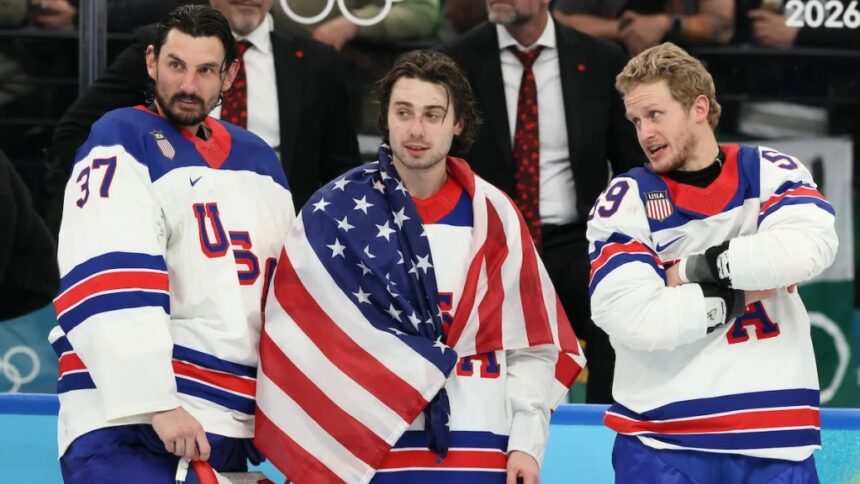
In the afterglow of a dramatic overtime victory over Canada to capture the 2026 Winter Olympic gold medal, the U.S. Men’s Hockey Team found itself at the center of a different kind of national spotlight this week. Following a viral locker room moment with FBI Director Kash Patel and a congratulatory phone call from President Donald Trump, the team received a coveted invitation to the White House and a special appearance at the President’s State of the Union address. However, in a move that has sparked as much conversation as their on-ice heroics, not all of the gold medal-winning roster made the trip to Washington, D.C. The absence of five key players underscores the enduring, complex intersection of sports, politics, and personal choice.
The Viral Path from Olympic Glory to Political Spotlight
The team’s journey from the ice rink in Italy to the halls of power in Washington was anything but conventional. The celebration began in the locker room, where a video showed FBI Director Kash Patel, an avid hockey fan, enthusiastically celebrating with the team. The scene took a surreal turn when Patel placed a call to President Trump, putting the newly crowned champions on speakerphone. The President congratulated the athletes and extended the invitation that would lead to this week’s events. Yet, the call also contained the first hint of controversy. In footage that quickly spread online, Trump was heard telling the team, “I must tell you, we’re going to have to bring the women’s team,” adding that he “probably would be impeached” if he didn’t. This remark, seen by critics as dismissive of the equally gold medal-winning U.S. Women’s Team, set a politically charged backdrop for the impending visit.
The Five Absentees: A Statement of Quiet Protest?
On Tuesday, the majority of the men’s team donned suits for the traditional White House visit and secured seats in the gallery for the State of the Union. However, five notable players were conspicuously absent. While no player has issued a formal statement explaining their decision, sources close to the team and widespread media reporting confirm the identities of those who opted out.
The players who skipped the events are:
- Defenseman Connor Murphy – A veteran leader on the blue line, Murphy has been privately vocal in the past about supporting social justice initiatives within the NHL.
- Forward Jason Robertson – The tournament’s leading scorer for Team USA, Robertson is known for a quiet, focused demeanor and has historically kept his personal views out of the public sphere.
- Goaltender Alex Lyon – The backup netminder, whose clutch performances in the semifinal were crucial, comes from a family with a history of political activism.
- Forward Nick Schmaltz – A skilled playmaker, Schmaltz’s absence surprised some teammates, as he is not typically outspoken on political issues.
- Defenseman Quinn Hughes – The team’s ice-time leader and powerplay quarterback, Hughes is the younger brother of NHL star Jack Hughes, who has participated in White House visits in the past.
The decision by these five athletes continues a long tradition of sports figures declining White House invitations, a practice that has become more common in politically polarized times. Their choice, whether rooted in disagreement with the President’s comments, broader political alignment, or simply a desire to avoid the partisan fray, speaks volumes without a word being said publicly.
Expert Analysis: Navigating the New Normal in Sports Celebrations
“This is the modern playbook for championship teams,” explains Dr. Lena Torres, a professor of Sports Sociology at Georgetown University. “The team victory is unifying, but the White House visit is often a point of fracture. A decade ago, skipping was a bold, singular statement. Today, it’s almost an expected part of the process for a handful of players on any winning team, especially in an Olympic year where athletes represent the country, not a professional league with a unified front.”
The analysis points to the unique pressure on Olympic athletes. Unlike professional champions who are employees of a league, these players temporarily wear the national crest. Their decision carries a different weight. “They are ‘Team USA,'” Torres notes. “So when some members opt out of a ceremony with the sitting President, it is inherently viewed through a political lens, regardless of their intent. The backlash from the President’s initial comments about the women’s team likely solidified the decision for some, providing a hockey-centric reason for their absence that aligns with team solidarity.”
The presence of the women’s team at the event, following the President’s on-air remarks, added another layer. Their attendance was celebrated, but it also highlighted the initial awkwardness of the invitation, potentially making the environment less comfortable for some men’s players who wished to honor their female counterparts’ achievements.
Predictions and Repercussions: What Comes Next for Team USA?
The immediate fallout will be more noise than tangible consequence. The players will not face sanction from USA Hockey, which respects individual athlete choices for such non-competition events. The team’s legacy is secure on the ice, defined by their gold medal triumph, not their political attendance records.
However, the incident offers a clear prediction for the future: the politicization of victory tours is permanent. Future Olympic teams, in all sports, will likely see similar patterns. Agents and advisors will now routinely discuss the pros and cons of White House visits with their client-athletes as a standard part of post-victory planning. The narrative around a team’s celebration will now almost always include a “who attended” subplot, driven by media and social media scrutiny.
For the 2026 squad itself, the true test will be at their next training camp or international tournament. The key will be ensuring that this off-ice divergence does not create locker room fissures. Based on the history of teams that have navigated this before, the shared bond of winning a gold medal is typically strong enough to withstand differing political choices, especially when handled with the quiet discretion this group has shown.
Conclusion: A Gold Medal Standard, a Divided Celebration
The U.S. Men’s Hockey Team’s 2026 Olympic victory was a moment of pure, nationalistic joy, capped by an iconic overtime goal. Their subsequent journey into the political arena, however, proved that even the most unifying sports achievements are filtered through the prism of contemporary America. The five players who chose to skip the White House visit and State of the Union exercised a personal right that has become a familiar part of the championship script. Their absence, alongside the attendance of their teammates and the celebrated women’s team, paints a complete picture of modern American sports: triumphant, talented, and inevitably tangled in the broader conversations of the nation it represents. In the end, their legacy will have two distinct chapters: one written in gold on the ice, and another, more complicated one, written in the choices they made off it.
Source: Based on news from Yahoo Sports.