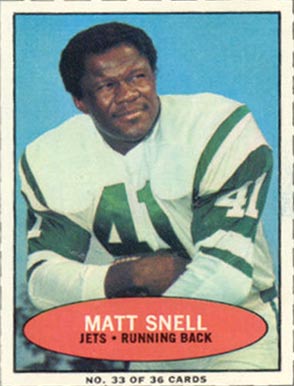
Matt Snell, the Unbreakable Engine of the Jets’ Super Bowl III Miracle, Dies at 84
The New York Jets, a franchise defined by a singular, earth-shattering moment, have lost the man whose legs and willpower made that moment possible. Matt Snell, the bruising, indispensable running back who powered the AFL’s historic upset in Super Bowl III, died Tuesday morning on Long Island at the age of 84. His passing marks the end of an era for a team whose greatest triumph is forever linked to his relentless, between-the-tackles running style. While Joe Namath’s guarantee provided the audacious prophecy, it was Matt Snell’s punishing 121-yard performance that served as the fulfillment, grinding the mighty Baltimore Colts into the Orange Bowl turf and forever altering the landscape of professional football.
The Workhorse Who Made Broadway Joe’s Guarantee a Reality
To understand Matt Snell’s legacy, one must first dispel a modern misconception. Super Bowl III is often remembered as Namath’s game, a passing spectacle. The truth is far grittier. It was a game won in the trenches, a physical declaration of equality by the AFL, delivered via a 6-foot-2, 220-pound sledgehammer wearing number 41. Facing a Colts defense that had allowed a paltry 68 rushing yards per game in the regular season, Jets head coach Weeb Ewbank built a game plan squarely on Snell’s broad shoulders.
The statistics from January 12, 1969, tell a story of sheer dominance:
- 30 Carries: A Super Bowl record at the time, showcasing an incredible workload.
- 121 Yards: Nearly double the Colts’ season average allowed, a methodical dismantling.
- The Decisive Touchdown: A 4-yard blast in the second quarter that gave the Jets a lead they would never relinquish.
Snell didn’t just run; he imposed his will. He was the ball-control offense that kept Johnny Unitas and the Colts’ offense sidelined. He was the clock-chewing weapon that protected the lead born from Namath’s guarantee. As Namath himself stated upon hearing of Snell’s passing, “without him we wouldn’t have had a chance to win a championship.” This was not mere hyperbole; it was the candid assessment of a quarterback who knew his arm needed Snell’s legs to make history.
More Than One Game: The Embodiment of Jets Toughness
While Super Bowl III is his crowning achievement, Matt Snell’s career was a testament to consistency, versatility, and rugged durability. A first-round pick out of Ohio State in 1964 (by both the Jets and the NFL’s New York Giants, choosing the AFL), Snell was the prototype for the modern power back. His rookie season was a tour de force, earning AFL Rookie of the Year honors by leading the league in rushing attempts, finishing second in yards, and catching 56 passes—a staggering number for a back of his size in that era.
He was the complete package:
- Blocker: He provided crucial protection for the franchise quarterback, Namath.
- Receiver: A reliable safety valve out of the backfield with soft hands.
- Short-Yardage Specialist: The ultimate finisher, whose north-south style wore down defenses.
Injuries ultimately shortened his career, but his impact was indelible. As Jets Chairman Woody Johnson noted, Snell was “the embodiment of toughness, selflessness and belief.” He played in an era before massive contracts and personal branding; he was the blue-collar hero in a blue-collar town, a perfect symbol for a team that had to fight for every ounce of respect it received.
A Legacy That Echoes Through Modern Football
Analyzing Snell’s career through a contemporary lens reveals how foundational his style was to championship football. In today’s pass-happy NFL, the value of a back who can control tempo and salt away victories in critical games remains immense. Think of the Seattle Seahawks’ Marshawn Lynch in their Super Bowl run, or the physical presence of a Derrick Henry in the playoffs. These are the spiritual descendants of Matt Snell—backs whose primary job is to inflict physical and psychological punishment.
Snell’s performance was a masterclass in situational football. The Jets, as massive underdogs, knew they could not win a track meet. They needed to shorten the game, limit possessions, and win at the line of scrimmage. Snell’s 30 carries were the execution of a perfect, pressure-proof strategy. This analytical approach—identifying a mismatch of will, not just talent, and hammering it relentlessly—is a timeless playoff blueprint. His game tape from Super Bowl III should be required viewing for any coach preaching the importance of establishing the run.
The Final Whistle: An Immortal Jet
With the passing of Matt Snell, the Jets and the football world lose a direct link to one of the sport’s most pivotal games. He was a bridge between eras, a player whose success was a direct result of fundamental, hard-nosed football. In an age of highlight-reel plays, Snell’s legacy is a powerful reminder that championships are often won in the cumulative, grinding effect of four-yard gains that become first downs, that drain the clock, and that ultimately break an opponent’s spirit.
His place in the Pro Football Hall of Fame has been debated by fans and historians for years, often overshadowed by the more flamboyant figures of his era. But within the pantheon of New York Jets legends, his stature is unassailable. He is, quite literally, the man who carried them to their only title. The heart of the AFL’s legitimacy beat strongest in his chest on that January afternoon in Miami.
Matt Snell’s story is not one of what could have been, but of what was definitively achieved. He was the unwavering force behind the ultimate upset, the quiet powerhouse to Namath’s swaggering maestro. He leaves behind a legacy etched not just in record books, but in the very identity of a franchise. For the New York Jets, Matt Snell will forever be the standard of toughness, the personification of a promise kept, and the unbreakable engine of a miracle.
Source: Based on news from Deadspin.
Image: CC licensed via commons.wikimedia.org