VAR Under the Microscope: How a Costly Error Denied Brighton in Arsenal Defeat
The quest for Premier League perfection is a noble, if impossible, dream. In its pursuit, we introduced the Video Assistant Referee, a system designed to eradicate the “clear and obvious error.” Yet, as Brighton & Hove Albion’s 1-0 loss to Arsenal on March 4th starkly illustrates, the human element—and human error—remains the system’s most unpredictable variable. A newly revealed verdict from the Premier League’s own Key Match Incidents Panel has confirmed what the Amex Stadium suspected in real-time: Brighton were wrongly denied a pivotal penalty. This isn’t just a post-match grumble; it’s an official admission that a critical mistake was made, reigniting the fierce debate about VAR consistency and its impact on the integrity of the title race and the battle for Europe.
The Incident: A Tussle in the Shadows, A Decision in the Spotlight
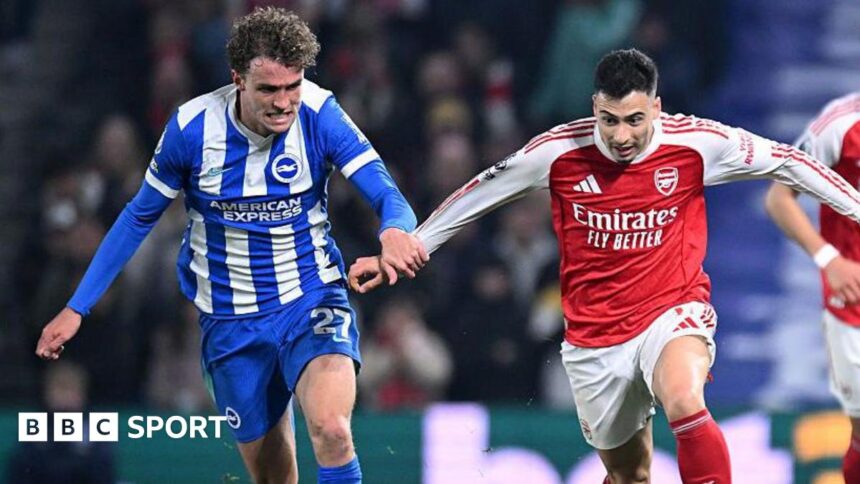
With the clock ticking into first-half stoppage time, Brighton, trailing to Bukayo Saka’s early strike, pressed for an equalizer. A cross arced in from the left, promising chaos in the Arsenal six-yard box. Brighton’s Dutch midfielder, Mats Wieffer, made a determined run to meet it. What happened next was a moment of pure, unadulterated Premier League physicality. Arsenal’s Gabriel Martinelli, tracking back, engaged in a tussle with Wieffer. Replays showed Martinelli’s left arm wrapped across Wieffer’s chest, followed by a clear tug on the shoulder that unbalances the Brighton man, pulling him to the turf as the ball sails past.
On-field referee Chris Kavanagh, perhaps unsighted or deeming it a fair contest, waved play on. The natural next step in 2024’s footballing drama: a VAR review. The protocol is clear. Is it a clear and obvious error? Is there contact? Does that contact have a consequential impact? Video Assistant Referee Michael Salisbury checked the monitor and, astonishingly to most observers, cleared the incident. No penalty. The Key Match Incidents Panel, comprised of five members including three former players and representatives from the PGMOL and Premier League, has now ruled 4-1 that this was a mistake. A penalty should have been awarded.
Expert Analysis: Deconstructing a VAR Failure
This incident is a textbook case of VAR’s subjective pitfalls. It wasn’t a marginal offside or a question of millimeter-accurate technology; it was a judgment call on a foul in the penalty area. The panel’s overwhelming consensus suggests the evidence was compelling. Let’s break down why this decision is so confounding:
- The “Clear and Obvious” Threshold: This is the mantra of VAR. The panel’s verdict indicates the error was, in fact, clear. Martinelli’s action wasn’t a subtle nudge; it was a sustained hold and pull that directly prevented Wieffer from challenging for the ball. By not overturning Kavanagh’s non-call, VAR effectively set a dangerously lenient precedent for defensive grappling in the box.
- Selective Intervention: Consistency remains VAR’s greatest flaw. Similar holding incidents have been penalized after reviews in other matches. This inconsistency erodes fan trust and creates a sense of arbitrariness. Was the high-stakes nature of a title-challenger’s away game a subconscious factor? It’s a question that will linger.
- The Human Chain of Error: The system failed at two points: the on-field call and the VAR review. It underscores that technology is only as good as the people operating it. Salisbury, in the VAR hub, had the benefit of multiple angles and slow motion but reached a conclusion at odds with most experts and the league’s own review body.
The ramifications are immediate. For Brighton, a crucial chance to level from the spot just before halftime, with the momentum of a roaring home crowd, was stolen. The entire tactical landscape of the second half would have shifted. For Arsenal, it represents a fortune favouring the brave—or the fortunate—in a title race where fine margins define destiny.
Broader Implications: Trust Eroded and Races Altered
This admitted error extends far beyond one result at the Amex. It strikes at the heart of competition fairness and fan sentiment.
Impact on the Premier League Table: While we can never guarantee a penalty conversion, the expected points swing is significant. A Brighton draw (or win) would have:
- Dented Arsenal’s title charge, potentially handing crucial initiative to Liverpool and Manchester City.
- Boosted Brighton’s faint European qualification hopes, applying pressure on teams like West Ham and Newcastle.
- Altered the psychological framework for both teams’ subsequent fixtures.
The Crisis of Confidence: Each high-profile VAR failure acts as a corrosive agent on the relationship between the sport and its supporters. When the league’s own panel publicly contradicts the officials in charge, it creates a damaging “us versus them” narrative. Fans are left to wonder: if this isn’t a clear error, what is? The PGMOL faces yet another week of justified scrutiny and must explain how such a consensus-defying decision was reached.
Predictions and the Path Forward for VAR
The fallout from this incident will shape the remainder of the season and the ongoing evolution of VAR.
First, expect increased pressure for transparency in VAR communications. The push for live audio of reviews, as trialed in FIFA tournaments, will gain momentum. Hearing the reasoning in real-time, while controversial, might at least provide clarity and humanize the process.
Second, the Key Match Incidents Panel reports, while currently released with a delay, may need to be integrated more formally into the accountability structure. Could they inform referee training and VAR calibration more directly?
Finally, this incident will be Exhibit A in the argument for a permanent, independent VAR review board staffed by former officials and players, separate from the PGMOL, to audit decisions weekly and mandate standardized interpretations of contact in the penalty area.
For Brighton, the apology is cold comfort. For Arsenal, it’s a fortunate escape in a marathon where every step counts. For the Premier League, it’s another self-inflicted wound in the credibility wars.
Conclusion: A Stain on the Sport’s Fabric
The admission that Brighton were wronged is a necessary but painful step. It validates the fury of Roberto De Zerbi and the Seagulls’ faithful, but it does not restore the lost point or the fractured momentum of their match. This episode is more than a debating point; it is a critical VAR error with tangible consequences for the Premier League’s most prestigious races.
The beautiful game is built on passion, skill, and, fundamentally, fairness. When a system implemented to uphold fairness instead becomes a source of glaring injustice, its very purpose is undermined. The Martinelli-Wieffer incident is not an anomaly; it is a symptom of a system struggling with its own human limitations. Until the PGMOL can deliver not just technology, but consistent, courageous, and correct interpretations of the laws, the shadow of doubt will lengthen across every crucial decision, and the Premier League’s pursuit of perfection will remain a distant, troubled dream.
Source: Based on news from BBC Sport.