Brewers’ Replay Review Exposes Another Costly C.B. Bucknor Miss at First Base
In the modern MLB, technology is the great equalizer. It can turn a surefire out into a game-extending baserunner, and a called strike into a pivotal ball four. More than anything, it has become the definitive check on the human error that has always been part of baseball’s fabric. This season, that check is being applied with startling frequency to one man in particular: veteran umpire C.B. Bucknor. And it’s not just the new automated ball-strike challenge system putting him under the microscope. A crucial replay review in Milwaukee has highlighted that Bucknor’s struggles are a full-field phenomenon, threatening to impact games in ways that go far beyond the count.
A Clear Miss on a Routine Play
The scene was American Family Field on March 31. In the bottom of the sixth inning, with the Brewers facing the Minnesota Twins, first baseman Jake Bauers hit a ground ball to the right side. He was thrown out, but the play required a clean pickup by Twins pitcher Caleb Thielbar at first. Bauers sprinted down the line, stretched his stride, and clearly tapped the center of the bag with his foot as Thielbar applied the tag. To the naked eye, and certainly on the high-definition replay, it was a standard, if hurried, putout.
But C.B. Bucknor, overseeing first base, saw something different. He emphatically signaled that Bauers had missed the bag, calling him out for what would have been the third out of the inning. Brewers manager Pat Murphy immediately stormed from the dugout, not to argue, but to invoke the league’s replay review system. The review was swift and decisive. The call was overturned. Bauers was safe. The inning continued.
The broadcast replay told a damning story. Not only did Bauers unmistakably touch the base, but Bucknor’s angle and focus appeared to be misplaced. He was not locked in on the critical point of contact between foot and bag, a fundamental umpiring technique for such a play. This wasn’t a millimeter-close call; it was a wholesale misreading of a routine play, saved only by the technological safeguard MLB has instituted.
Beyond the Plate: A Pattern of Poor Positioning and Focus
This incident is significant because it moves the conversation about Bucknor beyond the confines of the automated strike zone. His replay review reversal at first base points to deeper issues in his umpiring methodology: positioning and focus.
- Poor Angle: On bang-bang plays at first, umpires are taught to get into a position where they can see the base and the foot arriving simultaneously. Bucknor’s stance seemed to prevent a clean sightline.
- Focus on the Glove: Veteran umpires often warn against watching the glove instead of the base. The evidence suggests Bucknor may have been tracking the catch and tag by Thielbar, rather than the primary action at the bag itself.
- Lack of Anticipation: The play, while requiring a scoop, was not extraordinarily complex. An umpire with sharp anticipation sets himself for the point of conflict. Bucknor appeared unprepared for the play’s conclusion.
This umpiring error had immediate consequences. While Bauers was eventually stranded, he did steal second base in the aftermath, forcing the Twins to alter their approach and expending pitcher energy. More broadly, it erodes the confidence of both teams in the fairness of the game’s adjudication. As one NL scout told me anonymously, “When you see a miss that clear, it makes you question every 50/50 call that follows. Players and managers lose the benefit of the doubt.”
The ABS Challenge System: An Amplifier, Not the Cause
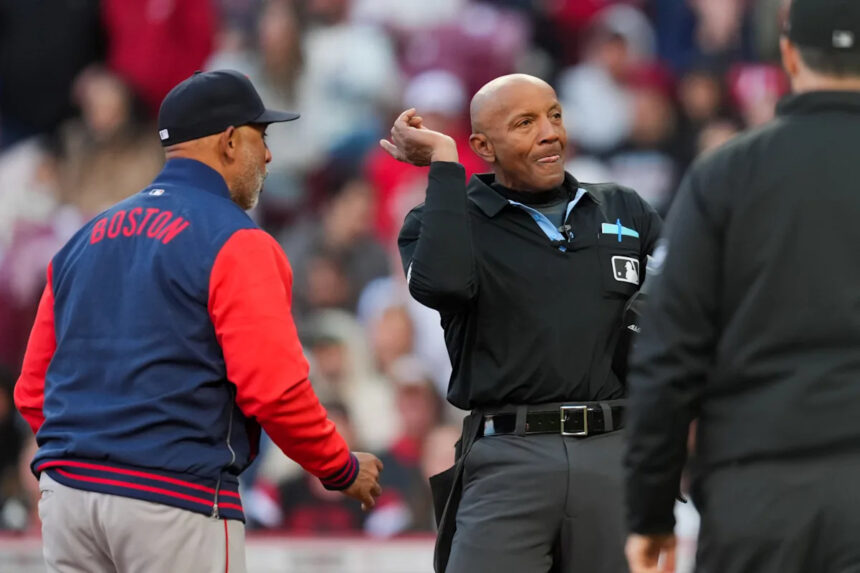
Bucknor’s early-season notoriety began just days before the Milwaukee incident. On March 28, in a game between the Boston Red Sox and Cincinnati Reds, the new automated ball-strike challenge system was used to overturn six of Bucknor’s ball-strike calls. He became the unwitting poster umpire for the system’s implementation, a stark example of the gap between human judgment and the electronic zone.
That outing was historic in its correction rate, but it should not be viewed in isolation. The replay review at first base confirms a troubling trend: Bucknor is having a profound crisis of consistency. The ABS system exposes his struggles with the vertical edges of the zone and breaking balls low and away. The field replay exposes lapses in fundamental mechanics on the bases. Together, they paint a picture of an umpire whose performance is deteriorating across the board.
Umpire accountability is no longer a theoretical clubhouse rant. It is quantifiable. We now have public, verifiable data on missed balls and strikes, and high-definition video evidence of missed calls on the bases. League offices can no longer rely on the old “he’s a veteran with a tough job” defense. The metrics are the metrics.
Predictions and Ramifications for MLB and Umpiring
So, where does this lead? The mounting evidence against Bucknor’s current form forces MLB into a delicate position. He is a long-tenured umpire, part of the union’s seniority structure. However, the league’s credibility is tied to the accuracy of its officiating.
Here is what to expect:
- Increased Scrutiny: Every Bucknor-called game will now be a focal point for analysts and fans. His ball-strike stats will be tracked obsessively, and his field calls will be instantly dissected on social media.
- Internal Pressure: MLB’s umpire evaluation team will be forced to have difficult conversations. Expect Bucknor to receive less high-leverage assignment—fewer playoff games, fewer prime-time slots—if his performance does not improve markedly.
- A Tipping Point for Full ABS: While the challenge system is designed to correct errors, its repeated use on one umpire strengthens the argument for a fully automated strike zone. If an umpire’s zone is consistently unreliable, why have a human perform that function at all?
- Managerial Strategy Shift: Managers will now challenge Bucknor’s calls on the bases with greater aggression, knowing there is a higher probability of a reversal. He has effectively lost the presumption of accuracy.
The most significant prediction is cultural. We are moving toward an era where umpire performance metrics will become part of the public discourse, much like a pitcher’s ERA or a hitter’s OPS. Umpires will be graded publicly, and persistent underperformers will face a form of performance-based demotion.
Conclusion: Technology as the Unblinking Eye
The story of C.B. Bucknor’s early season is not one of malevolence, but of fallibility being exposed in high definition. For years, questionable calls lived only in argument and grainy replay. Today, they are cataloged, analyzed, and undeniable. The replay review in Milwaukee that saved Jake Bauers from Bucknor’s brutal miss at first base is a companion piece to the six ABS challenges in Cincinnati. They are two sides of the same coin.
Baseball is in a transitional period, wrestling with its human element. The game has decided that certain types of errors—a missed tag, a foot off the bag, a ball an inch off the plate—are no longer acceptable. Umpires like C.B. Bucknor, who once operated with near-absolute authority, are now finding their work subject to instant, irrefutable audit. For fans and teams craving accuracy, it’s a victory. For an umpire struggling with his craft, it’s a relentless, unblinking spotlight. The replay review didn’t just save an out for the Brewers; it underscored that in today’s game, no miss, no matter how routine, will go uncorrected.
Source: Based on news from Yahoo Sports.