Buffalo Bills 53-Man Roster Projection After the 2026 NFL Draft: The Leonhard Era Begins
The 2026 NFL Draft is officially in the books, and for the first time this offseason, the Buffalo Bills roster is beginning to take a tangible shape. While the core of the offense remains largely intact—a luxury few contenders enjoy—the real story of this projection is the tectonic shift happening on the defensive side of the ball. With Sean McDermott handing the keys to a new defensive coordinator in Jim Leonhard, the Bills are transitioning from a zone-heavy, read-and-react scheme to a more aggressive, pressure-based system. This isn’t just a tweak; it’s a philosophical overhaul.
- Offense: The Law Firm of Allen & Allen Returns
- Quarterbacks (3): Josh Allen, Kyle Allen, Shane Buechele
- Running Backs (3): James Cook, Ray Davis, Ty Johnson
- Wide Receivers (5): Khalil Shakir, Keon Coleman, Curtis Samuel, Justin Shorter, Daequan Hardy
- Tight Ends (4): Dalton Kincaid, Dawson Knox, Quintin Morris, Zach Davidson
- Offensive Line (9): Dion Dawkins, David Edwards, Connor McGovern, O’Cyrus Torrence, Spencer Brown, Ryan Van Demark, Alec Anderson, Tylan Grable, La’el Collins
- Defense: The Jim Leonhard Experiment Takes Shape
- Defensive Line (6): Ed Oliver, DaQuan Jones, DeWayne Carter, Austin Johnson, Jordan Phillips, Kameron Cline
- Edge Rushers (5): Greg Rousseau, A.J. Epenesa, Von Miller, Javon Solomon, Kingsley Jonathan
- Linebackers (5): Terrel Bernard, Dorian Williams, Nicholas Morrow, Baylon Spector, Joe Andreessen
- Cornerbacks (6): Christian Benford, Taron Johnson, Kaiir Elam, Cam Lewis, Ja’Marcus Ingram, Daequan Hardy
- Safeties (4): Taylor Rapp, Cole Bishop, Damar Hamlin, Mike Edwards
- Special Teams: The Unsexy Constants
- Predictions & Final Takeaways
As we look ahead to training camp at St. John Fisher University, most of the offensive jobs are locked in. But the defense? It’s a blank canvas. Here is my first, fully original 53-man roster projection for the Buffalo Bills following the 2026 NFL Draft.
Offense: The Law Firm of Allen & Allen Returns
The most predictable unit on the roster is the offense. General manager Brandon Beane did not use a single draft pick on a skill position player, signaling a massive vote of confidence in the returning cast. This unit will live and die by the health of its stars, but the depth chart is written in permanent marker.
Quarterbacks (3): Josh Allen, Kyle Allen, Shane Buechele
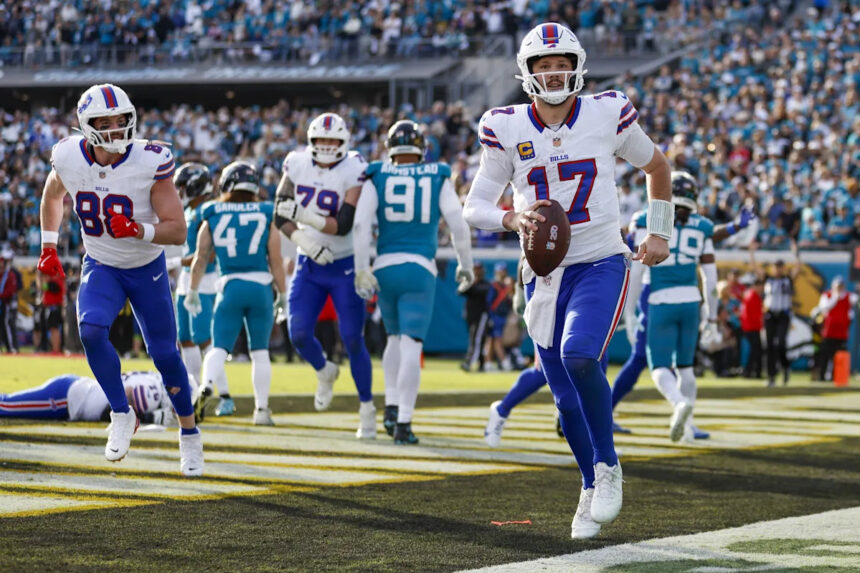
The “law firm of Allen and Allen” is officially open for business again. Josh Allen remains the undisputed franchise cornerstone. Veteran backup Kyle Allen returns for his third season in the system, providing a steady hand and a deep understanding of the offense. Shane Buechele sticks as the QB3, not because of draft capital, but because his mobility better mirrors Josh Allen’s style in practice than a traditional pocket passer would. No surprises here.
Running Backs (3): James Cook, Ray Davis, Ty Johnson
Without a running back added in the draft, I’ll be short and sweet here. No changes. James Cook is the primary weapon, coming off another 1,000-yard season. Ray Davis is the thunder to Cook’s lightning, a short-yardage specialist. Ty Johnson retains his roster spot as a core special teamer and change-of-pace back. The Bills are betting that Joe Brady’s scheme elevates the run game without a new face.
Wide Receivers (5): Khalil Shakir, Keon Coleman, Curtis Samuel, Justin Shorter, Daequan Hardy
This is where the draft silence is most notable. The Bills did not take a wideout, which means Khalil Shakir ascends to the WR1 role by default. Keon Coleman enters his third year needing to prove he can be a consistent X-receiver. Curtis Samuel provides the gadget plays and jet sweeps. The surprise cut here is Mack Hollins, replaced by Justin Shorter, who finally flashes his 6’4” frame in camp. Daequan Hardy makes the cut as a return specialist, a role he dominated in college.
Tight Ends (4): Dalton Kincaid, Dawson Knox, Quintin Morris, Zach Davidson
Dalton Kincaid is the focal point of the intermediate passing game. Dawson Knox remains the best inline blocker on the roster. Quintin Morris is a trusted special teams captain. The fourth spot goes to Zach Davidson, a 2025 UDFA who showed enough receiving upside in the spring to push veteran free agent signee off the roster. The Bills love 12-personnel, and Davidson provides a vertical threat Knox cannot.
Offensive Line (9): Dion Dawkins, David Edwards, Connor McGovern, O’Cyrus Torrence, Spencer Brown, Ryan Van Demark, Alec Anderson, Tylan Grable, La’el Collins
The starting five is set in stone: Dion Dawkins (LT), David Edwards (LG), Connor McGovern (C), O’Cyrus Torrence (RG), and Spencer Brown (RT). The depth is the story. Ryan Van Demark and Alec Anderson are the primary swing tackles. Tylan Grable sticks because of his ability to play guard and tackle. The veteran La’el Collins earns a spot as a mentor and emergency RT, a luxury the Bills can afford after not drafting an O-lineman.
Defense: The Jim Leonhard Experiment Takes Shape
This is where the projection gets volatile. Jim Leonhard’s defense is a hybrid 3-4/4-2-5 scheme that prioritizes speed over size, and blitzes from every angle. The roster construction reflects a dramatic shift in philosophy. Several familiar names from Sean McDermott’s zone-heavy days will be on the outside looking in.
Defensive Line (6): Ed Oliver, DaQuan Jones, DeWayne Carter, Austin Johnson, Jordan Phillips, Kameron Cline
Ed Oliver is the engine, but his role changes. In Leonhard’s system, Oliver will align more as a 3-technique attacking the B-gap, rather than a two-gapping tackle. DaQuan Jones returns as the veteran nose tackle. DeWayne Carter is the future, a disruptive 3-tech who will rotate heavily. The surprise inclusion is Kameron Cline, a raw power rusher who beats out a drafted player due to his length and ability to set the edge in the new 3-4 fronts. Jordan Phillips earns a roster spot as a situational pass rusher, but his snap count will be heavily managed.
Edge Rushers (5): Greg Rousseau, A.J. Epenesa, Von Miller, Javon Solomon, Kingsley Jonathan
This group is the biggest beneficiary of the scheme change. Greg Rousseau is now a pure 3-4 outside linebacker, tasked with dropping into coverage on occasion but primarily rushing from a two-point stance. A.J. Epenesa is a perfect fit as a power rusher who can set the edge against the run. Von Miller returns for one more season, but his role is now strictly a third-down sub-package rusher. The big news: Kingsley Jonathan beats out a 2025 draft pick for the fifth spot. Jonathan’s motor and special teams value in the kicking game are too valuable to cut.
Linebackers (5): Terrel Bernard, Dorian Williams, Nicholas Morrow, Baylon Spector, Joe Andreessen
Terrel Bernard is the green dot player, the quarterback of the defense. Dorian Williams finally gets his chance as a full-time starter next to Bernard. This duo is fast, but undersized. Nicholas Morrow is the veteran insurance policy who can play all three linebacker spots. Baylon Spector sticks as a core special teamer. The true wildcard is Joe Andreessen, the local product from the University of Buffalo. He makes the roster as a camp darling who outplays a drafted rookie with his instincts in Leonhard’s complex blitz packages.
Cornerbacks (6): Christian Benford, Taron Johnson, Kaiir Elam, Cam Lewis, Ja’Marcus Ingram, Daequan Hardy
Christian Benford is the CB1. Taron Johnson remains the nickel corner, though Leonhard will move him all over the formation. The drama is at boundary corner. Kaiir Elam makes the team, but as the CB3, not a starter. He finally shows consistency in a more aggressive, press-man scheme that fits his skill set. Cam Lewis is the versatile backup who can play inside or out. Ja’Marcus Ingram earns a spot due to his 6’1” frame and special teams prowess. Daequan Hardy is listed here as a corner, but his primary value is as a punt returner. Expect him to be inactive on game days unless needed.
Safeties (4): Taylor Rapp, Cole Bishop, Damar Hamlin, Mike Edwards
Taylor Rapp and Cole Bishop are the starting duo. Bishop’s range allows Rapp to play closer to the line of scrimmage, which is ideal for Leonhard’s blitz-heavy approach. Damar Hamlin returns as the third safety, a role he excels in. The veteran Mike Edwards makes the cut over a younger player because of his experience in multiple defensive schemes, providing a veteran brain for a unit learning a new language.
Special Teams: The Unsexy Constants
No drama here. The kicking battery remains unchanged.
- Kicker: Tyler Bass – Needs a bounce-back year, but his contract guarantees the spot.
- Punter: Sam Martin – Consistent and reliable.
- Long Snapper: Reid Ferguson – The most anonymous and valuable player on the roster.
Predictions & Final Takeaways
This roster is built on a fascinating dichotomy. The offense is a veteran-laden, continuity-driven machine that will rely on Josh Allen’s heroics. The defense is a laboratory experiment. Jim Leonhard is going to ask his players to do things they haven’t done before—blitz from the secondary, play man coverage on 60% of snaps, and use complex pre-snap disguises. The success of this season hinges on whether the defensive line can generate pressure without blitzing, because if they can’t, the secondary will be exposed.
My bold prediction: Kaiir Elam will have a career year. The press-man scheme is exactly what he was drafted for, and he will win the CB2 job by Week 4. Conversely, I expect the Bills to struggle against the run early in the season as the new linebackers adjust to gap assignments.
This is a 53-man roster built for 2026, not 2025. It is younger, faster, and more aggressive on defense, but it carries significant risk. If the scheme clicks, the Bills are a Super Bowl favorite. If it doesn’t, we will be having a very different conversation in December. For now, the pieces are in place. Let the games begin.
Source: Based on news from Yahoo Sports.