


Hasselhoff, Clinton & Blatter v Williams: The Unforgettable Vegas Spectacle of USA ’94
The FIFA World Cup draw is now a meticulously choreographed, globally streamed ceremony of sleek graphics and polite applause. But rewind to December 1993, and the script was wildly different. The draw for the 1994 FIFA World Cup, held in the shimmering desert oasis of Las Vegas, was less a formal procedure and more a surreal, star-studded variety show. It was a chaotic, charming, and uniquely American collision of global football politics and Hollywood razzmatazz, forever remembered for its iconic cast: the earnest statesmanship of Bill Clinton, the bewildered charm of David Hasselhoff, the bureaucratic presence of Sepp Blatter, and the comedic hurricane that was Robin Williams.
A Vegas Gamble: FIFA’s American Dream Takes the Stage
FIFA’s decision to award the 1994 World Cup to the United States was a monumental gamble. “Soccer” was a niche sport, and FIFA knew it needed a spectacle to capture the American public’s imagination. Where better than Las Vegas, the entertainment capital of the world? The draw was held at the Las Vegas Convention Center, a venue more accustomed to trade shows than footballing destiny. The stage was set not just for determining groups, but for selling the beautiful game to a skeptical nation. The choice of hosts and participants was a deliberate blend of political clout, pop culture relevance, and sporting authority, creating a televised event that was equal parts diplomatic mission and prime-time entertainment.
The atmosphere was a far cry from today’s sterile productions. The set resembled a game show, complete with giant balls and glittering lights. The audience was a mix of suited federation officials, celebrities, and tourists, creating an energy that was palpably unpredictable. This was the 90s encapsulated: high-concept, slightly awkward, and utterly compelling.
The Cast of Characters: A Diplomatic and Comedic Melting Pot
The lineup of draw assistants was a cultural study in itself. Each figure represented a different facet of the American experiment being presented to the world.
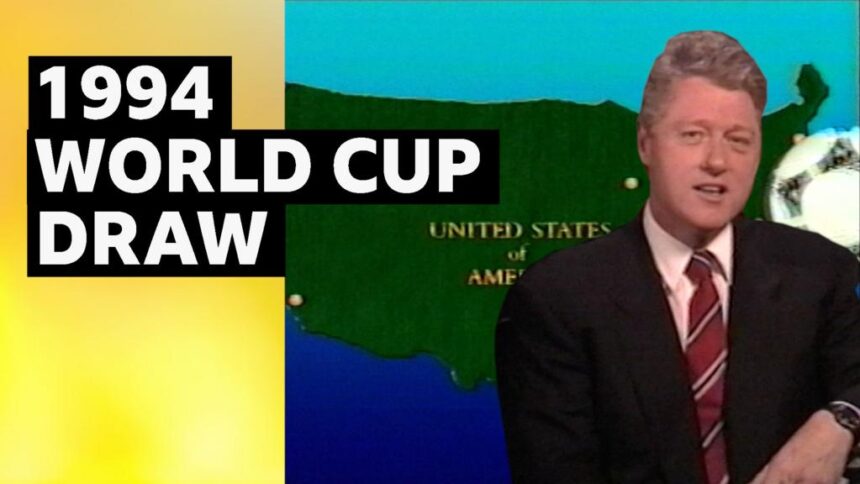
- President Bill Clinton provided the gravitas. Appearing via satellite from the White House, his presence legitimized the event on a global political stage. His brief speech was a pitch for soccer’s growth in the US, framing the tournament as a tool for international unity.
- David Hasselhoff, at the peak of his “Baywatch” fame, was the embodiment of American pop culture export. His role was pure celebrity wattage, designed to draw TV viewers who might not know an offside trap but knew Mitch Buchannon.
- Sepp Blatter, then FIFA’s General Secretary, represented the old guard of football governance. His stiff, formal demeanor contrasted sharply with the Vegas glitz, a visual metaphor for FIFA’s uneasy but lucrative partnership with American show business.
- Robin Williams, however, was the wildcard. Hired as the event’s “entertainment,” the comedic genius proceeded to hijack the proceedings with a relentless, improvised routine that left officials sweating and the audience in stitches.
This quartet created a dynamic tension that defined the night: Clinton’s diplomacy versus Williams’s anarchy, Blatter’s protocol versus Hasselhoff’s glamour.
Robin Williams Steals the Show: Chaos Meets Confederation
While the others played their assigned roles, Robin Williams treated the draw as his personal comedy club. As balls were drawn and teams placed, Williams unleashed a torrent of impressions, jokes, and observations. He mocked the complexity of the draw process, did accents for various nations, and provided a running, irreverent commentary that broke all the unspoken rules of FIFA solemnity.
His most legendary moment came when he was asked to draw a ball. Peering into the bowl, he quipped, “It’s like a lottery for rich, athletic guys!” He then proceeded to do an extended impression of a frantic, hyper-ventilating coach whose team had just been placed in a “Group of Death.” The camera would cut to Blatter and other FIFA executives, whose frozen smiles betrayed a deep anxiety. Williams was deconstructing the very event in real-time, exposing its inherent drama and absurdity with a warmth that made it more human. In doing so, he arguably did more to engage the casual American viewer than any scripted segment could have. It was unfiltered, unpredictable television, a stark contrast to the controlled messaging FIFA typically preferred.
Legacy and Analysis: The Draw That Defined an Era
In hindsight, the 1994 Vegas draw was a spectacular success in its primary goal: it generated buzz. It was talked about on news and entertainment shows, making the upcoming World Cup a topic of conversation beyond sports pages. The tournament itself would go on to break attendance records, a success paved by this audacious publicity stunt.
However, the event also highlighted a cultural clash. Purists were aghast at the carnival atmosphere. Yet, this clash was precisely what made USA ’94 transformative. It proved football could be packaged for the American market without losing its soul, and in fact, could gain a new kind of energy. The draw set the tone for a tournament that was open, festive, and welcoming—a “Soccer Summer Camp” that converted millions of Americans into fans.
Today’s draws are seamless, efficient, and designed for the digital age. Every moment is calculated, every word on a teleprompter. The risk of a Robin Williams-style improvisation is zero. We gained professionalism but lost the delightful, human unpredictability. The 1994 draw remains a singular artifact—a time capsule of an era when FIFA was still figuring out how to go truly global, and was willing to roll the dice in Vegas to do it.
Conclusion: The Night Soccer Learned to Play the Vegas Strip
The 1994 World Cup draw in Las Vegas was more than a procedural event; it was a symbolic kickoff. It announced that the world’s game had arrived in the world’s most potent entertainment complex, and it was ready to play by new rules. The images of Hasselhoff grinning next to a solemn Blatter, or the sound of Williams’ laughter echoing through the convention hall, are enduring reminders that football’s journey is not just about sport, but about culture, diplomacy, and spectacle.
It was a one-of-a-kind moment where the fate of nations on the pitch was decided amidst celebrity cameos and comedic riffing. While modern football may have outgrown such overt theatricality, the legacy of that night lives on in the record-breaking success of USA ’94 and the enduring American soccer market it helped ignite. It was, in every sense, a high-stakes gamble that paid off in spades, proving that sometimes, the best way to plan the world’s most organized tournament is to embrace a little Vegas-style chaos.
Source: Based on news from BBC Sport.
Image: Source – Original Article




