England’s Gabba Surrender: Vaughan’s “Fight” Critique Exposes Deep-Rooted Ashes Flaws
The floodlights at the Gabba didn’t just illuminate the Brisbane night; they exposed a glaring fault line in England’s Ashes psyche. As the final session of the third day descended into a familiar collapse, a damning verdict echoed from the commentary box, delivered by a man who knows what it takes to win in Australia. Michael Vaughan’s critique was succinct, brutal, and impossible to ignore: England, once again, failed to show the necessary fight.
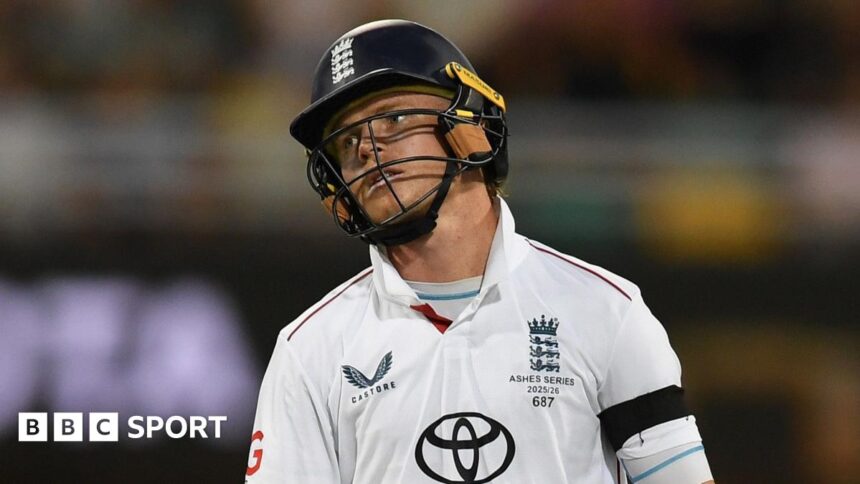
From a position of relative calm at 45-0 at the dinner interval, England’s innings disintegrated to 134-6 by the close, a staggering loss of six wickets for 89 runs under the lights. The dismissal of the promising Harry Brook, clipping Scott Boland tamely behind for 15, epitomized the soft surrender. It handed Boland his second wicket and confirmed Australia’s viselike grip on the Test and, potentially, the series. Vaughan’s words cut to the core of a performance lacking the grit and graft their opponents had displayed in spades.
The Vaughan Verdict: A Lesson in Contrasting Mindsets
“Surely as a team you’ve just got to think ‘just fight’,” said the former Ashes-winning captain. His analysis highlighted a stark contrast in application. “You’re under lights at Brisbane and you’ve got an hour and 10 minutes to go. You’ve seen the way that Australia grafted and grafted earlier in the day when they wanted to get to this stage.”
This is more than just punditry; it’s a forensic examination of mindset. Australia’s batsmen, notably Usman Khawaja and Cameron Green, had battled through difficult periods, valuing their wicket above all else to build a formidable first-innings lead of 177. England, facing the same challenging conditions with the pink Kookaburra ball, appeared to lack the same stubborn, session-by-session resolve. The collapse wasn’t just about technical flaws against the moving ball—though those were evident—but about a missing intangible: the unyielding desperation to survive.
Dissecting the Collapse: A Pattern of Fragility
England’s second-innings stumble followed a script seen too often on Australian soil. The initial platform built by the openers was not treated as a precious foundation, but as a license to play. The subsequent batting displayed a concerning lack of situational awareness.
- Failure to Adapt: Batting under lights at the Gabba is a known, extreme challenge. Where Australia adapted, England’s approach seemed rigid, caught between defence and attack.
- Boland’s Brilliance, England’s Complicity: Scott Boland’s spell was masterful, but wickets like Brook’s were gifts. The dismissal was not a jaffa; it was a misjudgment, a lapse in concentration at a critical moment.
- Leadership Void: In times of crisis, Test teams look to their experienced batters to dig in. That stabilizing presence was conspicuously absent, leaving the lower order exposed with a still-massive deficit.
This wasn’t a one-off. It was a manifestation of a fragile touring mentality that has plagued England in Australia for over a decade. The fight Vaughan demanded isn’t about reckless aggression; it’s about the mental fortitude to blunt the opposition’s momentum, to make them work exponentially harder for every breakthrough.
Beyond Brisbane: What This Means for the Ashes Series
The implications of this session stretch far beyond the almost-inevitable defeat in this first Test. Psychologically, handing Australia such a commanding position with a passive display is a huge boost for the hosts and a debilitating blow for the tourists.
Australia’s confidence will be sky-high. Their attack, particularly the relentless Boland and the ever-present threat of Pat Cummins, now knows that sustained pressure will likely yield rewards against an English lineup questioning its own methods. For England, questions are now urgent and profound. The “Bazball” philosophy, which has brought them success elsewhere, faces its ultimate examination: can it be tempered with the pragmatism required in unique Australian conditions? The answer in Brisbane was a resounding no.
Vaughan’s call for fight is ultimately a call for a smarter, more resilient brand of cricket. It requires:
- Acknowledging that some sessions are purely for survival.
- Valuing wicket preservation as the highest currency.
- Matching, and exceeding, the host’s work rate and desperation.
The Path Forward: Can England Rediscover Their Stomach for the Fight?
All is not lost, but the margin for error is now zero. History shows that losing the first Test in Australia is a mountain rarely climbed. To prevent the series from slipping away by Christmas, England’s response must be immediate and visceral.
It begins with selection. Does the team have the personnel capable of the kind of gritty, ugly batting that Steve Smith or Marnus Labuschagne produce as standard? It continues with strategy. The team must formulate clear, flexible plans for different conditions and match situations, moving away from a one-size-fits-all aggressive approach.
Most importantly, it requires a mental reset. The players must absorb Vaughan’s criticism not as an insult, but as a blueprint from a winner. They must look at Australia’s first-innings grind as the template. Fighting doesn’t mean swinging harder; it means concentrating deeper, leaving wider, and defending with your life for the team’s cause.
The final word on this damaging day belongs to Michael Vaughan. His critique has framed the narrative for the remainder of the series. England’s technical skills are under scrutiny, but their character and resilience are now on trial. The Gabba lights showed a team blinking under pressure. At Adelaide and beyond, England must prove they can stare back, can graft, can fight. If they don’t, the Ashes will be gone long before the Sydney fireworks, and the inquest will be far more severe than a commentator’s pointed observation. The fight Vaughan spoke of is the bare minimum; discovering it is England’s only hope.
Source: Based on news from BBC Sport.
Image: Source – Original Article