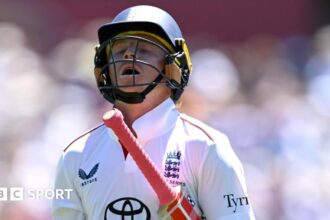
Harry Brook’s Rollercoaster: A Microcosm of England’s Brisbane Agony
The Ashes, in its storied history, has been defined by moments of high drama and crushing psychological blows. On a tense day three at the Gabba, a single over to England’s batting linchpin, Harry Brook, distilled the entire touring party’s tumultuous experience into two frantic deliveries. In a sequence that will haunt England fans, Brook successfully overturned a dismissal only to be sent packing by the video umpire the very next ball, a pivotal twist that left England in tatters at 123-5 and staring down the barrel of a decisive defeat in the second Test.
A Gabba Gambit: The Review That Bought a Moment’s Hope
England’s innings, already precarious, rested significantly on the shoulders of Harry Brook. Known for his aggressive counter-punching, Brook was navigating a minefield laid by a relentless Australian attack. The crucial moment arrived with a searing delivery from Pat Cummins, angling across the right-hander. Brook fished, a faint sound echoed around the Gabba, and the Australian appeal was a unified roar. The umpire’s finger shot skyward.
Brook, however, stood his ground, conferring with his partner. With England’s reviews precious and the situation dire, the decision to challenge was a high-stakes gamble. The Snickometer and UltraEdge technology became the focus of a global audience. Replays showed a clear gap between bat and ball, with the sound attributed to the ball brushing the trousers. The on-field decision was overturned. A sigh of relief emanated from the England dressing room; a lifeline had been seized.
This moment was more than just a reprieve for one batsman. It was a fleeting symbol of resistance. In a series where momentum is king, England had, for a second, wrestled it back. The Decision Review System (DRS) had delivered justice, and Brook was granted a second chance. Yet, at the Gabba, Australian pressure is a constant, suffocating force. Second chances are rarely followed by third.
The Cruelest Twist: Fortune’s Fickle Turn One Ball Later
The very next delivery from Pat Cummins was a masterpiece of fast bowling and a study in psychological warfare. Perhaps probing for a repeat of the previous uncertainty, Cummins delivered a fuller, straighter ball that tailed in slightly. Brook, perhaps still mentally resetting from the adrenaline of the review, committed to a defensive push. The ball thudded into the front pad, and once again, the Australian appeal was instantaneous and fervent.
This time, the umpire remained unmoved. Australia, fresh from the overturned call, immediately opted for their own review. The tension was palpable. Ball-tracking technology projected its verdict: the ball was pitching in line, hitting in line, and crashing into the stumps. The Umpire’s Call on impact mattered little; the projection was definitive. Three red lights. Out.
The dismissal was a devastating one-two punch. From the euphoria of a successful challenge to the despair of a confirmed dismissal in the space of two balls, the emotional whiplash was severe. For Brook, it was a personal nightmare. For England, it was the knockout blow their innings could not withstand. The wicket exposed the fragile middle order and underscored a recurring theme: England’s inability to build partnerships under the unrelenting Australian bowling attack.
Key Moments in the Fateful Sequence:
- Ball 1: Cummins draws the edge, or so it seems. Brook given out caught behind.
- Decision: Brook reviews immediately. Technology shows no bat involved. Decision overturned.
- Ball 2: Cummins delivers a pinpoint, full delivery targeting the stumps.
- Appeal: Huge shout for LBW turned down by the on-field umpire.
- Review: Australia reviews confidently. Ball-tracking shows it hitting the stumps.
- Outcome: Harry Brook is dismissed LBW, leaving England 123-5.
Expert Analysis: The Psychological Warfare of Modern Cricket
This two-ball saga is a perfect case study in the modern game’s psychological complexities. The DRS is no longer just a tool for correcting errors; it is a tactical weapon and an emotional rollercoaster. Brook’s successful review initially shifted pressure back onto the bowler and captain. However, Australia’s immediate and confident use of their review on the next ball demonstrated remarkable resilience and strategic clarity.
Pat Cummins’ role was exemplary. To deliver two such high-quality, yet different, deliveries under pressure speaks to his world-class temperament. The first preyed on doubt outside off-stump; the second attacked the very heart of the defence. It was a calculated assault that exploited the brief window of a batsman’s mental recalibration. For England, the episode highlights a concerning trend of batting collapses in key moments. The failure to consolidate after a lucky break is a hallmark of a side struggling for confidence.
Furthermore, the incident places the England top order under even greater scrutiny. With the series on the line, the reliance on individual brilliance over consistent, grinding partnerships has proven fatal. The middle order, now exposed, appears vulnerable to the relentless accuracy of Cummins, Mitchell Starc, and Nathan Lyon.
Predictions and the Path Forward for England
This Test match now appears beyond England’s grasp. The psychological damage of such a dramatic, quick-fire dismissal, coupled with the scoreboard pressure, is immense. Australia will look to wrap up the England tail quickly and may even enforce the follow-on, aiming to secure a victory that would give them a commanding 2-0 series lead.
Looking ahead, England’s selection and mindset require urgent attention. The Ashes series is being won and lost in these critical passages of play. To salvage pride and potentially claw back into the contest, England must:
- Address top-order fragility: Finding a way to blunt the new ball is non-negotiable.
- Win the DRS battle: Using reviews more prudently while understanding its psychological impact.
- Build pressure with the ball: England’s bowlers must replicate Australian discipline to give their batsmen a chance.
- Embrace the grind: The flashy cameo is not enough; building sessions through old-fashioned Test match grit is essential.
Conclusion: A Moment That Defined a Match
Harry Brook’s dramatic stay at the crease—lasting just two fateful deliveries—will be replayed as the defining microcosm of England’s dismal day in Brisbane. It had everything: the fleeting hope of technology, the supreme skill of a champion fast bowler, and the cruel, rapid swing of fortune that characterizes Ashes cricket at its most brutal. This was more than a wicket; it was a narrative encapsulated. It showcased the mental fortitude of the Australians and the fragile confidence of the English. As the sun set on the Gabba, England’s hopes in this Test likely set with it, their journey from reprieve to ruin complete in the time it took Pat Cummins to load up and deliver one more perfect ball. The Ashes, as they so often do, are slipping away in a cascade of what-ifs and moments of sheer, unforgiving cricket.
Source: Based on news from BBC Sport.
Image: Source – Original Article