Sabalenka vs. Kyrgios: Why This Exhibition is a Win for Tennis, Not a Threat to Women’s Sport
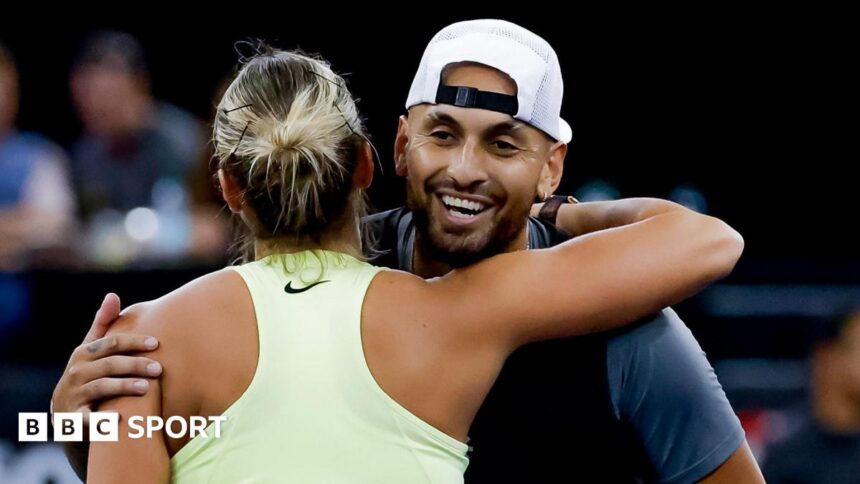
The roar of a sold-out Madison Square Garden crowd still echoes. The flashbulbs have faded. But the conversation ignited by a simple, thrilling exhibition match between Aryna Sabalenka and Nick Kyrgios is just beginning. This week in New York, the world No. 1 in women’s tennis and the sport’s most electrifying maverick shared a court for a lighthearted yet fiercely competitive set, a precursor to a full-scale “Battle of the Sexes” exhibition slated for Dubai on December 28, to be broadcast live on the BBC. While the spectacle promises entertainment, it has also sparked a debate: is this a fun showcase or a step back for women’s athletics? Sabalenka herself has issued a powerful rebuttal to the critics, asserting that playing Kyrgios “will not damage women’s sport.” She’s right. This isn’t a regression; it’s a reflection of a modern sports landscape where spectacle, personality, and pure athleticism transcend outdated gender binaries.
Beyond the Scoreline: The Real Stakes of a Modern Exhibition
To frame the Sabalenka-Kyrgios clash as a referendum on the validity of women’s tennis is to fundamentally misunderstand its purpose and context. This is not a sanctioned tour match with ranking points on the line. It is not a replication of the 1973 Billie Jean King vs. Bobby Riggs match, which was played against a backdrop of profound inequality and fought for existential legitimacy. The landscape today is radically different. Women’s tennis stands as the global leader in female professional sports, with equal pay at all four Grand Slams, massive independent star power, and a depth of competition that is the envy of many sports leagues, men’s or women’s.
The Dubai exhibition, much like the MSG teaser, is first and foremost a business and entertainment product. It sells because of the unique ingredients:
- Unmatched Power: Sabalenka possesses arguably the most devastating first-strike power in the history of the women’s game.
- Kyrgios’s Genius: Kyrgios brings unparalleled shot-making creativity, touch, and theatrical flair.
- Global Star Power: Both are headline-making, social media-savvy athletes who command attention beyond the tennis core.
Viewers tuning into the BBC broadcast are paying for a unique, unpredictable athletic experience, not a scientific comparison. The potential “damage” some fear presupposes that the public is incapable of understanding this distinction. It underestimates the intelligence of the modern sports fan, who can simultaneously appreciate Sabalenka’s 78 mph average forehand and Iga Świątek’s relentless domination of the WTA tour without conflating the two.
Strength in Visibility: How Showcases Elevate All Athletes
Critics who worry about the optics of a potential Sabalenka loss are focusing on the wrong metric. The true measure of this event’s impact lies in its platform and promotional value. A prime-time exhibition on a network like the BBC places tennis squarely in the public consciousness during the off-season. It captures casual fans who might not watch a routine tour semifinal. For Sabalenka, it is an opportunity to showcase her personality and her staggering power to an audience that may see her only during Grand Slam finals.
This visibility is a net positive for the women’s game. It reinforces Sabalenka’s status as a global sporting icon, separate from but equal to her male counterparts. Furthermore, it creates a narrative of mutual respect and elite competition. When Kyrgios speaks in awe of Sabalenka’s serve or she laughs at his between-the-legs attempts, it humanizes them as peers in the upper echelon of athletic performance. This does not belittle; it elevates. It says that the world’s best female player is a compelling enough athlete to share a marquee with one of the men’s game’s biggest draws. The subtext is one of celebration, not diminishment.
Expert Analysis: Context is Everything
The historical “Battle of the Sexes” was a necessary political act. Today’s exhibitions are voluntary commercial and promotional spectacles. The key difference is agency. Billie Jean King played under the immense weight of representing an entire gender’s sporting future. Aryna Sabalenka is choosing to participate in a high-profile, lucrative event that highlights her individual skills. This shift from representation to individual empowerment is profound.
Athletic comparison between elite male and female athletes is a complex, often futile exercise due to inherent physiological differences. But in a controlled, exhibition format, these differences become part of the intrigue, not the verdict. Can Sabalenka’s return handle Kyrgios’s 130 mph serve? Can Kyrgios’s reflexes withstand Sabalenka’s cross-court rocket? The fascination is in the clash of styles and power, not in using the result to make sweeping generalizations. Sports science has long settled the physical differentials; the public doesn’t need this match to inform them. They need it to entertain them.
Importantly, Sabalenka enters this contest as a reigning two-time Australian Open champion and a pillar of consistency. Her credibility is unassailable. A loss in a fun, one-off format with modified rules does not tarnish her Grand Slam titles or her No. 1 ranking, just as a victory would not suddenly crown her the equal of Novak Djokovic in a best-of-five-set major. The tennis world is sophisticated enough to hold both truths at once.
Prediction and Lasting Impact: A Template for the Future
So, what can we expect in Dubai? Expect fireworks, incredible shot-making, and a heavy dose of entertainment. Kyrgios, with his bigger serve and perhaps more match sharpness depending on his health, might be the favorite in a straight tennis match. But exhibitions often feature modified scoring, on-court interviews, and a focus on crowd engagement. The result is almost secondary.
The lasting impact, however, could be significant. This event could pioneer a new, profitable model for the off-season:
- Hybrid Events: More mixed exhibitions featuring top-tier talent from both tours.
- Increased Crossover Appeal: Building bridges between the often-siloed fan bases of the ATP and WTA.
- Financial Upside for Stars: Providing another major revenue stream for the sports’ biggest attractions.
If successful, the Sabalenka-Kyrgios model may inspire similar events, potentially featuring rivalries like Coco Gauff vs. Ben Shelton or Iga Świątek vs. Carlos Alcaraz. This doesn’t replace tour competition; it complements it by growing the sport’s overall profile.
Conclusion: Celebrating Spectacle, Not Fueling Division
Aryna Sabalenka’s stance is clear, confident, and correct. Playing Nick Kyrgios will not damage women’s sport. In fact, it demonstrates its strength. The very fact that a leading female athlete can engage in such a spectacle without her entire tour’s legitimacy being questioned is a testament to the battles already won by legends like King, Serena Williams, and others. This exhibition is not a step back into the past; it is a step forward into a future where the best athletes in the world, regardless of gender, can collaborate to create unforgettable moments of entertainment.
The real threat to any sport is not a friendly cross-gender exhibition; it is irrelevance. By commanding a sold-out Garden and a BBC broadcast slot, Sabalenka and Kyrgios are fighting irrelevance with every serve and smile. They are reminding the world that tennis, at its best, is a thrilling, personality-driven, and powerfully athletic spectacle. To view this through a lens of gender politics is to miss the point entirely. This is not a battle of the sexes. It is a celebration of sport, and in that arena, everyone wins.
Source: Based on news from BBC Sport.