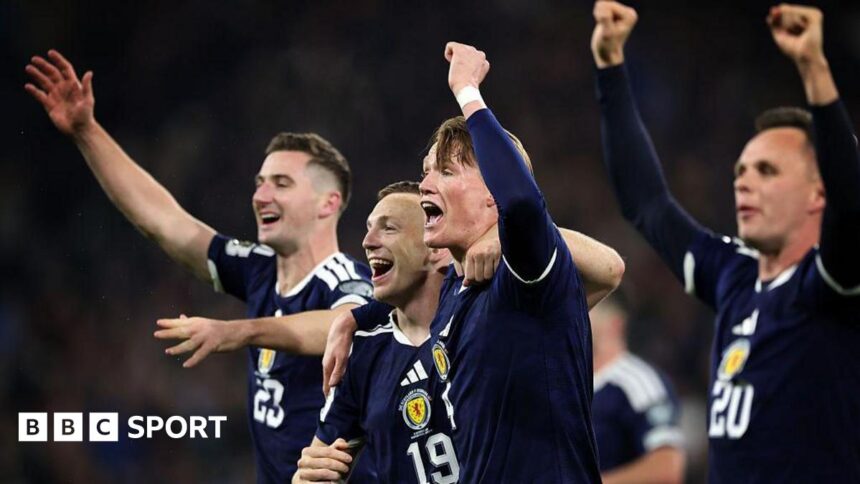
A Tartan Homecoming: BBC Secures Historic Broadcast of Scotland’s World Cup Return
The whistle blows, the national anthem swells, and a nation holds its breath. For the first time in a generation, Scotland’s men’s national team will walk out at a FIFA World Cup, and for millions of fans across the nation, they will do so on a familiar and cherished platform: the BBC. In a major broadcasting coup, the BBC has secured the rights to air Scotland’s historic opening match of the 2026 tournament against Haiti on June 14th—a moment 28 years in the making. This announcement is more than a scheduling note; it’s a cultural homecoming, stitching the fabric of a long-awaited sporting dream directly into the living rooms of a hopeful public.
The Long Road Back: From 1998 to 2026
To understand the magnitude of this moment, one must journey back to 1998. Scotland’s last appearance, in France, ended in group-stage heartbreak against Morocco. Since then, a litany of near-misses, playoff agonies, and managerial changes have defined a painful hiatus. The 1998 World Cup became a fading memory, a benchmark of a bygone era. The qualification for the 2026 edition, co-hosted by the USA, Canada, and Mexico, has thus ignited a fervor unlike any other in modern Scottish football history. The BBC’s role in broadcasting this return is profoundly symbolic. It was the broadcaster that narrated the highs and lows of campaigns from the 1970s onwards, making its coverage the traditional soundtrack to the nation’s footballing aspirations. Securing the Scotland vs Haiti broadcast ensures continuity with that storied past, providing a thread that connects the heroes of today with those of decades past.
The BBC’s coverage won’t stop at the opener. They will also show Scotland’s final, daunting Group C fixture against footballing royalty, Brazil. This scheduling creates a compelling narrative arc for viewers: from the palpable tension of a must-win opening game to the glorious spectacle of facing the five-time champions. The middle match, against Morocco—a poignant reminder of 1998—will be on ITV, splitting the group stage between the two UK terrestrial giants.
Broadcasting Battleground: BBC and ITV Split the Spoils
The UK’s World Cup coverage has long been a shared endeavor between the BBC and ITV, and 2026 is no different. The split this time offers a fascinating mix of fixtures for home nations fans. While the BBC celebrates its Scottish homecoming, it also holds significant rights for England’s World Cup journey. The broadcaster will show England’s crucial second group match against Ghana, a fixture dripping with narrative given Ghana’s history of eliminating England from major tournaments. Furthermore, the BBC is guaranteed to broadcast any England knockout match in the last 32, last 16, and semi-finals, should Gareth Southgate’s side progress.
ITV, meanwhile, gets first pick of England’s group stage, showing the encounters with Croatia and Panama. They also hold the rights to the potential home nations decider between Scotland and Morocco. This balanced split ensures maximum reach and fierce competition for audience share, with each broadcaster aiming to outdo the other with superior punditry, analysis, and production value.
The picture could yet become more complex and celebratory. The BBC has positioned itself for a potential Celtic bonanza, securing the rights to broadcast a possible group match for Wales or Northern Ireland should either qualify via March’s arduous play-offs. Specifically, if either nation wins its place, their opening game against Canada on June 12th would air on the BBC, potentially creating an unprecedented fortnight of home nations football on the channel.
- BBC’s Key Matches: Scotland vs Haiti (June 14), Scotland vs Brazil, England vs Ghana, England’s knockout fixtures (from last 32 to semi-final), Potential Wales/N. Ireland vs Canada.
- ITV’s Key Matches: Scotland vs Morocco, England vs Croatia, England vs Panama, plus first pick of England’s group games.
Group C Analysis: Daunting, but Not Impossible
Drawn in Group C with Brazil, Haiti, and Morocco, Scotland faces a classic World Cup cocktail of the sublime, the unknown, and the revenge narrative. The opening fixture against Haiti is, without question, the most important match Scotland has played this millennium. It is a proverbial cup final. Haiti, qualifying for their first World Cup, will be no pushovers—they carry the explosive, unpredictable threat of a CONCACAF side with nothing to lose. A win here is non-negotiable for any hopes of progression.
The second match against Morocco is a spine-tingling twist of fate. The North Africans, now a global force after their 2022 semi-final heroics, will be overwhelming favorites. Yet, the psychic scar of 1998 could serve as a powerful motivator for Scotland. A result here would be one of the nation’s greatest ever. Finally, facing Brazil is the stuff of childhood dreams. While a monumental challenge, it could also be a glorious, pressure-free occasion if progression is already secured—or a tragic backdrop if already eliminated. The group’s dynamics demand a fast start. Four points may well be enough for second place, making the Haiti game and the Morocco clash the definitive battlegrounds.
Predictions and Legacy: What Success Looks Like in 2026
Realistically, success for Scotland in this group would be achieving a knockout stage qualification. Navigating a path past either Morocco or Brazil to second place would be a monumental achievement. The primary target must be to exit the tournament with pride restored and a foundation built. This means:
- A victory over Haiti to exorcise the nerves and bank crucial points.
- A competitive, disciplined showing against Morocco, aiming for at least a draw.
- A fearless performance against Brazil that showcases Scottish football on the world’s biggest stage.
Beyond the points, the legacy of this World Cup is already being written. The mere fact of qualification has rejuvenated the sport at all levels in Scotland. The BBC’s widespread, free-to-air coverage will amplify this effect exponentially. A generation of children who have never seen Scotland at a World Cup will now have that reference point, that inspiration. It will be a shared national event, a fortnight where office talk, pub gatherings, and family conversations revolve around a common, hopeful cause.
Conclusion: A Nation Tunes In
The announcement that the BBC will broadcast Scotland’s World Cup return is a perfect symmetry. It brings a long-awaited national moment back to the broadcaster that has chronicled its footballing soul for decades. From the nervous optimism of facing Haiti to the awe-inspiring challenge of Brazil, the journey of Steve Clarke’s squad will be a collective experience, amplified by the reach and tradition of the BBC. For England, the shared coverage with ITV promises a summer of intense debate and analysis. And for the potential inclusion of Wales or Northern Ireland, the stage is set for a truly historic British and Irish football celebration. On June 14th, 2026, a quarter-century of waiting ends. The pictures will be in HD, the kits will be modern, but the feeling—of a nation united, hopeful, and glued to the BBC—will be beautifully, reassuringly familiar. The world’s game is coming home, to a Scottish screen near you.
Source: Based on news from BBC Sport.