Marie-Louise Eta: The Bundesliga’s Groundbreaking Interim Coach, For Whom It’s “Just About Football”
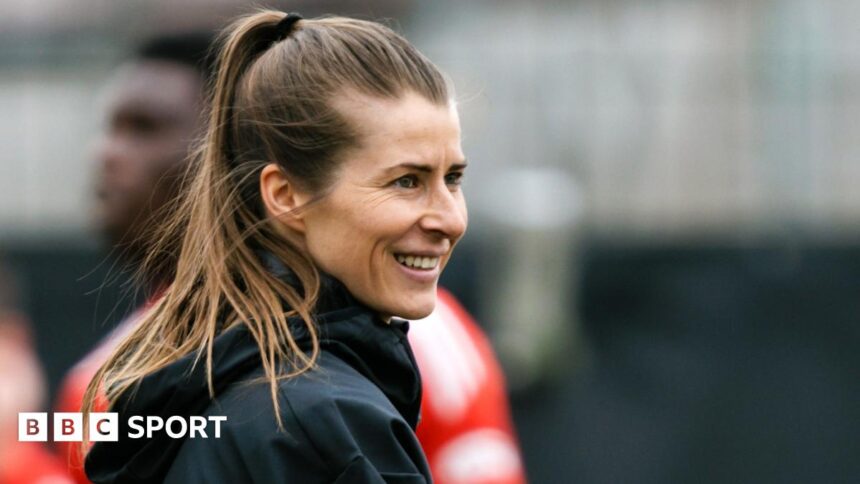
The air in the press room at Union Berlin’s Stadion An der Alten Försterei was thick with the weight of history. Cameras clicked, journalists shifted, and the global spotlight fixed on a single figure at the front. Yet, as she surveyed the unprecedented media scrum, Marie-Louise Eta’s expression betrayed a flicker of bemusement. For the world, her appointment as interim head coach of the Bundesliga men’s team was a seismic event. For her, it was simply the next step in a football life. “It’s good to see so many people here and I totally understand that this is a big topic,” she said. “But for me it has always just been about football and working with people.” With those words, Eta reframed a narrative, setting the tone for a potentially transformative chapter in European football.
A Historic Appointment in the Shadow of the Alte Försterei
When Union Berlin dismissed head coach Steffen Baumgart after a string of poor results, the club’s sporting hierarchy turned to a familiar and trusted figure within their setup. Marie-Louise Eta, at 34 years old, was promoted from her role as an assistant coach with the Under-19s and the first team. Her interim tenure, covering the final five matches of the season, is far from a ceremonial role; it is a football decision with profound historical implications. On Saturday, as her side lines up against VfL Wolfsburg, Eta will officially become the first female head coach in men’s top-five European league history. This milestone shatters a long-standing glass ceiling in the sport’s most visible and scrutinized arena.
Eta is no stranger to breaking barriers. A former midfielder, she won the Women’s Champions League with Turbine Potsdam and earned 27 caps for Germany. Her transition to coaching was swift and successful, earning her UEFA Pro License honors and a role with the German football association (DFB). Her work with Union’s youth teams and her integration into the first-team staff under Baumgart prepared her for this moment, even if the timing was unexpected. The club’s statement emphasized her “broad knowledge of the team and the structures,” signaling this as a pragmatic choice for a club fighting for Bundesliga survival, not merely a symbolic gesture.
Beyond the Headlines: Eta’s Football Philosophy and Immediate Challenge
While the headlines scream “first woman,” the substance of Eta’s appointment lies in her football intellect and the immense task ahead. Union Berlin, a club that captured hearts with its fairy-tale rise to the Bundesliga and Champions League, finds itself in a dire Bundesliga relegation battle. Sitting just above the playoff spot, every point from the final five games is precious. Eta’s focus, as she stated, is purely on the pitch. Her immediate challenge is threefold:
- Stabilizing a Leaky Defense: Union has conceded the second-most goals in the league. Organizing a resilient defensive structure will be job one.
- Restoring Team Confidence: A season of struggles has taken a psychological toll. Eta’s renowned man-management and communication skills will be tested instantly.
- Extracting Results with Limited Time: With no transfer window and minimal training time, she must maximize the existing squad’s potential through tactical clarity and motivation.
Her coaching philosophy, shaped by her experiences, is likely to emphasize collective spirit, tactical discipline, and vertical play—hallmarks of Union’s identity during their most successful periods. The question is whether she can imprint these principles swiftly enough to secure vital results.
Expert Analysis: Why This Moment is Different
Previous female pioneers in men’s professional football, such as Corinne Diacre in France’s Ligue 2 or Helena Costa in Portugal, often faced tokenistic appointments or untenable working conditions. Eta’s situation is structurally different, and this gives her a genuine chance to succeed and influence.
First, she is an internal appointment. She knows the players, the club culture, and the demands of the Bundesliga intimately. She is not an outsider brought in for shock value. Second, the context is purely sporting. Union is in a crisis, and the board has turned to her believing she can help secure Bundesliga status. This is performance-based, not PR-based. Third, the landscape is evolving. The success of managers like Emma Hayes at the highest levels of the women’s game and the integration of female coaches like Rennae Stubbs in tennis have slowly shifted perceptions in high-performance sport.
However, the scrutiny will be unparalleled. Every team selection, substitution, and post-match comment will be analyzed through a dual lens: football decisions and gender. Eta’s calm, focused demeanor at that first press conference suggests she is prepared for this unbalanced burden. As one German pundit noted, “Her greatest strength this season may be her immunity to the external noise that has plagued Union all year. She represents a clean slate.”
Predictions and Lasting Impact
Predicting the outcome of Eta’s five-game tenure is fraught with difficulty. The Bundesliga’s relegation dogfight is notoriously unpredictable. Success will be measured in points, not plaudits. A survival miracle would etch her name in Union folklore and make her a compelling candidate for a permanent head coach role somewhere in the professional men’s game. Even a respectable collection of points in a failed bid to stay up could be seen as a positive mark on her resume.
But the long-term impact of Marie-Louise Eta’s appointment transcends Union’s league position. It has already achieved something critical: normalization.
- Pathway Demonstration: It shows young female coaches a tangible, credible path to the top of the men’s game.
- Club Validation: It signals to other clubs that hiring a qualified female coach is a viable, and perhaps advantageous, option.
- Media Narrative Shift: The focus, forced by Eta herself, is already shifting from “female coach” to “coach in a relegation fight.” This is progress.
The hope among advocates for diversity in coaching is that Eta’s stint, however brief, will be judged on footballing merit alone. If it is, the door she has pushed open will become harder to close.
Conclusion: A Quiet Revolution in Köpenick
As Saturday approaches, the circus will descend again. The cameras will follow her every move on the touchline. The world will watch. But in the dressing room and on the training pitch at Union Berlin, a different reality is taking hold. There, Marie-Louise Eta is not a symbol, but simply the boss—the person tasked with organizing, inspiring, and finding a way to win. Her amused reaction to the media frenzy was telling; she understands the significance but refuses to be defined by it. Her mission is pure football: to win points for a beloved club in distress.
In making this appointment, Union Berlin has not just made history; it has initiated a profound test case. Can a highly qualified, internally-respected female coach succeed in the high-pressure crucible of a men’s top-flight relegation battle? The next five games will provide the beginning of an answer. Regardless of the result, Eta’s calm assertion that this is “just about football” is itself a revolutionary act. It demands that we watch not the history, but the football. And in doing so, she may just change the game forever.
Source: Based on news from BBC Sport.