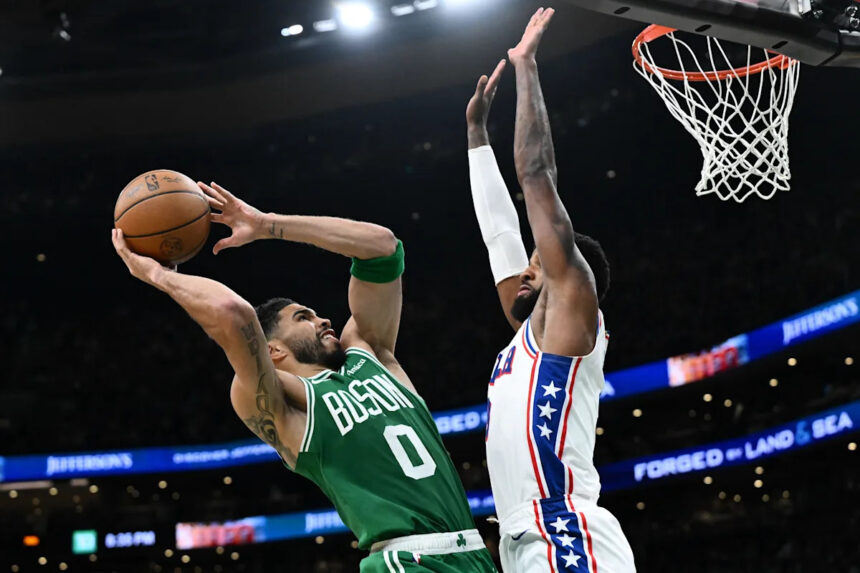
Jayson Tatum’s Ultimate Win: Perspective Forged in Adversity After Celtics’ Game 2 Loss
The TD Garden crowd filed out into the Boston night, the taste of a 111-97 Game 2 defeat to the Philadelphia 76ers still bitter. The series was now tied, momentum seemingly shifted. Yet, at the podium, the face of the franchise wore not a scowl, but a look of profound, almost serene, perspective. For Jayson Tatum, the calculus of victory had been irrevocably altered. A year removed from a moment where he believed his career was over, simply walking off the court on his own two feet represented a triumph no box score could ever capture.
The Shadow of Madison Square Garden: A Career-Defining Moment That Wasn’t
To understand Jayson Tatum’s equanimity after a playoff loss, you must rewind to the visceral trauma of last May. In Game 4 of the Eastern Conference Semifinals against the Knicks, a non-contact injury sent him crashing to the Madison Square Garden floor. The diagnosis: a ruptured Achilles. The immediate aftermath was a brutal, public display of athletic vulnerability.
Tatum had to be helped off the court, his weight on the shoulders of teammates, before eventually being wheeled out in a wheelchair. In that moment, the arc of a superstar’s career seemed to violently bend. “I thought it was over,” Tatum has since admitted, voicing the silent fear of every professional athlete. The grueling journey back was a masterclass in pain and patience—re-learning to walk, to trust his body, to push against the mental ghosts whispering of permanent decline.
His return in early March wasn’t just a roster addition; it was a medical marvel. To not only play but to perform at an All-NBA level, averaging nearly 22 points in the regular season’s final stretch, defied the historical gravity of such an injury. This context is the essential lens through which to view his post-Game 2 demeanor. The battle isn’t just against Joel Embiid or a 2-3 zone; it’s against the memory of that wheelchair.
Beyond the Box Score: Finding Victory in the Grind
On paper, Tatum’s Game 2 line was stellar: 19 points, 14 rebounds, 9 assists in 39 minutes—a near-triple-double against a fierce defensive scheme designed to stop him. For most stars, that in a loss would be a footnote of frustration. For Tatum, it was evidence of something greater.
“I’m feeling good,” he stated, before delivering the quote that frames his new worldview. “It sounds cliché but, man, I’m back in the playoffs. For me, it’s a win every day that I’ve come back from what happened last May… I get to walk off the court on my own two feet. So as long as I do that every game, I win a little bit.”
This is not acceptance of defeat. This is the hard-earned perspective of an athlete who has stared into the abyss. The “little win” he speaks of is the foundation upon which championship mentality is now built. The minor frustrations of a missed rotation or a cold shooting night pale against the monumental challenge of returning from an injury that ends careers. This perspective is a strategic asset, allowing Tatum and, by extension, the Celtics to weather playoff storms without spiraling.
- Mental Fortitude: The psychological toll of an Achilles recovery is arguably greater than the physical. Overcoming that builds a resilience that a single playoff loss cannot crack.
- Long-Term Vision: Tatum’s outlook forces a focus on process and health over any single game’s result—a crucial balance in a grueling two-month playoff run.
- Leadership Tone: His public calm sets the emotional temperature for the entire locker room, preventing panic after a series-tying loss.
Expert Analysis: How This Perspective Fuels Title Hopes
Veteran sports psychologists and player development coaches often speak of “post-traumatic growth” in athletes. Tatum’s journey is a textbook case. The player who might have once internalized the pressure of every playoff possession now operates with a liberated gratitude. This doesn’t diminish his hunger; it refines it.
“What we’re seeing is a maturation that often only comes from profound adversity,” notes Dr. Elena Rodriguez, a performance psychologist who works with professional athletes. “His identity is no longer solely tied to the immediate result, but to the gratitude of being able to compete at the highest level again. That creates a steadier, more sustainable competitor under playoff pressure. He’s playing with house money in a sense, but with the skill of a superstar.”
On the court, this manifests as patience. In Game 2, when his shot wasn’t falling (7-of-17 FG), he didn’t force the issue or settle. He leveraged the defensive attention to become a playmaker, dishing 9 assists and controlling the glass. His game expanded because his mind is no longer confined by the fear of failure—he’s already conquered something far more daunting.
Predictions: The Silver Lining as a Strategic Catalyst
So, what does this mean for the remainder of the Celtics-Sixers series and beyond? Tatum’s perspective is the ultimate stabilizer. Expect the following:
1. A Ruthless Response in Philadelphia: A team that isn’t emotionally wrecked by a home loss is a dangerous team on the road. Tatum’s calm leadership suggests a focused, not desperate, Celtics squad heading into Games 3 and 4. The “little win” philosophy prevents a hangover.
2. Sustainability for a Deep Run: The NBA playoffs are a war of attrition. Tatum’s ability to mentally compartmentalize setbacks, born from his rehab journey, will help conserve the collective emotional energy of the team over a potential two-month grind. He is the buffer against panic.
3. Elevated Clutch Performance: Players burdened by the weight of “championship or bust” narratives can tighten up in key moments. Tatum, who has already faced down a career-ending scenario, may find late-game pressure easier to metabolize. The stakes, however high, are not life-or-death to his career.
Conclusion: The Journey Redefines the Destination
The Philadelphia 76ers won Game 2 on the scoreboard, and the tactical adjustments for the rest of this series will be dissected endlessly. But in the larger narrative of the Boston Celtics’ championship aspirations and Jayson Tatum’s legacy, a more profound story is unfolding.
Tatum’s triumphant return from a ruptured Achilles has gifted him something rare: an unshakeable understanding of what truly matters. The “little win” of walking off on his own power is the bedrock. Every dribble, every shot, every playoff game is now a bonus round—a chance to do what he once thought was stolen from him forever.
This isn’t a story about settling for moral victories. It’s about a superstar who has been forged in a fire far hotter than a second-round playoff game. The perspective he gained in that wheelchair at Madison Square Garden may ultimately be the very thing that propels him, and the Celtics, to the final victory he still desperately seeks. The championship pursuit continues, but for Jayson Tatum, a pivotal, personal championship has already been won.
Source: Based on news from Yahoo Sports.