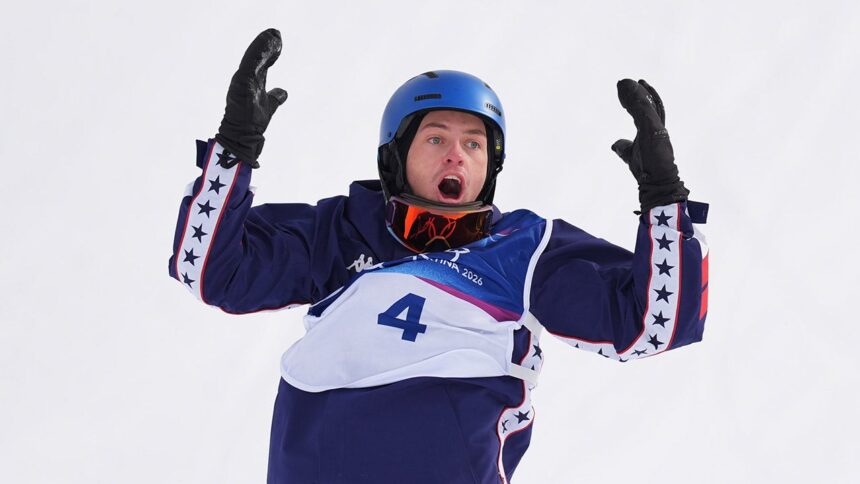
American Jake Canter Secures Olympic Bronze in Men’s Snowboard Slopestyle Thriller
The purest agony and the most profound ecstasy in snowboarding are often separated by a single score and an excruciating wait. For American Jake Canter, perched precariously in provisional bronze medal position in the men’s snowboard slopestyle final at the 2026 Winter Olympics, that wait felt eternal. As the world’s best riders dropped in for their final runs in Livigno, Italy, Canter’s Olympic destiny was entirely out of his hands. What followed was a masterclass in composure under pressure, culminating in a bronze medal that was as much a testament to mental fortitude as it was to aerial prowess.
The Agonizing Wait: A Podium Hanging in the Balance
Canter’s path to the podium was a narrative of clutch performance. Needing a big final run, the 22-year-old from Colorado delivered under the brightest lights, putting down a clean, technical run that earned a score of 79.36. The run featured his signature blend of stylish rail work and massive, grabbed spins, but it was far from a guaranteed medal-winner. He immediately stepped into the “hot seat,” forced to watch as three of the sport’s heaviest hitters—Canada’s Mark McMorris, Norway’s Marcus Kleveland, and New Zealand’s Dane Menzies—prepared for their final attempts.
“You’re just a spectator at that point, but your whole life is riding on what you’re watching,” a veteran Olympic analyst noted. “The mental toll is immense. Every takeoff, every landing, your stomach drops. Canter showed the patience of a veteran.” One by one, the challengers fell short. McMorris, a slopestyle legend, couldn’t improve his score. Kleveland, capable of supernatural tricks, fought for a landing. Menzies, the daring newcomer, came closest but ultimately finished just behind Canter’s mark. The wait, which Canter later described as “a thousand years long,” ended in a cathartic eruption of joy as he officially became an Olympic bronze medalist.
Breaking Down Canter’s Medal-Winning Performance
While the drama unfolded after his run, Canter’s bronze was earned on the strength of a meticulously constructed and executed slopestyle run. In a field increasingly dominated by quadruple cork variations, Canter’s run stood out for its technical precision and flow from top to bottom.
- Technical Rail Mastery: Canter initiated his run with complex rail combinations, including a switch backside lipslide to pretzel out and a frontside boardslide to 270 out, demonstrating superior control and setting a high technical baseline for the judges.
- Amplitude and Style: On the jumps, Canter opted for massive, perfectly executed triple corks. His emphasis on amplitude—getting huge air—and clean, tweaked grabs provided a classic style that scored well on execution.
- Strategic Composition: In a finals where many riders attempted—and failed—to land the sport’s most difficult tricks, Canter’s strategy of a slightly less risky but flawlessly landed run proved to be the perfect podium recipe. He prioritized control over chaos, and it paid off.
“Jake’s run was a statement in intelligent competition snowboarding,” commented a former Olympic coach. “He didn’t win the trick-of-the-day award, but he won the ‘put-it-all-together-when-it-counts’ award. In an Olympic final, that’s often what separates the medalists from the rest.”
The New Guard: What Canter’s Bronze Means for US Snowboarding
Jake Canter’s bronze medal arrives at a pivotal moment for U.S. Snowboarding. With iconic figures from previous generations moving on, the question of who would step up to fill the podium void has lingered. Canter’s performance in Livigno provides a resounding answer.
This medal does more than just add to Team USA’s count; it signals the arrival of a new, confident American core ready to compete on the global stage. Canter, along with his peers on the team, represents a bridge between the sport’s foundational style and its hyper-progressive future. His ability to medal with a run focused on execution over sheer, dizzying difficulty shows there is still a winning path for all-around snowboarders. This Olympic medal will inject energy into the US program, inspiring the next wave of riders and proving that the American pipeline of talent remains robust and capable of delivering under Olympic pressure.
Looking Ahead: Predictions for the Future of Slopestyle
The men’s slopestyle final in Livigno was a microcosm of the sport’s current state: breathtaking progression tempered by the unforgiving nature of Olympic contest pressure. As we look to the future, several trends are clear.
First, the technical difficulty on rails will continue to escalate, becoming as important as the jumps in building a winning score. Second, while quadruple corks are now standard for the gold medal, the battle for the other podium spots will increasingly hinge on the combination of style, amplitude, and consistency that Canter displayed. Finally, the mental game is more critical than ever. The ability to manage nerves during a long, tense final—as Canter did—is now a non-negotiable skill for any contender.
For Jake Canter, the future is blindingly bright. An Olympic medal at 22 transforms him from a promising talent into a proven champion and a focal point of the sport. The experience gained from navigating the pressure cooker of Livigno will be invaluable. Predictions for the next Olympic cycle already place him not just as a podium threat, but as a serious gold medal contender who has now felt the ultimate pressure and thrived.
Conclusion: A Bronze Forged in Nerve and Skill
Jake Canter’s Olympic bronze medal in men’s snowboard slopestyle will be remembered not for a single, earth-shattering trick, but for a complete performance under duress. It was a medal earned twice over: first on the snow with a flawless final run, and then in the agonizing minutes of waiting that followed, where his composure was tested and validated. This victory is a landmark moment for Canter personally and a vital spark for American snowboarding collectively. It underscores a timeless Olympic truth: while physical talent gets you to the games, it is often mental strength that secures a place on the podium. In Livigno, Jake Canter proved he has an abundance of both, announcing his arrival on the world stage with a hard-earned, brilliantly defended piece of Olympic hardware.
Source: Based on news from Fox Sports.