Aryna Sabalenka Survives Madrid Open Scare, Edges Naomi Osaka in Three-Set Thriller
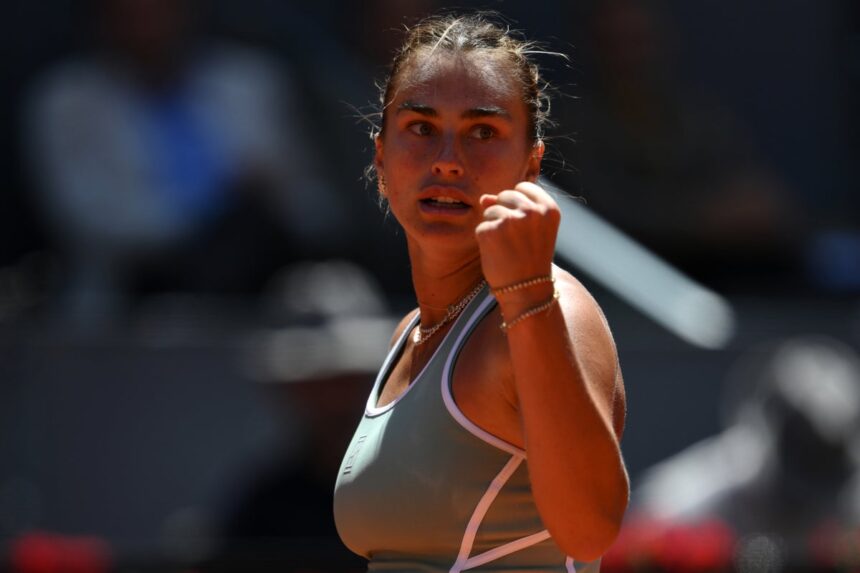
In a match that felt more like a Grand Slam final than a fourth-round contest, world No. 1 Aryna Sabalenka dug deep into her championship reserves to overcome a resurgent Naomi Osaka at the Madrid Open. The Belarusian powerhouse rallied from a set and a break down, eventually posting a 6-7(1), 6-3, 6-2 victory in two hours and 20 minutes of high-octane tennis on the Manolo Santana Stadium court.
The win keeps Sabalenka’s hopes of defending her title—and capturing a fourth career trophy in the Spanish capital—very much alive. But for long stretches of the first set and early second, it looked as though the two-time Australian Open champion would be packing her bags early.
Here is the full breakdown of a match that had everything: power, drama, momentum shifts, and a masterclass in composure under pressure.
First Set: Osaka’s Resurgence and a Tiebreak Masterclass
From the opening exchanges, it was clear that this was not the same Naomi Osaka who has struggled for consistency over the past 18 months. The former world No. 1 came out firing, using her trademark heavy serve and flat groundstrokes to push Sabalenka behind the baseline.
Sabalenka, known for her aggressive return positioning and ability to dictate rallies, found herself on the defensive more often than she would have liked. The Belarusian had chances early, earning break points in the third game, but Osaka held firm with a combination of first-serve winners and clutch net play.
The set proceeded on serve until the tiebreak, where the script flipped entirely. Sabalenka’s usually reliable tiebreak prowess—she has one of the best win percentages in tiebreaks on the WTA tour—completely deserted her. A series of unforced errors, including a forehand into the net on her own serve, handed Osaka a 5-0 lead. The Japanese star closed out the breaker 7-1, leaving the top seed stunned.
Key stats from the first set:
- Osaka won 82% of her first-serve points
- Sabalenka committed 12 unforced errors, compared to Osaka’s 9
- The tiebreak lasted just over six minutes, with Sabalenka winning only one point
For a moment, the court felt like it belonged to Osaka. The crowd, heavily in favor of the four-time major winner, roared as she took the early lead. But Sabalenka’s history suggests she is never truly out of a match, and the second set would prove that in dramatic fashion.
Second Set: The Comeback Begins with a Gutsy Break
The start of the second set was a microcosm of the match’s tension. Sabalenka held to open, but Osaka broke her in the second game after a 12-minute marathon that featured six deuces. At 2-1, Osaka held serve to extend her lead, and suddenly the world No. 1 was staring at a 3-1 deficit.
But this is where the match turned. Sabalenka, rather than pressing, began to reset her mental game. She started taking the ball earlier, stepping inside the baseline to cut off Osaka’s angles. In the fifth game, with Osaka serving at 2-1, Sabalenka broke back to love—a stunning turnaround aided by a critical double fault from Osaka at 30-0.
“I just told myself, ‘You have to fight for every point. No easy ones,’” Sabalenka said in her on-court interview. “Naomi was playing incredible, but I knew if I could stay in the rallies, she might give me a chance.”
That chance came in the eighth game. Osaka, serving at 3-4, raced to a 40-0 lead. It seemed the set would go to 4-4. But Sabalenka, displaying the tenacity that has made her world No. 1, reeled off five consecutive points. She broke Osaka’s serve with a screaming backhand down the line, then served out the set with a love hold, dropping just two points in her final two service games of the set.
Turning point of the match:
- Sabalenka’s break from 40-0 down in the second set’s eighth game
- She won 14 of the last 16 points in the set
- Osaka’s double-fault count rose to three in the set, a sign of growing frustration
The momentum had shifted decisively. The third set would be a test of who could hold their nerve.
Third Set: Sabalenka’s Serve Becomes Unplayable
If the first two sets were a chess match of power and counter-punching, the decider was a Sabalenka masterclass in serve dominance. The Belarusian dropped just three points on her serve in the entire third set, winning 15 of 18 points. Her first-serve percentage climbed to 78%, and she did not face a single break point.
Osaka, by contrast, began to unravel. Errors crept into her game from the baseline, particularly on the backhand side. A double fault in the opening game of the set gave Sabalenka an immediate break, and the top seed consolidated for 2-0.
“I felt my rhythm go a little bit,” Osaka admitted post-match. “She started serving so well, and I was rushing my shots. Credit to her for raising her level.”
Sabalenka broke again in the fifth game after a lengthy rally that ended with Osaka netting a forehand. From there, the match was effectively over. Sabalenka held serve with ease, closing out the set 6-2 with an ace down the T.
Sabalenka’s decider stats:
- Won 83% of first-serve points
- Hit 12 winners to just 6 unforced errors
- Converted 2 of 3 break points
- Lost only 3 points on her serve across six service games
The match was a reminder that, while Sabalenka’s power is her calling card, her mental resilience is what separates her from the pack. She has now won 14 of her last 15 matches in Madrid, a run that includes two titles and a semifinal appearance.
Expert Analysis: What This Win Means for Sabalenka’s Title Defense
This victory was far from straightforward, and that might actually be good news for Sabalenka. Players often talk about needing a “tough match” early in a tournament to shake off rust and build confidence. Sabalenka got exactly that against a motivated and dangerous opponent.
Osaka, who entered the tournament on a wildcard after returning from maternity leave, showed flashes of her old brilliance. Her serve was firing in the first set, and her movement looked sharper than it has all year. But the lack of match fitness and consistency in pressure moments ultimately cost her.
For Sabalenka, the path to the title now opens up. She will face either Mirra Andreeva or Jelena Ostapenko in the quarterfinals. Both are dangerous, but neither has the raw power to consistently trouble Sabalenka when she is serving as well as she did in the third set.
Predictions for the rest of the tournament:
- Sabalenka’s serve is peaking at the right time—expect her to drop no more than one set en route to the final
- Her ability to adjust mid-match, as she did against Osaka, makes her the clear favorite to defend her title
- If she meets Iga Swiatek in the final, the match will be a classic. But Sabalenka’s form in Madrid suggests she can win a third consecutive title here
One thing is certain: Aryna Sabalenka is not just the world No. 1 on paper. She plays like it when it matters most.
Conclusion: A Champion’s Response Under Pressure
The Madrid Open has a history of producing epic matches, and the fourth-round clash between Aryna Sabalenka and Naomi Osaka will be remembered as one of the tournament’s finest. It had the tension of a Grand Slam, the quality of a final, and the drama of a rivalry renewed.
Sabalenka’s ability to fight back from a set and a break down against a player of Osaka’s caliber is the hallmark of a true champion. She did not panic when the tiebreak went sideways. She did not crumble when Osaka broke her early in the second. Instead, she trusted her game, adjusted her tactics, and let her serve carry her home.
For Osaka, there is no shame in this loss. She pushed the best player in the world to the limit and reminded everyone that her talent remains immense. But for Sabalenka, this is the kind of win that builds title runs. She now has the momentum, the confidence, and the experience of surviving a scare.
If she continues to serve at the level she showed in the third set, no one in the draw will stop her. The Madrid Open is still hers to lose, and after tonight’s performance, she looks ready to keep the trophy in her hands.
Source: Based on news from Yahoo Sports.