Jessica Campbell’s Historic Tenure in Seattle Ends: What’s Next for the Trailblazing Coach?
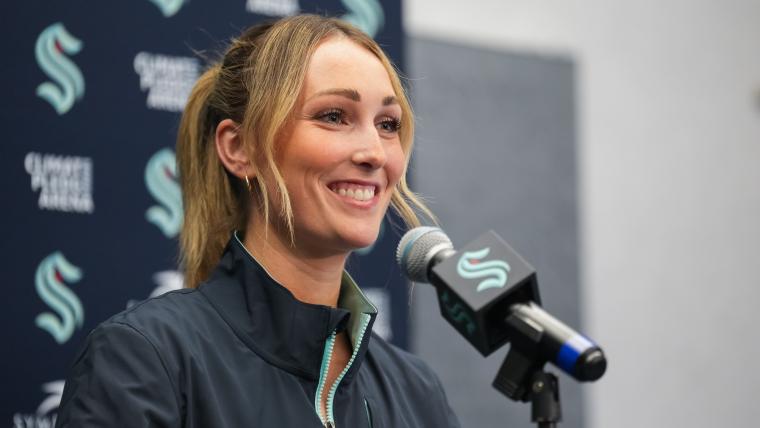
The Seattle Kraken are facing a significant shift behind the bench. After making history as the first full-time female assistant coach in NHL history, Jessica Campbell will not return to the Kraken for the 2026-27 season. The news, first reported by Emily Kaplan of ESPN and originally appearing on The Sporting News, confirms that Campbell’s contract expires this summer. While the Kraken have left the door open for her return in a different capacity, all signs point to a new chapter—one that could see her become the first woman to serve as a head coach in the NHL or a top-tier professional league.
Campbell’s departure is not a story of failure. It is a story of evolution. According to Kraken Executive Vice President and General Manager Jason Botterill, Campbell chose to move on due to other potential coaching opportunities. This is a pivotal moment for a coach who has already shattered glass ceilings and proven her tactical acumen at the highest level of hockey.
The Historic Rise: From AHL Power Play Architect to NHL Pioneer
To understand the weight of this departure, we must revisit the summer of 2024. That was when the Kraken promoted Campbell from their AHL affiliate, the Coachella Valley Firebirds, to an assistant coach role on the NHL bench. At that moment, she became the first woman in NHL history to hold a full-time, on-the-bench assistant coaching position. It was not a ceremonial appointment. Campbell earned it.
Her resume spoke volumes. Before joining the Kraken, she spent two seasons with the Firebirds, where she was tasked with running the power play. The results were undeniable: Coachella Valley reached back-to-back Calder Cup Finals. Her ability to design offensive zone entries, create high-danger scoring chances, and adjust in real-time made her a highly sought-after tactical mind. When the Kraken struggled with their man advantage in the NHL, Campbell’s system at the AHL level was often cited as a model for what Seattle wanted to build.
Campbell’s journey to the NHL bench was unconventional but earned. A former professional player in the NWHL (now PHF) and the German Frauen-Bundesliga, she also played for the Canadian national women’s team. She transitioned into coaching with a focus on skills development, working with NHL players like Nazem Kadri and Brayden Point during off-seasons. Her reputation as a meticulous technician and a communicator who could bridge the gap between analytics and on-ice execution made her an invaluable asset.
Why Did She Leave? The Business of Breaking Barriers
The simple answer: opportunity. Botterill’s statement that Campbell made the decision to move on due to “other potential coaching opportunities” is a clear indicator that her stock has never been higher. In the NHL, assistant coaches rarely leave a stable job unless a promotion—or a significantly larger role—is on the table.
Here’s the reality of the coaching market: Campbell has received interest across the league. Multiple teams are reportedly intrigued by her ability to develop young talent and her innovative approach to the power play. But the most tantalizing possibility is a head coaching job. While no NHL team has officially offered her a head coaching position yet, the AHL or even a major junior league could be the next logical step. A head coaching role in the AHL would allow her to manage a bench, handle line matching, and build a system from the ground up—experience that is essentially mandatory for any future NHL head coach.
Let’s not ignore the elephant in the room: the Kraken’s 2025-26 season was a disappointment. The team missed the playoffs, and head coach Dave Hakstol’s job security was a topic of speculation. While Campbell was not the head coach, the organization’s overall direction may have influenced her desire to explore other options. She wants to win, and she wants to lead.
Key Factors in Campbell’s Decision:
- Contract Expiration: Her deal ends this summer, giving her full autonomy to negotiate.
- League-Wide Interest: Multiple NHL teams have expressed interest in her tactical expertise.
- Desire to Lead: Sources indicate she is eager to take on a head coaching role, not just an assistant position.
- Seattle’s Door Is Open: The Kraken have offered a non-coaching role, but it appears she wants to remain behind the bench.
Expert Analysis: What This Means for the Kraken and the NHL
From a tactical standpoint, the Kraken lose a coach who specialized in offensive structure. Campbell’s power play system at Coachella Valley was known for its movement and unpredictability. She utilized a hybrid umbrella-1-3-1 formation that forced penalty killers to choose between covering the slot or pressuring the points. In the NHL, she was tasked with helping Seattle’s forwards improve their zone entries, an area where the team ranked near the bottom of the league in 2025-26.
For the Kraken, this creates a void. General Manager Jason Botterill now must find an assistant who can replicate Campbell’s ability to develop young players. The Kraken have a promising core of forwards like Shane Wright and Jagger Firkus who need a power play architect. Losing Campbell means losing the coach who had the most direct impact on player development in the organization.
For the NHL, Campbell’s departure from Seattle is not a setback for diversity—it’s a sign of progress. She is not leaving the league; she is leaving a job to pursue a higher-profile role. This is the natural career progression for elite coaches. In fact, her decision normalizes the idea that a woman in a coaching role is judged solely on her merit and ambition, not her gender. The next step is a head coaching job, and if she succeeds there, the NHL will have to seriously consider her for a top job.
Predictions for Campbell’s Next Move:
- Most Likely: Head coach of an AHL team (e.g., Chicago Wolves, Hershey Bears, or a team with a clear NHL pipeline).
- Dark Horse: Assistant coach (with power play responsibilities) for a Stanley Cup contender like the Carolina Hurricanes or Tampa Bay Lightning, where she could learn from a veteran head coach.
- Long Shot: Head coach of a Canadian Hockey League (CHL) team, though the AHL is more likely given her professional experience.
- Historic Potential: If she takes an AHL head coaching job and wins, the NHL head coaching conversation becomes very real within 2-3 seasons.
The Legacy: More Than a First
Jessica Campbell’s tenure in Seattle will be remembered for more than the history she made. She proved that tactical intelligence and leadership have no gender. When she stood behind the bench at Climate Pledge Arena, she was not a novelty; she was a coach who drew up breakouts, challenged players in practice, and earned their respect through preparation.
Her departure is bittersweet. For the Kraken, it is a loss of institutional knowledge. For the sport, it is a victory. Campbell is leaving because she has options—real, substantive options to grow her career. She is not being pushed out; she is being pulled forward by the gravity of her own success.
As the 2026-27 season approaches, the hockey world will watch where she lands. If she becomes a head coach in the AHL, expect that team’s power play to jump into the top five. Expect her to demand accountability and creativity. And expect her to be patient, because her ultimate goal is clear: to become the first woman to serve as a head coach in the National Hockey League.
Conclusion: The Door Is Open, But the Path Is Forward
The Seattle Kraken have left the door open for Jessica Campbell to return in a different capacity. That is a classy move from an organization that understood they were part of something bigger. But Campbell’s trajectory suggests she will walk through a different door—one that leads to a bench where she is the one making the final call.
This is not the end of a story. It is the end of a chapter. Jessica Campbell made history in Seattle, but her legacy will be defined by what she does next. Whether she is running an AHL bench or joining a contender’s staff, one thing is certain: she will not be the last woman to hold an NHL assistant coaching role. She is, however, the first to leave one because she had better opportunities waiting.
For the Kraken, the search begins for a replacement. For the NHL, the blueprint is clear: hire the best coach, regardless of gender. And for Jessica Campbell? The next power play is about to start.
Source: Based on news from Yahoo Sports.