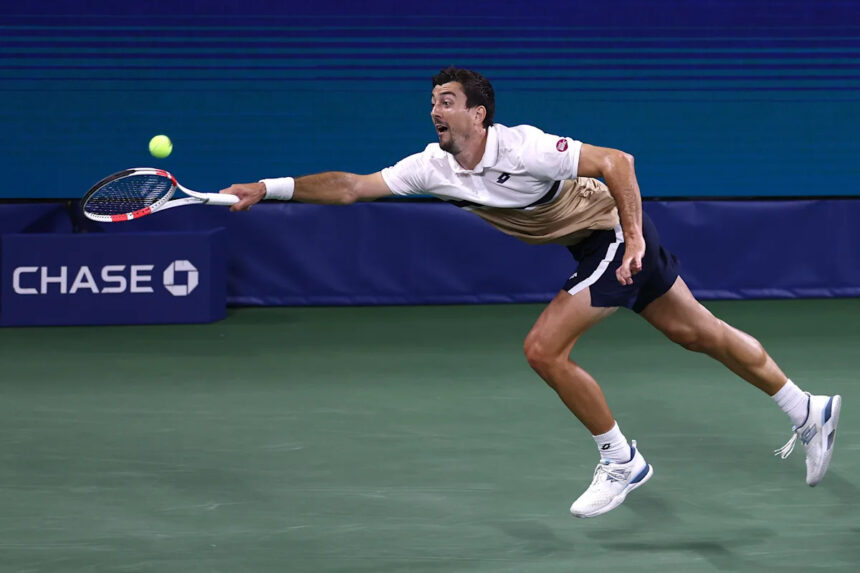
Sebastian Ofner’s Premature Celebration Proves Costly in Australian Open Qualifying Heartbreak
The line between triumph and disaster in professional tennis is often a single point. For Austria’s Sebastian Ofner, that line became a chasm of his own making in a surreal and brutal twist at Australian Open qualifying. In a moment that will be replayed on blooper reels for years, Ofner learned the hardest of lessons: it ain’t over ’til it’s over. His premature victory celebration, born from a critical mental lapse, triggered a catastrophic collapse, handing American Nishesh Basavareddy an unimaginable comeback win.
A Crucial Misunderstanding on the Grand Stage
The scene was set on the sun-baked courts of Melbourne Park. Sebastian Ofner, a 29-year-old veteran with a powerful game, was locked in a tense battle with 20-year-old Nishesh Basavareddy. The prize was a spot in the final round of qualifying, one win away from the main draw and a significant payday. After splitting sets, the match hurtled into a decisive third-set tiebreak. Ofner seized control, racing to a seemingly insurmountable 6-1 lead. He then won the next point to go ahead 7-1, and in that instant, his match memory failed him.
On the ATP Tour, a final-set tiebreak is a first-to-10-points affair. In Grand Slam qualifying, however, the traditional first-to-seven-points tiebreak is used for all sets. Ofner, in the heat of battle, conflated the two. Believing he had won the match at 7-1, he dropped his racket and began a triumphant celebration, walking to the net to shake his opponent’s hand.
The reality was a gut punch. The chair umpire was forced to intervene, informing the bewildered Austrian that the tiebreak was, in fact, a first-to-seven, but with a winning margin of two. The score was 7-1, not game, set, and match. The point stood, but the emotional whiplash was seismic. Basavareddy, given a lifeline from a comatose state, suddenly had a pulse.
The Psychological Unraveling and a Brutal Collapse
What followed was a masterclass in the psychological fragility of sport. The emotional pendulum had swung with violent force. Ofner, moments earlier riding a wave of endorphins and relief, was now plunged into a pit of embarrassment and confusion. The mental game of tennis had just delivered a knockout blow to his focus.
- The Momentum Shift: Basavareddy, sensing his opponent’s vulnerability, pounced. He began to play freely, while Ofner’s game tightened into knots.
- Point-by-Point Erosion: The American reeled off points with consistency, while Ofner’s errors mounted. The commanding 7-1 lead evaporated into an 8-8 deadlock.
- The Final Blow: From there, Basavareddy kept his nerve, eventually clinching an extraordinary 7-6 (11) tiebreak victory. His final act was a pointed, celebratory mimicry of the infamous “choke” gesture—popularized by NBA stars Reggie Miller and Tyrese Haliburton—directed at his support team, a brutally fitting coda to one of the most dramatic choke jobs in recent memory.
Ofner’s collapse was statistical carnage. From 6-1 up in the tiebreak, he lost 12 of the next 16 points. The match that was in his grasp ended as a 4-6, 6-4, 7-6 (11) victory for Basavareddy, who advanced to face Britain’s George Loffhagen for a main-draw spot.
Expert Analysis: Where It All Went Wrong
This incident transcends a simple brain fade. It exposes the intricate layers of pressure in professional tennis. “This is a catastrophic failure of match awareness, but it stems from the immense pressure of Grand Slam qualifying,” says Dr. Michael Hart, a sports psychologist who works with elite athletes. “Players operate in a high-stakes, high-stress environment where every point feels monumental. Ofner’s mind, in a moment of extreme tension, defaulted to a more familiar pattern—the ATP tiebreak rule. The celebration was a release valve for that pent-up pressure, but it was triggered five minutes too early.”
The tactical fallout was immediate. “You cannot come back from that emotional cliff mentally intact,” notes former pro and analyst Rennae Stubbs. “Your focus shatters. Your muscle memory loses its feel. Basavareddy’s job became simple: get the ball back in play and let Ofner’s nerves and crumbling technique do the rest. It was a perfect storm of one player’s mental error meeting another’s resilient opportunism.”
This episode also highlights the often-overlooked brutal reality of the qualifying rounds. These matches are played outside the main arenas, with fewer officials and less fanfare, yet they carry life-changing consequences. The pressure in qualifying is uniquely intense, a factor that undoubtedly contributed to Ofner’s costly lapse in concentration.
Predictions and Ramifications: Paths Diverge Sharply
The aftermath of this match sends the two players on profoundly different trajectories.
For Nishesh Basavareddy: This win is a massive injection of belief. Surviving such a scenario is a career-defining mental fortitude test. He now carries momentum and a priceless lesson in never giving up into his final qualifying match. If he can harness this experience, he has a strong chance to breakthrough to his first Grand Slam main draw, a feat that would completely redefine his 2024 season.
For Sebastian Ofner: The road back is psychological. The physical loss is one thing, but the nature of this defeat will haunt him. The key for Ofner will be to process the embarrassment quickly. He must use it as fuel rather than let it become a recurring nightmare. His immediate future depends on his support team’s ability to help him reframe this not as a joke, but as a brutally sharp lesson in situational awareness that he will never, ever repeat.
Conclusion: A Cautionary Tale Etched in Melbourne History
Sebastian Ofner’s premature celebration at the Australian Open will be filed alongside other infamous sporting premature celebrations. It serves as an eternal reminder that in tennis, and in all of sport, the final point is the only one that truly matters. It underscores the non-negotiable requirement of match awareness and the devastating speed at which momentum can evaporate.
For the fans, it was a shocking and unforgettable spectacle. For Basavareddy, it was a stolen victory forged from relentless hope. For Ofner, it was a nightmare in broad daylight, a lesson paid for with the cruelest of currencies: a chance at glory. As the Australian Open main draw commences, this qualifying match will stand apart—a stark, raw testament to Yogi Berra’s timeless wisdom, proven once more on the tennis court: “It ain’t over ’til it’s over.”
Source: Based on news from Yahoo Sports.