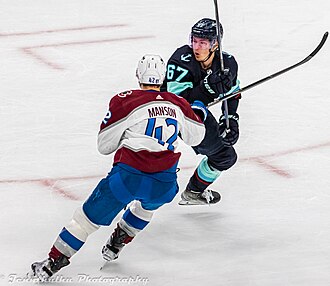
Avs’ Josh Manson Fined $5K for Butt-Ending Incident: A Calculated Risk or Reckless Play?
The NHL Department of Player Safety delivered a verdict on Tuesday that has sparked debate across the hockey world: Colorado Avalanche defenseman Josh Manson has been fined $5,000 for a butt-ending infraction against Minnesota Wild forward Michael McCarron. The incident, which occurred in the first period of Monday night’s Game 4, was a flashpoint in a series that is rapidly slipping away from the Wild.
At first glance, a $5,000 fine—the maximum allowable under the Collective Bargaining Agreement without a hearing—might seem like a slap on the wrist. But in the context of a heated playoff series where emotions run high and every shift matters, this moment reveals much about Manson’s role, the Wild’s frustration, and the razor-thin line between physicality and dangerous play.
The play in question unfolded as Manson and McCarron became tangled along the boards. As McCarron attempted to free himself, Manson appeared to jam the butt end of his stick directly into McCarron’s neck area. The referees immediately assessed a double minor for butt-ending, a penalty that carries significant weight because of the potential for serious injury. The Avalanche, leading the series 3-1 after a 5-2 victory, successfully killed off the penalty, but the damage to Manson’s reputation—and to the series’ physical tone—was already done.
The McCarron Accusation: “He’s a Dirty Player”
McCarron did not mince words in his post-incident interview with ESPN. “He’s a dirty player. He’s always been,” McCarron said during a break in the action. “Surprised he got away with a four-minute (penalty).”
These are strong accusations, especially coming from a player known for his own physical, abrasive style. McCarron, a 6-foot-6, 235-pound forward, is not one to shy away from contact. But his visceral reaction suggests he felt the play crossed a line. The butt-ending technique—where a player uses the top of the stick shaft as a weapon—is universally condemned in the NHL because of its ability to cause severe facial, neck, or eye injuries. The fact that Manson targeted the neck area, a vulnerable and unprotected zone, amplifies the concern.
From an expert perspective, this is a classic example of a player testing the boundaries of playoff officiating. Manson, 34, is a veteran who knows exactly where the line is. He has built a career on being a physical, shutdown defenseman—a role that requires intimidation and net-front presence. But there is a difference between a hard, clean hit and a deliberate, dangerous action with the stick. The NHL’s decision to fine but not suspend Manson indicates they viewed the act as reckless but not premeditated enough to warrant a multi-game ban. However, the Wild will surely argue that a $5,000 fine is a pittance for a player earning $4.1 million annually.
Manson’s Return: A Boost or a Liability?
This incident becomes even more interesting when you consider Manson’s recent history. The defenseman was making his first appearance since April 23 after missing time with an upper-body injury. He had been a key cog in Colorado’s blue line during the regular season, posting 31 points (five goals, 26 assists) and a staggering 91 penalty minutes in 79 games. In the postseason, he has two assists and eight penalty minutes in just four games.
The question for the Avalanche is whether Manson’s physical edge is worth the potential penalty risk. In Game 4, the Avalanche won convincingly, but the Wild’s power play had chances. If Manson had been suspended for a crucial Game 5, Colorado would have been forced to adjust their defensive pairings on short notice. Instead, he will be available, and the $5,000 fine is unlikely to change his aggressive approach.
Let’s break down what Manson brings to the table:
- Physical Presence: He leads the team in hits per game among defensemen this postseason. His ability to clear the crease and disrupt opposing forwards is invaluable.
- Penalty Minutes: His 91 PIMs in the regular season were the most on the Avalanche. He walks a tightrope between effective intimidation and costly penalties.
- Playoff Experience: Manson won a Stanley Cup with Colorado in 2022. He knows the intensity required to win in May and June.
- Injury Concerns: Coming off an upper-body injury, his timing and decision-making might be slightly off, as evidenced by the butt-ending incident.
The Avalanche coaching staff likely accepts Manson’s aggressive style as a necessary evil. In a series against a physical Wild team featuring players like Marcus Foligno and Ryan Reaves, having a defenseman who can match that intensity is a strategic asset. But the line between “effective” and “dangerous” is thin, and Manson has now been officially flagged by the league.
Series Implications: Can the Wild Capitalize on the Narrative?
The Western Conference second-round series currently stands at 3-1 in favor of the Avalanche. Minnesota faces elimination in Game 5 on Wednesday night in Denver. The butt-ending incident and McCarron’s subsequent comments have added a layer of animosity to an already tense series.
For the Wild, the narrative of Manson being a “dirty player” serves a dual purpose. First, it galvanizes their locker room. When a team feels wronged, they often play with a heightened sense of purpose. Second, it puts pressure on the officiating crew. If the referees are aware of the heightened tension, they might be more inclined to call marginal penalties on Manson early in Game 5, which could put the Avalanche on their heels.
However, history suggests that playoff fines rarely alter a player’s behavior. Manson will likely continue to play on the edge. The key for the Wild is to draw penalties by being the agitator themselves. If McCarron or another forward can bait Manson into a retaliatory penalty, Minnesota’s power play—which has been inconsistent in this series—could finally find its rhythm.
Expert Prediction: The Avalanche will close out the series in Game 5. They are the deeper team, have home-ice advantage, and possess the best player in the series in Nathan MacKinnon. However, the physical toll of this series, highlighted by the Manson-McCarron feud, could carry over into the next round. If the Avalanche face a team like the Dallas Stars or Edmonton Oilers, they will need Manson to be disciplined while still being a physical force. The $5,000 fine is a warning, not a suspension. The real test will come if Manson has another borderline play later in the playoffs.
Conclusion: A Costly Reminder in a Physical Series
The $5,000 fine handed to Josh Manson is the NHL’s way of saying, “We see you, and we don’t approve.” But in the high-stakes world of the Stanley Cup Playoffs, it is unlikely to change the course of this series. The Avalanche are in the driver’s seat, and Manson’s physicality—while occasionally crossing the line—remains a vital component of their championship formula.
For Michael McCarron and the Wild, the incident serves as a rallying cry. They can point to Manson’s fine as proof that the Avalanche are playing on the edge, and they can use that as motivation to stave off elimination. But ultimately, hockey games are won with goals, not fines. The Avalanche have the firepower. The Wild have the desperation. And Josh Manson has a lighter wallet and a target on his back.
As the series shifts back to Denver, all eyes will be on No. 42. Will he play with controlled aggression, or will he become a liability? One thing is certain: the Wild will be testing him early and often. The $5,000 fine is paid. The real price will be measured in wins and losses.
Source: Based on news from Deadspin.
Image: CC licensed via commons.wikimedia.org