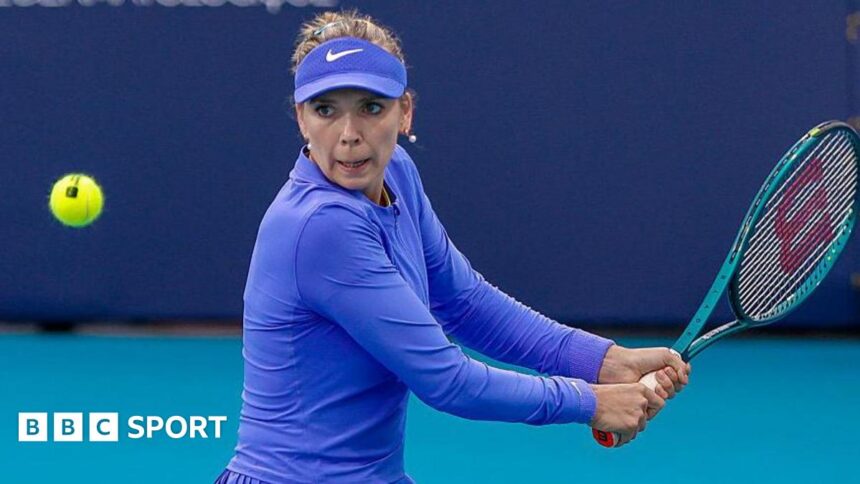
Boulter’s Austrian Hopes Dashed in Tight Linz Opener Against Ruse
The clay courts of the Upper Austria Ladies Linz Open delivered a classic, nerve-shredding encounter on Tuesday, but for Britain’s Katie Boulter, it ended in a frustrating first-round exit. The world number 62, seeded eighth at the WTA 250 event, fell in a nail-biting duel to Romania’s Elena-Gabriela Ruse, succumbing 7-6( ), 7-6( ) in a match where mere points decided the outcome. In a contest defined by momentum swings and resilient comebacks, Boulter’s inability to capitalize on key moments saw her journey in Linz end before it could truly begin, while Ruse celebrated a significant victory over a higher-ranked opponent.
A Tale of Two Tie-Breaks: The Match Narrative
From the outset, the match was a rollercoaster. Boulter, typically reliant on a potent first serve and aggressive baseline play, suffered an uncharacteristically shaky start. She was broken in her opening two service games, handing Ruse an early cushion. However, demonstrating the fighting spirit that has become her trademark, the British number three clawed her way back into the set, breaking Ruse’s serve twice to level the contest. The set inevitably marched towards a tie-break, where the Romanian’s consistency under pressure proved decisive, edging it to seize the early advantage.
Undeterred, Boulter responded emphatically at the start of the second set. She secured an immediate break of serve, suggesting a momentum shift and the potential for a deciding third set. Yet, in a pattern that would define the afternoon, her lead was instantly erased as Ruse broke straight back. What followed was a see-saw encounter with both players holding serve under duress, creating a mirror image of the first set. Once again, a tie-break was required to separate them, and once again, it was Elena-Gabriela Ruse who held her nerve in the crucial mini-break exchanges, sealing the match in straight sets after over two hours of intense battle.
Expert Analysis: Where the Match Was Won and Lost
While the scoreline suggests a match of fine margins—which it undoubtedly was—a deeper look reveals key areas that tilted the balance in Ruse’s favor. For Boulter, this loss will be a case of missed opportunities and rhythm disrupted.
- Service Game Inconsistency: Boulter’s normally reliable serve was a vulnerability. The loss of her first two service games set a difficult tone, and while she recovered, she finished with a lower first-serve percentage than desired on clay, where constructing points is paramount.
- Clay Court Adaptation: The surface in Linz posed a specific challenge. Ruse, with her heavier topspin and comfort in longer rallies, often dictated the pace from the baseline. Boulter’s flatter, more aggressive strokes can be lethal on hard courts but require precise timing on clay, where the ball sits up slower and higher.
- Clutch Point Performance: Ultimately, the match was decided in the two tie-breaks. These high-pressure moments are a test of mental fortitude and tactical clarity. Ruse, ranked 87th but a former top 50 player, showcased her experience, playing disciplined, low-error tennis when it mattered most. Boulter’s aggression tipped into unforced errors at the critical junctures.
- Ruse’s Resilient Response: Credit must go to the Romanian. Every time Boulter threatened to build momentum—most notably after breaking early in the second set—Ruse responded instantly. This psychological blow prevented Boulter from ever settling into a dominant rhythm.
Implications and Looking Ahead: The Road to Wimbledon
This first-round defeat is a setback for Boulter’s immediate momentum. As the British number three, and with significant ranking points to defend in the coming months, early exits in manageable tournaments like Linz are costly. Her primary goal will be solidifying a seeding position for the Grand Slams, particularly Wimbledon, where the spotlight and expectations will be immense.
For Elena-Gabriela Ruse, this victory is a timely boost. She advances to the last 16 where she will face either Ukraine’s powerful Dayana Yastremska or American Ann Li. A run here could see her push back towards the top 70, a crucial zone for direct entry into bigger events. Her victory over Boulter signals a return to form and confidence on a surface she favors.
For Boulter, the focus must quickly shift to the broader clay-court season. The path to grass is paved with red dirt, and accumulating match wins and ranking points on this surface is essential. Her game, built on confidence and first-strike tennis, requires match rhythm. Early exits disrupt that flow. The coaching team will likely work on reinforcing her service patterns and developing more margin on her groundstrokes for the clay, ensuring she can transition her power effectively across all surfaces.
Conclusion: A Stumble, Not a Fall
Katie Boulter’s exit at the Upper Austria Ladies Linz Open is a disappointment, but not a disaster. The nature of the WTA Tour is defined by these razor-thin matches, where a single point can swing a set and a match. Her performance against Elena-Gabriela Ruse highlighted both her resilience—fighting back from multiple deficits—and the clear areas for improvement needed to consistently challenge on clay.
This match serves as a stark reminder that in modern tennis, ranking numbers often tell only half the story. Ruse, a capable and experienced competitor, brought her best tennis on the day and executed in the moments that carried the most weight. For Boulter, the journey continues. The lessons from Linz—on maintaining focus after a break, adapting tactics to the surface, and winning the psychological battles within tie-breaks—will be invaluable as she navigates the demanding European spring, with the lawns of Wimbledon gleaming on the horizon. The defeat is a stumble in her 2024 campaign, but for an athlete of her caliber, it is the response that will define the chapters to come.
Source: Based on news from BBC Sport.