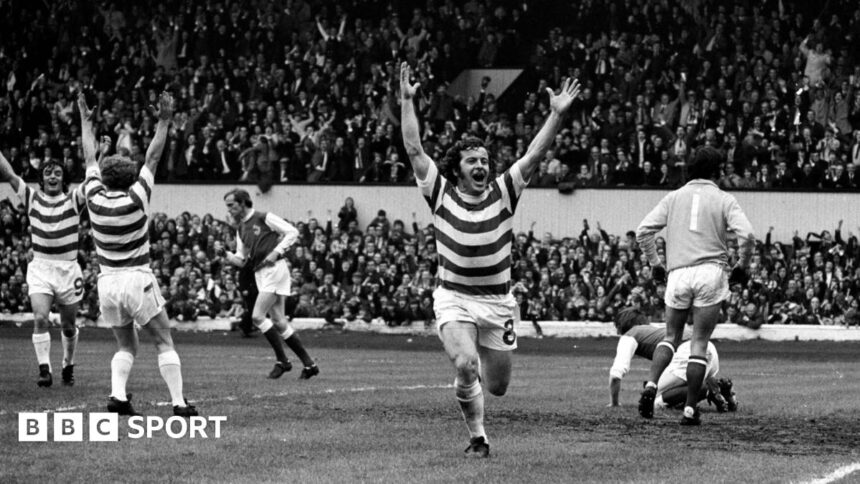
Celtic Mourns the Loss of Goalscoring Legend Dixie Deans at 79
The world of Scottish football is in mourning following the announcement that Celtic icon John ‘Dixie’ Deans has passed away at the age of 79. A figure whose name became synonymous with predatory instinct and unwavering passion, Deans’ legacy is etched not just in the trophy cabinets of Parkhead, but in the memories of a generation who witnessed a striker born to score. His passing marks the end of an era for a player whose journey from junior football to Celtic immortality is the stuff of legend.
From Juniors to Juggernaut: The Making of ‘Dixie’
The nickname said it all. Born John Deans, he was dubbed ‘Dixie’ after the legendary Everton and England goalscorer Dixie Dean, a moniker earned through a staggering haul of 60 goals in a single season for Neilston Juniors. This was not hyperbole, but a prophecy of what was to come. His raw talent soon demanded a professional stage, and in 1965, Motherwell secured his signature.
At Fir Park, Deans’ reputation as a prolific goalscorer was solidified. He netted 89 times in 198 appearances, a remarkable rate of consistency. His goals were instrumental in firing Motherwell to the Second Division title in the 1968-69 season, showcasing the kind of big-game temperament that would soon attract the attention of Scotland’s biggest club. It was here that the blueprint of the Dixie Deans story was drawn: a relentless, physical presence in the box, possessed of a sharp footballing brain and an unerring ability to be in the right place at the right time.
A Celtic Hero Forged in Goals and Glory
In 1971, Jock Stein, the architect of Celtic’s greatest era, saw in Deans the final piece of his attacking puzzle. The move to Celtic was a step into the cauldron of expectation, but Deans thrived under the pressure. He wasn’t the silky stylist of a Jimmy Johnstone, but his effectiveness was undeniable. He formed a formidable and feared partnership with the likes of Kenny Dalglish, his selfless running and aerial prowess creating space and chances, while his own finishing remained lethally sharp.
His Celtic career was decorated with six major trophies, a testament to his role in a dominant side. His contribution, however, is best measured in moments of sheer, unadulterated joy he delivered to the Celtic support:
- The 1972 Scottish Cup Final Hat-Trick: In a display of pure centre-forward play, Deans demolished Hibernian with a trio of goals, securing the cup in a 6-1 rout and writing his name into final folklore.
- Title-Deciding Clinchers: On multiple occasions, it was Deans’ crucial, late-season goals that sealed league championships, embodying the nerve and quality required of a Celtic striker.
- European Nights: While European Cup glory ultimately eluded that generation, Deans was a constant threat on the continent, his goals helping propel Celtic through numerous tough encounters.
Though capped only twice by Scotland, a reflection of the fierce competition of the era, his status at club level was never in doubt. He was a player built for the Celtic jersey—combative, passionate, and devastatingly productive.
Expert Analysis: The Enduring Legacy of a Prototype Number Nine
Analyzing Dixie Deans’ game through a modern lens reveals the timeless value of a classic number nine. In an age increasingly focused on false nines and fluid systems, Deans represented the quintessential target man. His game was built on fundamentals: intelligent movement, strength in hold-up play, and a ruthless finish with either foot or head. He was the focal point around which Celtic’s intricate, attacking football could revolve.
His legacy extends beyond statistics. Deans represented a bridge between the Lisbon Lions era and the teams that followed, ensuring the club’s winning mentality never dimmed. He played with a palpable love for the club and its fans, a connection that was fervently reciprocated. In today’s football, where the physical and psychological demands are scrutinized, Deans’ career is a masterclass in resilience and consistency. He absorbed the pressure of leading the line for Scotland’s most demanding club and responded not with flash, but with a relentless barrage of goals and effort.
His nickname, linking him to English football’s greatest ever goalscorer, was not a burden but a badge of honour he wore with every goal he scored. He made it his own in the green and white hoops.
Predictions: How History Will Remember a Celtic Great
As the tributes pour in, the historical assessment of Dixie Deans is clear and secure. He will be remembered not as a fleeting star, but as a foundational pillar of 1970s Celtic. In the coming days and years, his story will be told in the stands and in the club’s museum. We predict a strengthening of his legend in three key ways:
- Canonization in Celtic Folklore: Deans will be permanently enshrined alongside the other giants of the post-Lisbon era. His 1972 cup final performance alone guarantees his place in any highlight reel of Celtic’s greatest moments.
- A Benchmark for Future Strikers: While styles change, the requirement for a goalscorer remains. Future Celtic strikers will be measured not just against his goal tally, but against his unwavering commitment and knack for decisive contributions.
- Enduring Symbol of an Era: His career encapsulates a period where Scottish football commanded immense respect. His battles with rival defenders symbolize a physically intense, technically proficient, and passionately supported domestic game.
The modern Celtic fan, watching a team that dominates domestic football, will see in Dixie Deans the prototype of the player who turns dominance into silverware—the ultimate difference-maker.
Conclusion: A Final Salute to a True Hoops Hero
The passing of John ‘Dixie’ Deans leaves a void in the heart of Celtic Football Club. He was more than a statistic; he was a force of nature in the penalty area, a winner, and a beloved character who understood the profound privilege of representing Celtic. From the junior pitches to the trophy-laden fields of Hampden, his journey was fueled by an innate talent for scoring goals and a profound love for the game.
In an era of giants, Dixie Deans stood tall. His six major trophies with Celtic are a testament to his quality, but his true monument is the enduring affection of the support. He played with a smile, scored with gusto, and fought for every ball as if his life depended on it. As Celtic and the wider football world say farewell, we remember not just the player, but the legend: Dixie Deans, a true and timeless Celtic hero. Rest in peace.
Source: Based on news from BBC Sport.