NFL Admits Officiating Error in Ravens’ Loss to Steelers, Harbaugh Reveals
The margin between victory and defeat in the NFL is often razor-thin, a truth the Baltimore Ravens felt with acute pain after a 27-22 loss to the Pittsburgh Steelers. While the final score is etched in the record books, the post-game narrative has been dominated by yellow flags and their consequences. In a stunning revelation, Ravens head coach John Harbaugh disclosed that the NFL league office admitted to a critical officiating error that directly contributed to a pivotal Steelers touchdown. This admission, however, offers no solace in the standings, turning a tough divisional loss into a case study on the human element—and its flaws—in professional officiating.
A Costly Admission: The League’s Monday Morning Mea Culpa
During his standard Monday press conference, John Harbaugh provided unprecedented transparency into the league’s internal review process. He revealed that he, General Manager Eric DeCosta, and former referee Tony Michalek held a call with NFL senior vice president of officiating administration Perry Fewell and former referee Walt Anderson. The purpose: to review three crucial calls from the game’s final minutes. Harbaugh believed his team got two of those late calls correct. The league disagreed on those. But the most damning conclusion came on a third, earlier play—one the Ravens got absolutely right, and the officials got wrong.
Perry Fewell acknowledged that the unnecessary roughness penalty called on Ravens defensive tackle Travis Jones late in the second quarter was incorrect. The penalty occurred as Pittsburgh attempted a field goal. Jones, rushing between the snapper and guard, made contact with long snapper Christian Kuntz. The flag thrown by Alex Moore’s crew was for forcible contact to the head or neck area.
- The Sequence: Chris Boswell’s made field goal was nullified by the penalty.
- The Gift: Instead of a 13-3 deficit, the Steelers were awarded first-and-goal at the 6-yard line.
- The Result: Pittsburgh scored a touchdown on the next play, turning a 10-point game into a 17-3 chasm just before halftime.
“It wasn’t forcible contact to the head or neck area,” Harbaugh stated, relaying the league’s position. This single admission transformed a potential 10-point halftime deficit into a 14-point one, a monumental swing in a game ultimately decided by five points.
Beyond the Admission: The Late-Game Reversals and a Coach’s Frustration
While the Travis Jones penalty was a clear error, the late-game decisions formed the chaotic climax. Two potential game-changing calls were initially ruled in Baltimore’s favor on the field, only to be reversed after replay reviews. The first was a fumble by Steelers quarterback Kenny Pickett, recovered by the Ravens, that was overturned to an incomplete pass. The second was a catch-and-fumble by Pittsburgh’s Pat Freiermuth that was also overturned, ruled an incomplete pass.
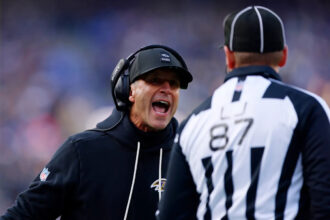
Harbaugh’s contention was that both plays lacked the “indisputable visual evidence” required to overturn the initial call on the field. The NFL, in its call with the Ravens, maintained the reversals were correct. This left Harbaugh in a philosophical, yet clearly frustrated, position. “I thought we had two out of three,” he said of the late calls, referencing his pre-review belief. “It turns out we had zero out of three, and they had zero out of three on the other one [the Jones penalty] earlier.” This statement underscores the core frustration for teams: the subjective nature of replay and the impossibility of correcting every mistake, even when the league privately acknowledges them.
Expert Analysis: The Ripple Effect of Officiating Errors
From an analytical standpoint, the admitted error on the Travis Jones penalty is a textbook example of how a single flag can warp a game’s entire strategic landscape. The four-point swing (removing a field goal and awarding a touchdown) is significant, but the deeper impact is psychological and tactical.
First, it robbed the Ravens’ defense of a critical stop before halftime, deflating a unit that had forced a field goal attempt. Second, it altered the Steelers’ play-calling for the rest of the game, allowing them to play with a larger lead and lean on their defense. Third, and perhaps most importantly, it forced the Ravens to play catch-up in a more desperate, one-dimensional fashion in the second half, playing directly into the strengths of the Steelers’ pass rush. While Baltimore mounted a furious comeback, the energy expended and the risks required were a direct product of that 14-point hole—a hole partially dug by an errant flag.
This incident also reignites the perennial debate about the NFL’s officiating accountability system. Private admissions to teams do nothing to alter outcomes or inform the public. The league’s “Next Gen Stats” for officiating remain shrouded in secrecy, unlike the very public player performance metrics they promote.
Predictions: What This Means for the Ravens and NFL Officiating
The immediate ramifications for the 2024 season are clear. In the hyper-competitive AFC North, a single loss can decide the division. This five-point loss, now shadowed by the league’s admission, could haunt Baltimore’s playoff seeding come January. For John Harbaugh and his staff, the challenge is to channel the justifiable frustration into focus, ensuring that a controversy in Week 5 doesn’t lead to a hangover in Week 6.
Looking at the broader picture for the NFL, this event will increase pressure on the league to reform its communication around officiating. The current model—where errors are confirmed in private calls but rarely in public—breeds fan cynicism and coach frustration. We may see:
- Increased advocacy for a more transparent “pool report” system where key adjudications are explained publicly by the league office, not just the referee on the field.
- Renewed discussion about expanding replay or coach’s challenges for certain penalty types, though the league has historically resisted this.
- A heightened spotlight on the performance of Alex Moore’s crew, which will be under a microscope in its upcoming assignments.
For the Ravens, the path forward is the same as it ever was: control what they can control. But this episode is a stark reminder that in today’s NFL, controlling one’s own destiny is sometimes subject to the judgment of a third party—a judgment that, even when later acknowledged as faulty, is irrevocable.
Conclusion: No Flags for Accountability
The NFL’s admission to John Harbaugh is a rare peek behind the curtain, confirming what fans often suspect: games of immense consequence can be altered by incorrect calls. The penalty on Travis Jones was, by the league’s own post-game analysis, a mistake that led directly to a touchdown. Yet, the Ravens’ record bears the loss without an asterisk. This incident crystallizes the central conflict in modern NFL officiating: the pursuit of perfect accuracy through technology and review, forever at odds with the inherent, human fallibility of the initial call. The league can identify its errors, but until it finds a way to meaningfully correct them—or at least publicly account for them with more than a private phone call—the bitterness of losses like Baltimore’s will continue to be compounded by the hollow ring of “we got it wrong.” For the Ravens, the only consolation is the knowledge that their protest was valid. In the standings, however, that knowledge is worth exactly zero points.
Source: Based on news from Deadspin.
Image: CC licensed via commons.wikimedia.org