Charles Lee Apologizes for ‘Foolish’ Collision with LaMelo Ball: A Coach’s Candid Moment of Accountability
In the high-stakes, meticulously choreographed world of the NBA, chaos is a constant. But rarely does it arrive from the sideline, wearing a suit. In a bizarre and frightening moment during the Charlotte Hornets’ 102-95 victory over the New Orleans Pelicans on Monday, first-year head coach Charles Lee became an unwilling participant in the action, colliding head-first with his franchise cornerstone, LaMelo Ball. The incident, which could have derailed a crucial win and injured the team’s most important player, instead became a powerful lesson in accountability, leadership, and the razor-thin margins that define professional basketball.
The Sideline Collision That Silenced the Arena
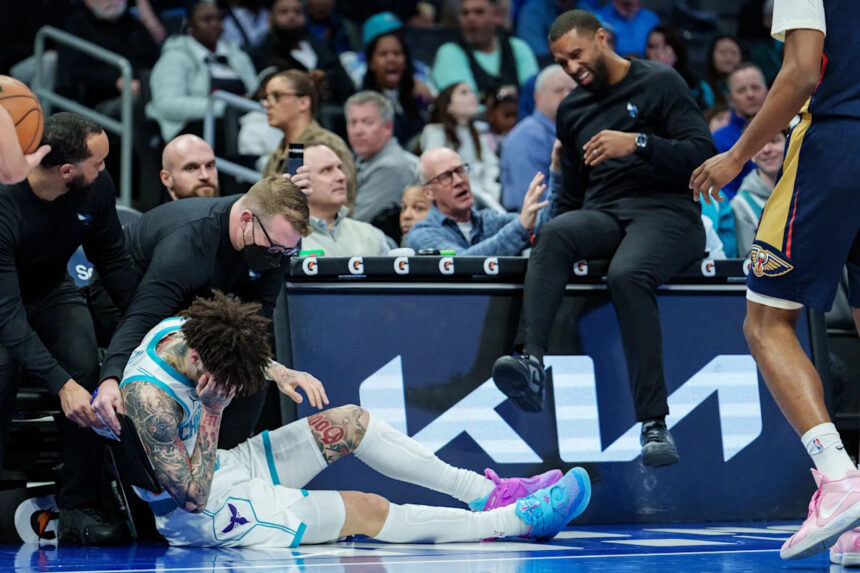
The play unfolded with the kind of mundane inevitability that precedes most accidents. A loose ball trickled toward the sideline near the scorer’s table. From one angle, LaMelo Ball, the Hornets’ electric point guard, lunged with his trademark reckless abandon, determined to save possession. From the other, Coach Charles Lee, instinctively moved to prevent the ball from sailing into the stands. Their trajectories converged in a sickening instant. The two slammed directly into each other, a full-speed, head-to-head collision that echoed through a suddenly hushed Spectrum Center.
The aftermath was immediate and concerning. Ball crashed to the hardwood, grabbing his head. Lee, looking dazed and banged up, stumbled backward. For Hornets fans, it was a nightmare scenario: their star player and their new leader taken out by each other. Ball eventually rose and, after a brief trip to the locker room for evaluation, remarkably returned to finish the game. The Hornets secured the win, but the post-game conversation was irrevocably shifted.
“I Took a Play Off”: A Coach’s Unfiltered Mea Culpa
In the aftermath, Charles Lee didn’t hide behind clichés or deflect blame. He stood before the media and delivered a masterclass in personal accountability. His analysis was blunt and self-critical.
“I took a play off, and you’re not supposed to take any plays off,” Lee stated, framing his instinctual coaching error in the same terms he would use for a player’s mental lapse. “I thought the ball was going out of bounds. I was gonna save it from going into the stands, and he was going to save the ball. We went head-to-head.”
This simple explanation carried profound weight. Lee, a respected longtime assistant known for his defensive intensity and preparation, held himself to the exact same standard he demands from his roster. He acknowledged the inherent danger of the moment and extended a direct apology to his player. “Credit to him, he didn’t yell at me too bad. I apologized, obviously,” Lee added, revealing a moment of levity and relief within the serious admission.
Beyond the Bump: Leadership in the Modern NBA
While the collision was a physical accident, Lee’s handling of it was a deliberate leadership decision. In an era where coaches often project an image of unflappable control, Lee’s vulnerability was refreshing and strategically astute. His public apology served multiple crucial purposes:
- Building Trust: By openly admitting fault, Lee reinforces a culture of mutual accountability. It signals to the team that no one, not even the head coach, is above owning their mistakes.
- Protecting the Asset: The swift and sincere apology publicly defused any potential tension with Ball, the team’s max-contract superstar. It turned a potentially fractious moment into a unifying, albeit unusual, team story.
- Setting the Tone: The “no plays off” mantra is a core coaching philosophy. By applying it to himself in such a visible way, Lee cemented its importance for every player on the roster.
This incident also highlights the intense, all-consuming nature of coaching from the sidelines. The best coaches are not passive observers; they are emotionally and physically invested in every possession. Lee’s instinct to save the ball, while misguided in execution, stemmed from that same hyper-competitive drive he wants from his players.
Looking Ahead: Implications for the Hornets’ Season
Fortunately, LaMelo Ball emerged unscathed and played normally upon his return. The long-term impact of this event, therefore, is more psychological than physical. For a franchise embarking on a new era under Lee, this bizarre moment could paradoxically become a foundational brick in building team chemistry.
Prediction 1: A Strengthened Player-Coach Bond. Shared, albeit painful, experiences can forge stronger connections. Ball now sees a coach who will literally put his body on the line (even if mistakenly) and who will own up to errors without hesitation. This builds a currency of respect that pays dividends during tough stretches of the season.
Prediction 2: The Birth of a Team Mantra. “Don’t take plays off—just ask Coach Lee.” This has all the makings of an internal rallying cry, a humorous but pointed reminder of the focus required. It’s a story that will be retold in locker rooms and huddles, serving as a unique touchstone for the team’s identity.
Prediction 3: Increased Sideline Awareness. Expect Lee and his staff to have a newfound, almost humorous, spatial awareness on the sideline. While his energy will remain, there will likely be a subconscious calculation to avoid a repeat. Players, too, may give the coaching box a wider berth when chasing loose balls.
Conclusion: A Lesson in Accountability, Not Just Athletics
The image of a coach and his star player colliding is a surreal one, a moment of pure, unscripted folly in a league of incredible athleticism. Yet, from that folly, Charles Lee extracted a clear lesson in leadership. His immediate and unequivocal apology transformed a potential crisis into a teachable moment. He demonstrated that true strength lies not in infallibility, but in the willingness to stand up and say, “That was my fault.”
For the Charlotte Hornets, a team striving for consistency and a return to relevance, this incident may be remembered as more than a blip on the highlight reel. It was the day their coach, in his zeal and subsequent humility, showed exactly what he stands for. In the end, the Hornets didn’t just win a game against the Pelicans; they may have gained something more valuable: a solidified standard of responsibility, set not by a lecture, but by a head coach who took one for the team—literally.
Source: Based on news from Yahoo Sports.