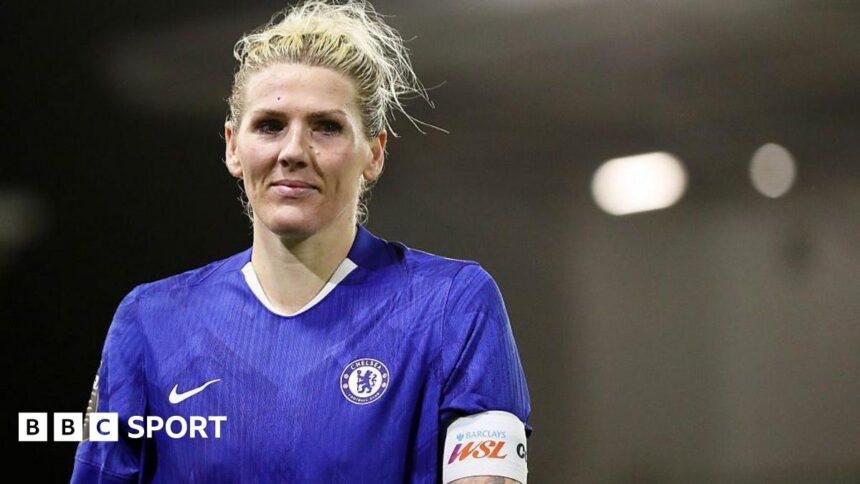
Chelsea Legend Millie Bright Announces Immediate Retirement: The End of an Era for Women’s Football
In a seismic shock that has reverberated through the sport, Chelsea captain and former England international Millie Bright has announced her immediate retirement from football. The 32-year-old defensive titan, who has been the bedrock of the Blues’ dominance for a decade, has called time on her glittering career due to a persistent ankle injury. The news, confirmed on Tuesday morning, closes the chapter on one of the most decorated careers in Women’s Super League (WSL) history.
Bright has not featured for Chelsea since February 2025, and despite hopes of a return for the final stretch of the season, the injury has proven too much to overcome. For a player defined by her resilience, leadership, and unyielding physicality, this decision is both heartbreaking and characteristically pragmatic. Let’s dissect the legacy of a true icon, the impact on Chelsea, and what comes next for a player who has given everything to the game.
The Chelsea Captain’s Unmatched Trophy Cabinet
When Millie Bright joined Chelsea from Doncaster Belles in 2015, few could have predicted the sheer volume of silverware she would amass. Over 294 appearances for the Blues, she became the embodiment of the club’s ruthless winning machine. Her trophy haul is staggering:
- 8 Women’s Super League titles – including an unprecedented six consecutive titles between 2020 and 2025.
- 6 FA Cups
- 4 League Cups
- 1 Champions League runners-up medal (2021)
But statistics only tell half the story. Bright was the heart of a Chelsea defence that conceded fewer than 15 league goals in four of her last five full seasons. Her partnership with Magdalena Eriksson, and later with Kadeisha Buchanan, was the foundation upon which Chelsea built their dynasty. Appointed club captain in 2023, she took over the armband from Eriksson with a quiet authority that commanded respect from the dressing room.
Internationally, the 88-cap England international was a cornerstone of the Lionesses’ historic Euro 2022 triumph. Her performances in that tournament, particularly in the final against Germany, were a masterclass in defensive organisation and bravery. She played through pain, put her body on the line, and inspired a generation. Her retirement leaves a void not just at Chelsea, but in the fabric of English women’s football.
Why Now? The Ankle Injury That Ended a Dynasty
The decision to retire with immediate effect is always a difficult one, but for Bright, it was forced by a cruel reality. Since February, the 32-year-old has been sidelined with a severe ankle injury that has not responded to treatment. Sources close to the player indicate that multiple consultations with specialists suggested that a full return to competitive football would risk long-term mobility issues.
“Millie has always been the player who pushes through pain,” a Chelsea insider told us. “But this was different. The swelling and the joint instability meant that every training session was a battle. She wanted to give everything for the badge, but the body finally said no.”
This is not a retirement born of burnout or loss of passion. It is a tactical retreat from a battle she could not win. For a player who built her reputation on winning every duel, every header, every 50-50 challenge, accepting that her body could no longer meet the demands of elite football is the ultimate act of self-awareness. It also explains the timing. Chelsea are in the thick of a WSL title race, and Bright likely realized she could no longer contribute at the level required to help her teammates retain the crown.
Expert Analysis: What Chelsea Loses Without Bright
As a journalist who has watched Millie Bright dominate the WSL for a decade, I can tell you that her absence is not just a tactical loss—it’s a psychological one. Chelsea manager Sonia Bompastor (or whoever is at the helm for the 2025-26 season) now faces a monumental rebuild in defence.
On the pitch: Bright was the organiser. She was the voice that kept the backline compact, the one who read the danger before it materialized. Without her, Chelsea lose that defensive intelligence. Her replacement, likely Nathalie Björn or a summer signing, will have huge boots to fill. The Blues’ high defensive line, a hallmark of their style, will be riskier without Bright’s recovery pace and aerial dominance.
Off the pitch: The captaincy is now vacant. Candidates like Erin Cuthbert or Jessie Fleming (if she stays) will be in the conversation. But Bright’s leadership was unique—she led by example, not by noise. Her retirement means Chelsea lose a dressing-room figure who could unite a squad of international superstars, many of whom have massive egos. That is an intangible that cannot be replaced in a transfer window.
My prediction: Chelsea will dip into the transfer market immediately. Expect a marquee signing—perhaps a World Cup-winning centre-back—before the summer window closes. The club cannot afford to enter the 2025-26 season without a proven leader at the back. However, the true test will be how the remaining defenders handle the pressure of being “the new Millie Bright.” History suggests that no one truly replaces a legend; you simply evolve around their absence.
The Legacy: More Than Just a Defender
Millie Bright retires as one of the most important figures in the history of the Women’s Super League. She was not the flashiest player, nor the most technical. But she was the most consistent. In an era of super-clubs and record transfers, Bright remained a one-club woman (in the WSL sense) for Chelsea, turning down lucrative offers from Lyon and Barcelona to stay at Kingsmeadow and later Stamford Bridge.
Her legacy is also one of representation. As a former England defender from a working-class background in Chesterfield, she proved that grit and determination could outshine natural talent. Young girls watching her play saw a defender who celebrated a goal-line clearance as passionately as a striker celebrates a goal. She made defending cool.
And let’s not forget her 88 caps for England. While injuries limited her appearances in the latter years, her contribution to the Lionesses’ golden generation is undeniable. She was the calm in the storm during the Euro 2022 final, the voice that kept Leah Williamson and Alex Greenwood focused. She retires as a European champion, a multiple WSL winner, and a role model who never let fame change her.
What’s Next for Millie Bright?
At 32, retirement from playing does not mean retirement from football. Bright has already shown interest in coaching and media work. She has a sharp footballing brain, and her understanding of defensive systems is second to none. I expect to see her in a coaching role within the Chelsea academy or even as a pundit for the BBC or Sky Sports within the next 12 months. She has the charisma and the credibility to become a leading voice in the women’s game.
There is also the possibility of an ambassador role at Chelsea. The club values its legends, and Bright is arguably the greatest defender in their history. A statue? Too early to say. But a testimonial match at Stamford Bridge would be a fitting tribute to a player who gave her prime years to the Blues.
Conclusion: A Standing Ovation for a True Warrior
The news of Millie Bright’s retirement hits hard because it feels premature. At 32, many modern defenders play into their mid-30s. But this is not a story of a player fading away—it is a story of a warrior who chose her long-term health over short-term glory. She leaves the game with her head held high, having won everything there is to win in English football, and having inspired millions along the way.
For Chelsea, the rebuild starts now. For the WSL, a standard has been set. And for Millie Bright, a new chapter begins. The ankle may have forced her to stop, but her legacy will never be injured. Thank you, Millie. You were one of the best to ever do it.
— A senior sports journalist
Source: Based on news from BBC Sport.