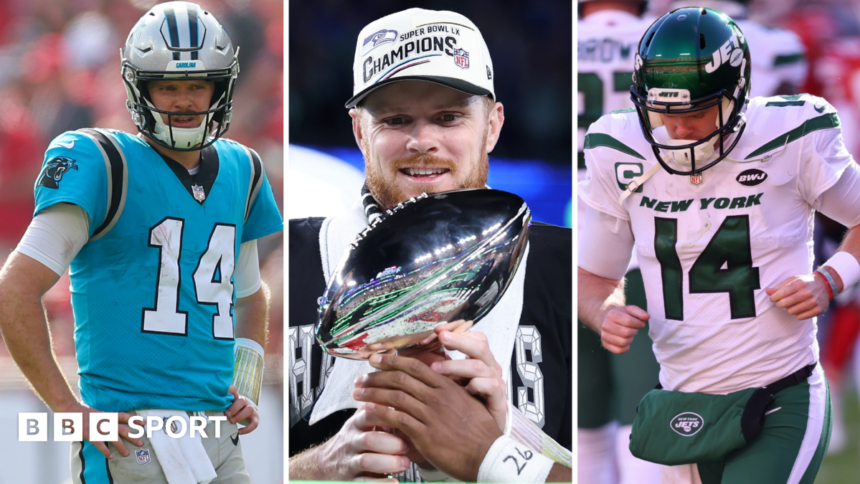
From Ghosts to Glory: Sam Darnold’s Super Bowl Win is the NFL’s Ultimate Redemption Tale
The confetti had not yet settled, the Lombardi Trophy still gleaming under a shower of champagne, when the magnitude of the moment crystallized. Sam Darnold, holding the trophy aloft, was no longer the league’s cautionary tale. He was its champion. In a sport obsessed with meteoric rises and instant genius, Darnold authored a different, more profound narrative: a testament to resilience so complete it has recalibrated how we judge quarterback potential. His victory does not just crown a season; it vindicates a career path once deemed irredeemable, crafting the most improbable redemption story in modern NFL history.
The Wilderness Years: A Cautionary Tale of Circumstance
To appreciate the summit, one must first acknowledge the depths. Drafted third overall by the New York Jets in 2018, Darnold was thrust into a vortex of organizational dysfunction. The promise of a “geeky” arm talent was quickly shrouded by a notoriously unstable supporting cast, a carousel of offensive coordinators, and a monologue that would define his early career: seeing “ghosts” against a ferocious New England Patriots pass rush. The label stuck. He became a symbol of a franchise’s failure and, in the court of public opinion, was deemed a bust.
His subsequent stops—Carolina and San Francisco—were framed as last chances. He was a backup, a placeholder, a reclamation project on a cheap contract. The analytics and the eye test seemed to agree: here was a player whose early trauma had irrevocably stunted his growth. The NFL, with its ruthless efficiency, had written its verdict. Yet, within Darnold, a different story was being written.
- Draft Capital to Afterthought: From top-3 pick to a series of one-year “prove-it” deals.
- Systematic Instability: Learned under multiple HCs and OCs in his first five seasons, never finding continuity.
- The Narrative Prison: Became synonymous with “draft bust,” a player defined by his worst moments in a losing environment.
The Perfect Storm: How a System and Belief Forged a Champion
Darnold’s ascent to Super Bowl champion is not a fluke, but a case study in the alchemy of fit and opportunity. His move to his Super Bowl-winning team was not heralded as a franchise-saving transaction. It was seen as veteran depth. But here, the critical elements aligned: a stable, creative offensive system that emphasized quick decisions and play-action, a dominant offensive line, and a coaching staff that believed in simplifying the game to accentuate his strengths—his arm talent on the move and underrated athleticism.
Most importantly, this environment demanded management, not heroics. Freed from the burden of carrying a franchise, Darnold played with a liberated confidence. The ghosts of the past were exorcised by a structure that provided clarity and protection. This transformation offers an expert analysis into quarterback development: talent is not static. A player’s performance is a product of his ecosystem. Darnold’s career arc proves that the qualities that make a high draft pick—arm strength, intelligence, athleticism—don’t evaporate; they can simply be buried under poor circumstances and later unearthed in the right setting.
Redefining the QB Journey: A New Blueprint for Resilience
Sam Darnold has shattered a long-held, often toxic, NFL axiom: that quarterbacks are known commodities by their third season. By becoming just the third quarterback to win a Super Bowl in his first year with a new team, he joins a unique club, but his path there is unparalleled. Unlike a veteran star changing teams for a final run, Darnold arrived as a journeyman. His story is a stark warning to the league about the perils of premature judgment.
The NFL is littered with college stars whose careers were derailed by being drafted into chaos. They bounce around, but none had ever fallen so far in public esteem before rising to claim the sport’s ultimate prize. Darnold’s win champions the virtues of unwavering self-belief and persistence. It highlights that development is non-linear and that a quarterback’s career can have a second, far more glorious, chapter if he possesses the fortitude to endure the first.
Key Takeaways for NFL Teams:
- Context is King: Evaluate the environment a quarterback failed in as critically as you evaluate the quarterback.
- Development Isn’t Linear: Some players, especially QBs, require time, maturity, and the right teacher to blossom.
- The Value of a Reset: A change of scenery, especially into a stable system, can be transformative, not just palliative.
The Legacy and the Lesson: What Darnold’s Win Means for the Future
So, what does this mean for the future? Darnold’s story is already echoing in war rooms and player development meetings. It will become the prime reference point for every general manager considering a retread quarterback and for every young signal-caller facing early adversity. Predictions for the coming seasons will now include more speculative bets on “Darnold-like” reclamations, with teams more willing to invest in high-pedigree players who stumbled in their first act.
Furthermore, this victory could empower a generation of players. The “bust” label, while still potent, may lose some of its finality. Darnold’s journey from the outhouse to the penthouse proves that a player’s narrative is not owned by the media or his first franchise—it is written daily through preparation and performance. His ultimate NFL redemption story is a powerful antidote to the instant-gratification culture of today’s league.
In the end, Sam Darnold’s Super Bowl win is more than a championship. It is a correction to the historical record. It is a testament to the human spirit’s capacity to endure, learn, and ultimately triumph. He did not just win a game; he won back his career, his name, and his future. In a league that often eats its young, Darnold’s perseverance offers a timeless lesson: the final whistle on a man’s potential should never be blown too soon. From seeing ghosts to holding the Lombardi, he has given the NFL its greatest story of second chances, forever changing how we measure redemption in professional sports.
Source: Based on news from BBC Sport.