The Prestianni Affair: Benfica’s ‘Defamation Campaign’ Defense Meets UEFA’s Racism Investigation
The beautiful game is once again marred by an ugly stain. In the aftermath of a fiery Champions League clash between Benfica and Real Madrid, a singular allegation has ignited a firestorm, pitting club against protocol and accusation against denial. At the eye of this hurricane is 18-year-old Argentine winger Gianluca Prestianni, a player with just one senior international cap, now facing one of the most serious charges in football. Benfica’s response—a forceful claim of a “defamation campaign” against their young star—has added a complex, contentious layer to UEFA’s investigation into alleged racial abuse directed at Vinicius Jr. This is more than a disciplinary hearing; it is a high-stakes drama about evidence, reputation, and the relentless fight against racism in sport.
A Night in Lisbon: The Incident That Stopped the Match
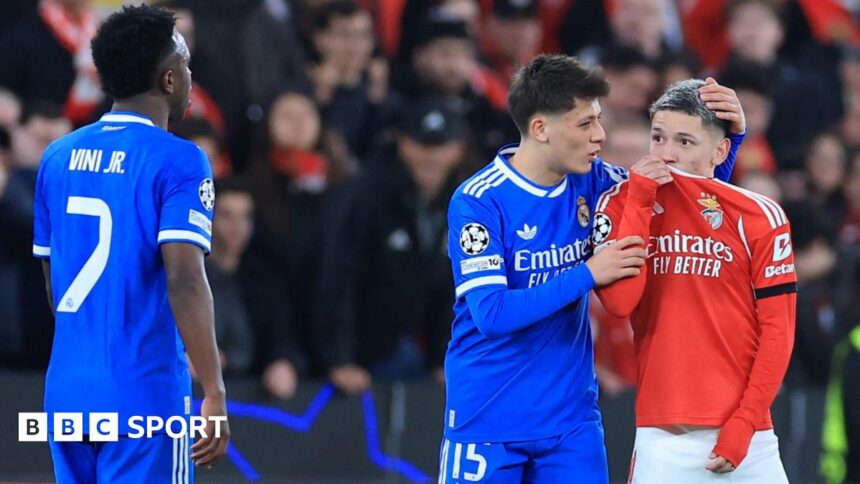
The stage was the Estádio da Luz this past Tuesday, a venue synonymous with European glory. The match was already a tense affair, but proceedings were abruptly halted in the second half. Real Madrid’s Vinicius Jr., a player who has tragically become a symbol of the battle against racism in football, approached referee Francois Letexier. After a conversation, the official led both teams from the pitch. A ten-minute pause ensued, a chillingly familiar scene in the career of the Brazilian winger. While play eventually resumed, the damage was done. The specter of racist abuse had, once again, invaded the pitch.
Vinicius, demonstrating remarkable resilience, later took to Instagram with a powerful, succinct statement: “Racists are, above all, cowards.” He did not name an individual, but the wheels of UEFA’s protocol were already in motion. Reports swiftly identified the accused as Benfica’s young substitute, Gianluca Prestianni. The alleged comment, reportedly a racial slur, was said to have been made from the bench area as Vinicius prepared to take a throw-in. Prestianni, who had entered the match in the 76th minute, was now at the center of an international scandal.
Benfica’s Bastion: The “Defamation Campaign” Allegation
Benfica’s reaction was not one of quiet cooperation but of immediate, aggressive defense. The club issued a statement that fundamentally shifted the narrative. They did not merely state Prestianni’s innocence; they launched a counter-accusation. The club asserted there was a “defamation campaign” against Gianluca Prestianni, framing their player as the victim of a targeted character assassination.
This strategy is a high-risk gambit. By crying defamation, Benfica is attempting to control the story, painting UEFA’s investigation as potentially influenced by external noise and prejudice. The club’s statement emphasized Prestianni’s “exemplary character” and his categorical denial. This approach serves several purposes:
- Club Solidarity: It sends a message of unwavering support to a young player, potentially shielding him from immediate internal fallout.
- Narrative Framing: It attempts to seed doubt in the public and possibly disciplinary minds, suggesting the accusation may be baseless or malicious.
- Institutional Pressure: It places UEFA under a microscope, warning that any ruling must be irrefutably evidence-based to avoid claims of bias.
However, this stance also risks appearing dismissive of the very serious, pattern-based issue of racism that Vinicius Jr. represents. It creates a stark dichotomy: a revered global star known for suffering abuse, versus an unknown teenager accused and defended by a powerful institution.
The Weight of Evidence and the Shadow of Sanctions
UEFA’s investigation now carries the weight of this added controversy. The governing body’s disciplinary body will rely on a multi-source evidence package, which typically includes:
- The referee’s official report, detailing what was reported to him on the pitch.
- Statements from match delegates and UEFA officials present.
- Audio and video footage from pitch-side microphones and broadcast feeds, which are often crucial in such “word against word” incidents.
- Testimonies from players and staff from both teams.
The potential consequences for Prestianni are severe. Under UEFA’s disciplinary regulations, acts of racist behavior carry a minimum 10-match ban from European competition. For a teenage prospect, such a suspension could be career-altering, stunting his development at a critical stage. For Benfica, a guilty verdict would also be a massive reputational blow, undermining their defiant stance and linking the club’s name to a racism scandal.
Conversely, if UEFA finds the evidence insufficient, the fallout will swing dramatically. Vinicius Jr.’s credibility, and the integrity of the anti-racism protocols he has come to symbolize, would face intense, unfair scrutiny. Benfica’s “defamation campaign” claim would gain significant traction, raising questions about the processes that allowed the allegation to escalate so publicly.
Expert Analysis: A Crossroads for Football’s Fight
This case represents a critical crossroads. From a disciplinary perspective, it tests the robustness of UEFA’s evidence-gathering. Can audio technology definitively pinpoint a single voice in a charged stadium environment? The burden of proof is “comfortable satisfaction,” not criminal “beyond reasonable doubt,” but the club’s aggressive defense raises the stakes.
From a social perspective, the incident highlights the perilous environment for players of color. Vinicius Jr.’s history makes him both a lightning rod for abuse and a powerful witness. His decision to report the incident, triggering the protocol, is a act of courage that continues his public stand. The alleged involvement of a player, rather than a fan, is also significant. It suggests the poison of racism can exist within the professional sanctum of the bench, a deeply troubling notion.
Benfica’s strategy, while legally understandable, carries a moral hazard. In vehemently defending their player, they must be careful not to inadvertently downplay the systemic issue at hand. The “defamation” claim, if not handled precisely, could be perceived as an attempt to weaponize victimhood and muddy the waters around a clear-cut ethical line.
Predictions and Lasting Implications
The path forward is fraught. UEFA’s ruling will likely hinge on forensic audio evidence. If clear proof exists, a lengthy ban for Prestianni is almost certain, and Benfica’s campaign claim will collapse. If evidence is inconclusive, UEFA may still impose a shorter ban based on the referee’s report and testimonies, or dismiss the case entirely—a result that would satisfy no one and leave a cloud over all parties.
Long-term, the “Prestianni Affair” will have several key impacts:
- Enhanced Technology: Increased pressure for even more sophisticated, directional audio systems at pitch-side to eliminate ambiguity in future cases.
- Club Protocol: Clubs may become more cautious in their public responses, balancing support for accused players with respect for the gravity of racism allegations.
- Player Education: A renewed focus on anti-racism education for young professionals, especially those moving between continents and cultures, will be imperative.
In conclusion, the allegation against Gianluca Prestianni and Benfica’s fierce retaliation have created a perfect storm. It is a case that transcends a single, alleged slur. It is about the mechanisms football uses to police itself, the power of narrative in the court of public opinion, and the painful, ongoing struggle to eradicate racism from the sport’s core. Whether this episode ends with a definitive sanction or a controversial acquittal, its reverberations will be felt long after the disciplinary committee’s gavel falls. The hope is that from this turmoil emerges not just a verdict, but a clearer, more resilient path toward a game where talent is the only color that matters.
Source: Based on news from BBC Sport.