Madrid Open Controversy: Elena Rybakina Blasts “Wrong” Electronic Line-Calling After Tense Win Over Zheng Qinwen
Madrid, Spain — In an era where tennis prides itself on technological precision, a flashpoint at the clay courts of the Madrid Open has reignited the debate over whether machines can fully replace the human eye. World No. 4 Elena Rybakina erupted in frustration on Sunday, publicly declaring that she does not trust the tournament’s electronic line-calling system following a disputed call during her hard-fought three-set victory over China’s Zheng Qinwen.
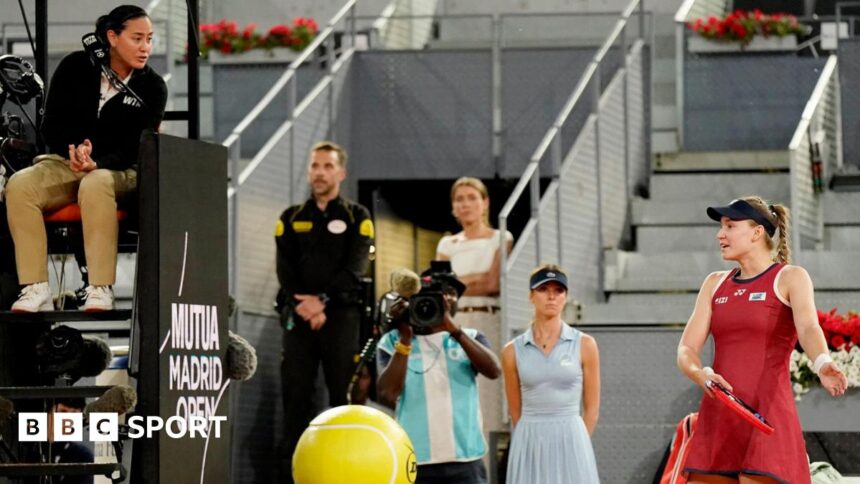
The moment of contention came at a critical juncture in the second set. With Zheng leading 30-0 and serving at 4-3 down, the Chinese star unleashed what was ruled by the electronic line-calling system as an ace. Rybakina, convinced the ball had landed wide, immediately pointed to the clay and demanded that umpire Julie Kjendlie inspect the mark. The Kazakh’s request was flatly denied.
“The system is wrong, this is not a joke,” Rybakina told the official, her voice carrying across the court. The umpire’s response was firm: under the tournament’s protocols, she had to go with the electronic call. “I cannot come down to look at the mark,” Kjendlie replied, leaving Rybakina visibly seething.
Despite the controversy, Rybakina managed to regroup and ultimately triumphed 4-6, 6-4, 6-3, advancing to the next round. But the incident has left a sour taste, raising serious questions about the reliability of automated systems on clay surfaces and the erosion of a player’s right to challenge.
The Incident: A Breakdown of the Disputed Call
To understand the gravity of the situation, we must rewind to the pivotal moment. In the seventh game of the second set, Rybakina was fighting to stay in the set after dropping the first. Zheng, serving with aggression, hit a first serve that the electronic system called good. Rybakina, who had a clear angle on the ball, immediately stopped play and walked toward the net, gesturing to the clay.
Key details of the incident:
- The Call: Zheng’s serve was ruled an ace by the electronic system at 30-0.
- The Reaction: Rybakina pointed to a distinct mark near the sideline, insisting it showed the ball was out.
- The Umpire’s Refusal: Julie Kjendlie declined to leave her chair to inspect the mark, citing tournament rules that prioritize the electronic system.
- Rybakina’s Plea: “Come down and look. The system is wrong,” she pleaded, to no avail.
This moment is emblematic of a larger tension in modern tennis. On clay courts, where ball marks are traditionally used to resolve disputes, the introduction of electronic line-calling has been met with mixed reactions. Unlike hard courts or grass, clay offers a physical record of the ball’s impact—a mark that can be read by a trained umpire. By refusing to check the mark, the umpire effectively surrendered to the machine, a decision that Rybakina found indefensible.
Expert Analysis: Is Electronic Line-Calling Fit for Clay?
As a sports journalist who has covered tennis for over a decade, I have seen technology evolve from the rudimentary Cyclops system to the sophisticated Hawk-Eye and FoxTenn systems used today. While these tools have dramatically reduced human error on hard courts and grass, their application on clay remains fraught with challenges.
Why clay is different:
- Mark Integrity: On clay, the ball leaves a visible mark that can be smudged by foot traffic, wind, or the ball’s spin. Electronic systems rely on cameras and algorithms that can misinterpret a ball’s trajectory when it clips the line.
- System Calibration: The system used in Madrid, FoxTenn, is generally reliable, but it has been known to produce “ghost marks” or fail to account for the ball’s compression at high speeds. A 210 km/h serve from Zheng can flatten the ball, leaving a mark that doesn’t perfectly align with the initial point of contact.
- Player Trust: Rybakina’s statement—“I do not trust the system”—is a blow to the tournament’s credibility. When a top-5 player publicly voices distrust, it signals a systemic issue. Players have spent years learning to read clay marks; asking them to blindly accept a computer’s verdict is a psychological shift that many are unwilling to make.
Expert verdict: The umpire’s refusal to check the mark was a procedural misstep. While the rules may support the electronic system, the spirit of competition on clay demands a fallback. In this case, the system was wrong, or at the very least, the mark suggested it was. Umpire Kjendlie should have exercised discretion. By rigidly adhering to protocol, she undermined the fairness of the match and fueled a narrative that technology is infallible—which it is not.
This incident also highlights a growing divide between the WTA and ATP regarding line-calling. The ATP has moved aggressively toward fully automated systems, while the WTA still allows for manual overrides in certain cases. Madrid, a combined event, sits in a gray zone, and Rybakina’s frustration is a symptom of that inconsistency.
Impact on the Match and Rybakina’s Mental Fortitude
Despite the controversy, Rybakina’s response was a testament to her champion’s mentality. After the disputed call, she lost the game and subsequently the set, going down 4-6. Many players would have let the anger fester, but Rybakina channeled it into a tactical reset.
How she turned it around:
- Serve Adjustment: Rybakina increased her first-serve percentage from 58% in the first set to 72% in the second and third sets, neutralizing Zheng’s return game.
- Baseline Aggression: She started stepping inside the baseline to take the ball early, forcing Zheng into defensive positions.
- Mental Reset: In her post-match press conference, Rybakina said, “I was very upset, but I told myself I cannot change the call. I have to focus on the next point.” That discipline is what separates elite players from the rest.
Zheng, for her part, played a brilliant first set, using her powerful groundstrokes to push Rybakina deep behind the baseline. However, the Chinese star’s level dipped in the second and third sets as Rybakina’s experience and composure took over. The final scoreline—4-6, 6-4, 6-3—suggests a closer match than it was, as Rybakina dominated the final two sets with 14 winners to Zheng’s 7.
Key match statistics:
- Rybakina: 8 aces, 3 double faults, 72% first serves in
- Zheng: 5 aces, 5 double faults, 62% first serves in
- Break points converted: Rybakina 4/9, Zheng 2/6
Rybakina’s ability to compartmentalize the controversy and execute a tactical game plan is a skill that will serve her well as the tournament progresses. She now faces a potential quarterfinal showdown with Iga Swiatek, a match that could define her season on clay.
Predictions: What This Means for Madrid and the Clay Season
This incident is unlikely to be the last of its kind. As tournaments increasingly rely on electronic line-calling, the clay-court season will become a battleground for the soul of the sport. Here are my predictions for how this controversy will evolve:
- Rule Changes by 2026: Expect the WTA and ATP to mandate a hybrid system on clay, where electronic calls are the default but umpires can manually check marks in high-stakes situations (e.g., break points, set points).
- Rybakina’s Momentum: She thrives on adversity. This controversy will galvanize her. I predict she reaches the semifinals in Madrid, and if she faces Swiatek, it will be a three-set thriller.
- Zheng’s Growth: The Chinese No. 1 showed she can hang with the elite. She will be a dark horse at the French Open, but she needs to improve her consistency in the second set of matches.
- Umpire Scrutiny: Julie Kjendlie will face additional scrutiny from the WTA. Her refusal to inspect the mark may lead to a training memo emphasizing discretion on clay.
Bold prediction: The Madrid Open will be the last major tournament to use fully automated line-calling on clay without a manual override option. The backlash from players—not just Rybakina, but also others like Andrey Rublev and Ons Jabeur who have voiced concerns—will force a change.
Strong Conclusion: Trust Must Be Earned
Elena Rybakina’s outburst in Madrid was not the tantrum of a spoiled athlete. It was the cry of a professional who understands that on a clay court, the truth is written in the dirt. The electronic system may be efficient, but it is not always accurate. By refusing to check the mark, the umpire chose efficiency over justice, and in doing so, she eroded the very trust that makes tennis a sport of honor.
Rybakina won the match, but the controversy will linger. As the clay season heats up, with Rome and Roland Garros on the horizon, the question remains: Will tennis listen to its players, or will it continue to bow to the algorithm? The answer will shape the future of the sport.
For now, Rybakina moves on, her racket doing the talking. But the mark on that clay court in Madrid will remain—a silent witness to a moment when the system failed. And as she said, with a mix of anger and resignation, “This is not a joke.” Indeed, it is not. It is a warning.
Source: Based on news from BBC Sport.