‘Everything is a Mess’: Inside the Manchester United Fan Protest That Overshadowed a Dramatic Win
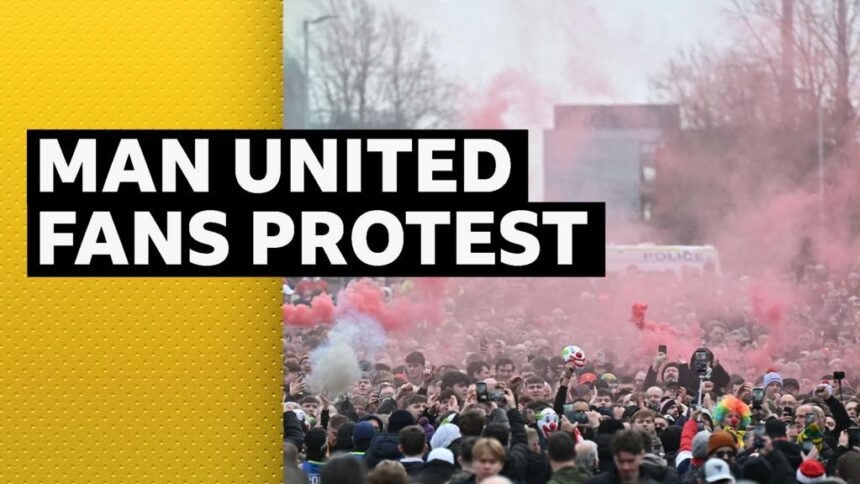
The roar that greeted Kobbie Mainoo’s stunning 91st-minute winner against Fulham was one of catharsis and defiance. Yet, just hours before that moment of pure footballing ecstasy, the air outside Old Trafford was thick with a very different emotion: unvarnished anger. In a stark juxtaposition that perfectly encapsulates modern Manchester United, a vital last-gasp victory was bookended by a significant fan protest, a reminder that on-field drama cannot paper over the deep, structural cracks at the club. The message from the supporters, led by the ‘The 1958’ group, was unequivocal: for all the talk of a new era under Sir Jim Ratcliffe, “everything is a mess.”
A Protest of Purpose: More Than Just Noise
As fans gathered on Sir Matt Busby Way before Sunday’s kick-off, this was not a spontaneous outburst of frustration. It was a coordinated, strategic demonstration by The 1958, a group dedicated to restoring what they see as United’s core identity through fan ownership and tangible influence. The targets were dual: the lingering, despised presence of the Glazer family, and the new minority owner, Sir Jim Ratcliffe. While Ratcliffe’s INEOS has taken over football operations, the protest highlighted a critical and growing sentiment: he is now viewed by a vocal section as part of the problem, not the solution.
The chants and banners laid bare their grievances. “We want Glazers out!” remained the foundational cry, but the inclusion of Ratcliffe’s name marked a significant escalation. The protest was a direct response to the club’s recent decision to raise season ticket prices by an average of 5%, a move seen as tone-deaf amidst a cost-of-living crisis and the ongoing stadium decay. For these fans, it was proof that the new regime, like the old, sees them first as customers, not as the lifeblood of the club.
- Targeted Anger: Protesters explicitly linked Ratcliffe with the Glazers, signaling distrust in the new “partnership.”
- Tangible Issues: The season ticket price hike and the dilapidated state of Old Trafford were central, tangible grievances.
- Structural Demand: The core demand remains a fundamental shift in governance, not just a change of personnel.
Expert Analysis: The Inescapable Shadow of the Glazers
From a football analyst’s perspective, the protest creates a complex and destabilizing backdrop for Erik ten Hag and his players. The team delivered a thrilling, character-filled win, but the day’s narrative was split. This duality is the curse of the post-Ferguson era. “The victory is a temporary relief valve,” notes veteran football journalist Martin Blackburn. “But the protest underscores that the club is operating in two parallel universes: one of fleeting on-pitch hope, and another of deep-rooted institutional failure. Until the ownership question is fully resolved—and that means the Glazers’ complete exit—this cycle will repeat. Ratcliffe is now under a microscope; his every decision, from ticket prices to transfer targets, will be judged against the promises of cultural renewal.”
The critical point is that fan sentiment has evolved. The initial optimism around Ratcliffe’s arrival has curdled into suspicion. His investment, while bringing football expertise, has not cleansed the club of the Glazer debt nor their ultimate authority. The stadium issue is a potent symbol. While Ratcliffe speaks of a “Wembley of the North,” fans see leaking roofs and rust. The disconnect between ambition and reality has never felt wider.
Predictions: A Season of Turbulence On and Off the Pitch
Looking ahead, this protest is unlikely to be an isolated event. It signals the start of a more intense, scrutinized phase of the INEOS project. We can anticipate several key developments:
1. A Season of Conditional Support: The atmosphere at Old Trafford will become increasingly conditional and volatile. Wins will be celebrated, but any misstep from the boardroom will be met with immediate backlash. The protest movement will likely grow more organized, using specific home games as platforms.
2. The Summer Transfer Window as a Litmus Test: Ratcliffe’s first summer window is now a high-wire act. Failure to invest significantly and wisely will be seen as a betrayal of his sporting mandate. However, big-money signings alone will not quell the discontent if accompanied by further commercial decisions that alienate the local fanbase.
3. The Stadium Saga: The debate over whether to refurbish Old Trafford or build anew will be a massive flashpoint. Any decision perceived as prioritizing cost-saving over the club’s heritage and the matchday experience will ignite fierce opposition.
Conclusion: Victory on the Pitch, Defeat in the Stands?
Manchester United beat Fulham in the seventh minute of stoppage time. But in the battle for the soul of the club, the final whistle is nowhere in sight. The protest organized by The 1958 was a powerful statement that the change fans were promised feels, in their eyes, like a rearrangement of deckchairs. The thrilling nature of the victory only heightens the tragedy—this is a fanbase that craves to pour its energy solely into celebrating its team, but feels compelled to fight its own owners instead.
The phrase “everything is a mess” resonates because it speaks to a holistic decay: the infrastructure, the ownership model, the communication, and the broken trust. Sir Jim Ratcliffe now faces a challenge far beyond rebuilding a squad. He must rebuild a relationship with a support base that is disillusioned, angry, and running out of patience. If he cannot bridge that chasm, the protests will grow louder, and the victories, however dramatic, will feel increasingly hollow. The war at Manchester United is no longer just about results; it’s about identity, and the fans have just fired a major salvo.
Source: Based on news from BBC Sport.