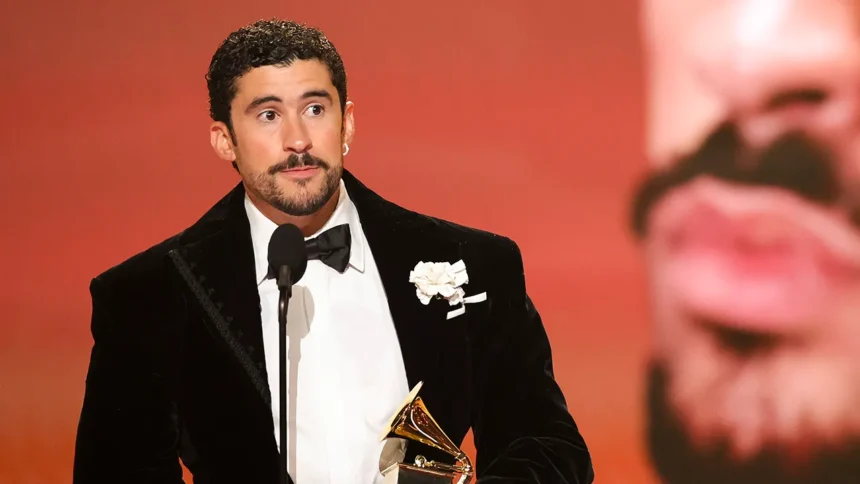
Ex-ESPN Star Sage Steele Calls Bad Bunny’s Super Bowl Halftime Booking “Disturbing,” Cites “Hate”
The announcement of global music sensation Bad Bunny as the headliner for Super Bowl LX’s halftime show was met with the typical mix of fanfare and debate. However, a recent critique has shifted the conversation from language and genre to one of intent and ideology. Former ESPN anchor Sage Steele, appearing on Fox News’ “The Faulkner Focus,” leveled a serious charge, calling the booking “disturbing” and accusing the Puerto Rican superstar of leading “with hate.” This analysis moves beyond the superficial culture war debates to probe a deeper question: in an era of heightened social consciousness, what are the ethical boundaries for selecting the performer for America’s most-watched stage?
- Beyond Language: Steele’s Core Accusation of Artistic “Hate”
- The Counter-Programming: Turning Point USA’s “Big Game Alternative”
- Expert Analysis: The Evolving Role of the Halftime Performer
- Predictions for Super Bowl LX and the Inevitable Firestorm
- Conclusion: A Halftime Show That Reflects a Fractured Audience
Beyond Language: Steele’s Core Accusation of Artistic “Hate”
Steele was quick to clarify that her issue is not with Bad Bunny’s heritage or his primary use of Spanish, a point that has sparked predictable online friction. She pointed to the iconic 2002 performance by Ireland’s U2 as a benchmark for an international artist delivering a unifying, emotionally resonant show. “This isn’t about someone who is not American,” Steele stated. “This is about, as an artist, you lead with hate, and that is what Bad Bunny has done from day one.”
This accusation hinges on Bad Bunny’s well-documented and unapologetic use of his platform for political and social commentary, often directed at institutions of power. His art and public persona are deeply intertwined with advocacy for:
- Puerto Rican independence and sovereignty, including lyrics critical of the U.S. government’s response to Hurricane Maria.
- LGBTQ+ rights and visibility, challenging machismo norms in Latin culture.
- Anti-colonial and leftist political stances, often expressed through symbolic gestures like wearing a “They Killed Alexa” shirt to the Grammys, referencing protests in Peru.
For Steele and some conservative commentators, this activism crosses a line from celebration into divisiveness. The “hate” label is applied to what they perceive as rhetoric that antagonizes American political figures, critiques American foreign policy, and challenges traditional values. The core of the debate is whether such pointed commentary is incompatible with the Super Bowl’s aspiration of mass appeal.
The Counter-Programming: Turning Point USA’s “Big Game Alternative”
Adding a tangible layer to the cultural schism, conservative youth group Turning Point USA announced it will host a “Big Game Alternative” concert in Las Vegas the same weekend, featuring country artists. While framed as a celebration of “American values,” its timing is a direct response to the NFL’s choice. This move effectively creates a parallel cultural universe, underscoring how the halftime show has become a proxy battlefield in America’s ongoing culture wars.
This development is significant for several reasons:
- It commercializes the backlash, offering a sponsored alternative to viewers who object to the official show.
- It frames certain genres (like country) as inherently more “American” or value-aligned than others (like reggaeton).
- It guarantees that regardless of Bad Bunny’s actual performance content, the narrative surrounding it will be one of conflict and choice.
The existence of this alternative concert validates Steele’s perspective for her audience while also ensuring the controversy maintains a high media profile leading up to the game.
Expert Analysis: The Evolving Role of the Halftime Performer
To understand the weight of Steele’s comments, one must examine the evolution of the Super Bowl halftime show. For decades, it was a spectacle of pure, apolitical entertainment—think marching bands and Up With People. The shift to megastar pop acts in the 1990s increased viewership but largely stayed within safe, celebratory boundaries.
The 21st century, however, has seen the stage become a site of unintended and intentional political statements. Janet Jackson and Justin Timberlake’s 2004 “wardrobe malfunction” sparked a national debate on decency. Beyoncé’s 2016 formation-themed performance, honoring the Black Panthers, was hailed as a powerful statement by many and criticized as divisive by others. Most recently, the 2022 Dr. Dre, Snoop Dogg, and Kendrick Lamar-led show was a potent celebration of West Coast hip-hop’s cultural impact, a genre once considered too controversial for the event.
Bad Bunny’s selection is the next logical step in this progression: an artist whose political stance is central to his brand, not a subtext. The NFL, by choosing him, is arguably making its own statement—aligning with a younger, more diverse, and globally-minded audience that expects its icons to stand for something. The risk, as Steele’s reaction demonstrates, is alienating a segment of the audience that views the Super Bowl as a three-hour escape from political discourse.
Predictions for Super Bowl LX and the Inevitable Firestorm
Given this charged climate, several predictions can be made about the road to Super Bowl LX and the performance itself:
1. The Narrative Will Be Set in Stone Before Kickoff: The discourse will be dominated by think pieces and cable news segments debating “hate” versus “activism,” “inclusion” versus “division.” Bad Bunny’s actual setlist may become almost secondary to the pre-game commentary.
2. The Performance Will Be Meticulously Crafted, But Not Neutral: Expect a visually stunning, high-energy show celebrating Latin culture. However, to remain authentic, Bad Bunny is unlikely to completely sanitize his message. Look for subtle, symbolic gestures—a flag, a lyric, a visual cue—that will be celebrated by fans and parsed as provocation by critics.
3. The Ratings Story Will Be Complex: Viewership will likely be enormous, driven by his global fanbase and the curiosity factor. The true metric will be in the social media engagement analysis: a spike in polarized reactions will prove Steele’s point about divisiveness for some, while a surge in positive sentiment from Latino and young viewers will validate the NFL’s choice for others.
4. The Legacy Will Be About the Line in the Sand: This halftime show will be remembered as the moment the NFL fully accepted that the role of the performer has permanently changed. The era of the purely neutral entertainer is likely over.
Conclusion: A Halftime Show That Reflects a Fractured Audience
Sage Steele’s “disturbing” critique is more than a celebrity hot take; it is a reflection of a deeply fractured American cultural landscape. The controversy is not really about Spanish lyrics or Puerto Rican pride. It is a fundamental disagreement over whether the Super Bowl, a de facto national holiday, should showcase an artist whose work challenges the nation’s history and power structures.
The NFL has made its bet. By choosing Bad Bunny, it has decided that cultural relevance and global reach outweigh the risks of political backlash. It has acknowledged that for millions of viewers, authenticity and social consciousness are the ultimate entertainment. Steele’s comments, and the Turning Point USA alternative, represent the powerful counter-force that believes sports and politics should remain separate, and that the halftime show should be a unifying, non-confrontational celebration.
When the lights go on in Las Vegas for Super Bowl LX, Bad Bunny won’t just be performing songs. He will be stepping onto the most charged cultural stage in America, embodying a clash of values that extends far beyond the football field. The only certainty is that, in our current age, the 12-minute halftime will generate more conversation than the game’s final score.
Source: Based on news from Fox Sports.