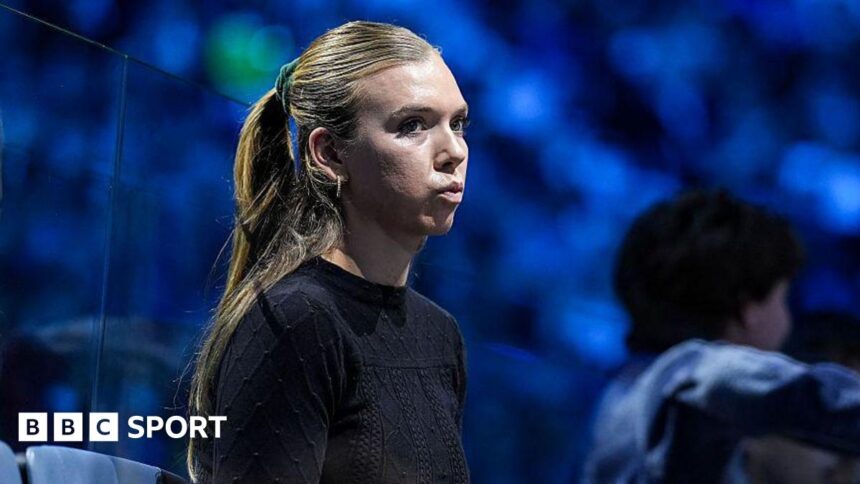
Boulter’s Melbourne Misfortune: Injury and Ranking Squeeze Force British Star into Australian Open Qualifying
The road to the Australian Open is paved with both triumph and tribulation, and for Britain’s Katie Boulter, the journey to Melbourne Park in January 2026 will take an unexpected and arduous detour. In a stark reminder of the razor-thin margins at the pinnacle of professional tennis, the former British number one has missed out on direct entry into the main draw. Currently ranked World No. 106, Boulter finds herself agonizingly two places outside the cut-off, a scenario that forces her into the grueling qualifying tournament for the first Grand Slam of the year. This development marks a significant setback for a player who, just months ago, was celebrating a career-high ranking of 23.
The Numbers Game: A Brutal Cut-Off Line
The mechanism of direct entry into a Grand Slam draw is a cold, mathematical process that offers little sympathy for reputation or past achievement. For the 2026 Australian Open, 104 players received direct entry, a figure that includes those utilizing protected rankings due to injury. Boulter’s position at 106 in the WTA rankings placed her directly in the crosshairs of this brutal cut-off. This two-place deficit is more than a mere statistic; it represents a cascade of consequences—financial, logistical, and psychological. Instead of preparing for a guaranteed main-draw appearance with its accompanying points and prize money, the 29-year-old must now battle through up to three high-pressure qualifying matches against hungry opponents, with no room for error.
This situation underscores the volatile nature of tennis rankings, especially for players hovering around the top 100. A single result, a withdrawn opportunity, or an untimely injury can dramatically alter a season’s trajectory. For Boulter, the convergence of ranking and physical misfortune has created a perfect storm.
The Injury Conundrum: A Calculated Risk Backfires
The narrative behind Boulter’s ranking slide is inextricably linked to a physical setback. In October, during the tournament in Hong Kong, Boulter sustained a hip injury that disrupted her offseason preparations. This ailment led to a critical decision point in the final weeks of the 2025 season. A WTA 125 challenger event in France presented a final opportunity to accrue precious ranking points and potentially climb above the Australian Open cut-off line.
However, Boulter and her team made the strategic choice to prioritize long-term health over short-term gain. Opting not to compete in France was a calculated risk to ensure proper recovery. In the high-stakes world of professional athletics, such decisions are a constant gamble. The analysis here is clear: protecting her body for the full 2026 season was deemed more valuable than risking further damage for a chance at main-draw status in one event. Yet, the immediate cost of that prudent decision is now evident. This highlights the immense pressure athletes face in managing their calendars, where every tournament entry or withdrawal is a move in a complex chess game against their own physiology and the ranking computer.
- Protecting Long-Term Fitness: The decision to skip the WTA 125 event was rooted in medical advice and a focus on being fully fit for the entire upcoming season.
- Immediate Ranking Impact: The forfeited points from that tournament ultimately created the ranking gap that led to her missing direct entry.
- The Athlete’s Dilemma: This scenario perfectly illustrates the conflict between playing through pain for points and resting to ensure career longevity.
Expert Analysis: Navigating the Fall from the Top 30
Boulter’s predicament is not uncommon in the modern WTA tour, known for its depth and competitiveness. A drop from a career-high of 23 to 106 within a year suggests a combination of factors beyond a single injury. Analysts point to the challenge of consolidating a breakthrough. The 2024 season, which saw her crack the top 25, would have placed a new kind of target on her back; she was no longer the hunter but the hunted. The pressure to defend points from previous successes, coupled with the injury, creates a steep slope to slide down.
Furthermore, her game, built on aggressive first-strike tennis and a potent serve, relies heavily on confidence and rhythm. A hip injury can subtly disrupt service mechanics and movement, eroding the foundations of her primary weapons. The mental toll of battling back from injury while watching your ranking slip can be as debilitating as the physical pain itself. The key for Boulter will be to treat the qualifying rounds not as a demotion, but as an opportunity to rebuild match sharpness and competitive fury away from the glaring spotlight of the main show courts.
Predictions and Path Forward: Qualifying as a Catalyst?
While missing direct entry is a undeniable blow, it is far from a career epitaph. The Australian Open qualifying tournament at Melbourne Park is a furnace that forges resilience. For a player of Boulter’s experience and caliber, it can serve as a powerful catalyst. Successfully navigating three rounds could inject a surge of momentum, providing her with a “nothing to lose” attitude upon entering the main draw. History is replete with players who have used qualifying runs as a springboard to deep Grand Slam performances.
The prediction here is twofold. Firstly, Boulter will be a heavy favorite to progress through the qualifying draw, provided her hip is fully recovered. Her big-match experience and superior weaponry, when functioning, should see her through. Secondly, this setback could galvanize her 2026 campaign. The hunger to reclaim her position in the top 50, and eventually the top 30, will be fueled by the memory of this administrative disappointment. Her schedule following Australia will likely be meticulously planned to accumulate points and rebuild ranking security.
Conclusion: A Setback Before the Storm
Katie Boulter’s absence from the Australian Open main draw list is a poignant story of sport’s fine lines. It is a tale where a hip injury in Hong Kong reverberates months later into a ranking squeeze, forcing a former top-25 player back to the qualifying trenches. Yet, within this setback lies a formidable opportunity. The path through qualifying is arduous, but it is a path Boulter has walked before in her ascent. For the British star, the 2026 season now begins not with the fanfare of a main-draw announcement, but with the gritty, determined work of earning her place. How she responds to this challenge will define the opening chapter of her new season. Melbourne Park, a court of dreams, will first become a court of redemption. The tennis world will be watching to see if this misfortune becomes the fuel for a powerful and resolute comeback.
Source: Based on news from BBC Sport.