FIFA in the Firing Line: Infantino’s Trump Award Sparks Ethics Investigation and Neutrality Crisis
The pristine, often politicized world of international football governance is facing a fresh and profound credibility crisis. At its epicenter is FIFA President Gianni Infantino and a controversial decision that has critics crying foul: the presentation of an inaugural “FIFA Peace Prize” to former United States President Donald J. Trump. What was framed as a gesture of gratitude for the U.S.-led 2026 World Cup bid has rapidly escalated into a formal ethics complaint, alleging Infantino brazenly breached FIFA’s own core rules of political neutrality. This award, far from a diplomatic coup, has ignited a firestorm that threatens to scorch the very principles FIFA claims to uphold.
A Prize and a Precedent: The Washington Controversy
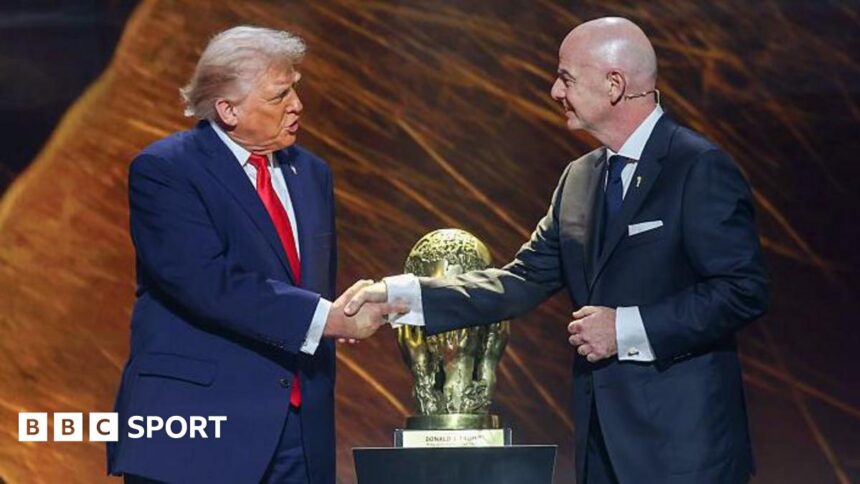
The scene was the 2026 World Cup preliminary draw in Washington D.C., an event meant to build anticipation for the tournament to be hosted by the U.S., Canada, and Mexico. In a move that stunned many observers, Gianni Infantino took the stage to confer a new, previously unknown honor upon Donald Trump. “This is truly one of the great honours of my life,” Trump stated in acceptance. Infantino justified the award, citing Trump’s role in the “incredible success” of the united 2026 bid and his “unique personality and his unique way of communicating to the world.” However, the fanfare was immediately met with skepticism and alarm. The creation of a “peace prize” for a divisive political figure, particularly one whose tenure was marked by significant social unrest and polarized global diplomacy, struck many as incongruous at best, and a blatant political act at worst. The ceremony, coupled with Infantino’s subsequent social media posts and interviews in support of Trump, transformed a sporting event into a political lightning rod.
Breach of Trust: Dissecting the Formal Ethics Complaint
The backlash has moved beyond opinion columns. Human rights campaign group FairSquare has lodged a formal complaint with FIFA’s Ethics Committee, a document obtained by BBC Sport that meticulously outlines the alleged transgressions. The complaint asserts that President Infantino has committed four clear breaches of Article 25 of the FIFA Statutes, which mandates the organization’s neutrality in political matters.
The core allegations are damning in their specificity:
- Political Endorsement Through Award: The very act of awarding a prize to a sitting or recently sitting head of state—especially one actively engaged in a re-election campaign—is viewed as a de facto endorsement, violating neutrality.
- Public Praise and Advocacy: Infantino’s repeated public statements lauding Trump’s “unique personality” and leadership extend beyond diplomatic courtesy into the realm of political advocacy.
- Electoral Interference Concerns: By amplifying support for a candidate in a forthcoming national election, FIFA, via its president, risks being seen as attempting to influence the political process of a member association.
- Undermining FIFA’s Ethical Framework: The actions are seen as setting a dangerous precedent that erodes the ethical guardrails designed to protect FIFA from the corrosive influence of geopolitics.
“The award of a prize of this nature to a sitting political leader is in, and of itself, a clear breach of FIFA’s duty of neutrality,” the FairSquare letter states unequivocally. This frames the issue not as a minor misstep, but as a fundamental failure of governance.
Expert Analysis: Between Gratitude and Governance
From a sports journalism perspective, this controversy is a textbook case of mission drift and compromised integrity. FIFA’s recent history is a scarred landscape of corruption scandals, with the Infantino era ostensibly focused on reform and “putting football first.” This incident suggests a troubling return to old habits, where transactional relationships with powerful political figures are prioritized over institutional principles.
“The optics are disastrous,” notes Dr. Samantha Cole, a sports governance expert. “FIFA’s neutrality rules exist for a vital reason: to protect the global game from being used as a pawn by nations and politicians. By creating an ad-hoc prize for a figure like Trump, Infantino isn’t just thanking a host nation; he’s aligning FIFA’s brand with a specific, highly contentious political identity. It raises immediate questions about what similar gestures might be expected for other authoritarian leaders who covet World Cups.”
The analysis extends to the 2026 World Cup itself. While gratitude for U.S. government support in securing the bid is understandable, there are diplomatic channels for such thanks. The stage of a global draw, broadcast worldwide, was a choice that weaponized the spectacle for political purposes. Furthermore, it overlooks the collaborative effort of Canada and Mexico, implicitly crediting one nation’s leader above the tri-national partnership.
Predictions and Repercussions: What Happens Next?
The path forward is fraught with risk for Infantino and FIFA’s reputation. The Ethics Committee now faces a monumental test of its independence. Several outcomes are possible:
- A Mild Reprimand: The committee could issue a private warning, finding a technical violation but minimizing public fallout. This would be seen as a whitewash, critically damaging the Ethics Committee’s credibility.
- A Public Censure: A stronger finding of a breach, accompanied by a public statement, would validate the complaints but likely stop short of serious sanction against the president.
- Dismissal of Complaint: Outright dismissal would signal that FIFA’s neutrality rules are effectively meaningless, inviting further politicization and criticism from human rights groups and member associations who feel targeted by such political favoritism.
- Long-term Erosion of Authority: Beyond the committee, the breach of neutrality sets a perilous precedent. Could other FIFA awards or decisions now be challenged as politically motivated? It opens a door the organization has struggled to keep closed.
Critically, this incident may galvanize FIFA’s critics within the congress. Member associations from regions less favored by such personal diplomacy could begin to question Infantino’s leadership more openly, seeing it as increasingly aligned with specific geopolitical interests rather than the universal development of football.
Conclusion: A Game of Principles, Not Politics
The awarding of the FIFA Peace Prize to Donald Trump is more than a bizarre footnote in football history. It is a stress test of FIFA’s institutional integrity. Gianni Infantino’s actions, whether born of genuine gratitude or calculated realpolitik, have demonstrably entangled the world’s football governing body in the partisan fray of a U.S. election cycle and compromised its stated commitment to neutrality. The ethics committee investigation into Infantino is now the most watched match in football governance.
FIFA’s mission is to govern football for the world. That world is composed of 211 member associations with vastly different political leaders, ideologies, and values. The only way to navigate this complex terrain is through strict, impartial adherence to its own statutes. By appearing to bend those rules for a powerful figure, Infantino hasn’t just honored a former president; he has potentially dishonored the sport’s principle of being a unifying force above politics. The beautiful game deserves referees who enforce the rules equally, especially when the person blowing the whistle is also the one accused of the foul. How FIFA adjudicates this self-inflicted crisis will define its legitimacy for years to come.
Source: Based on news from BBC Sport.