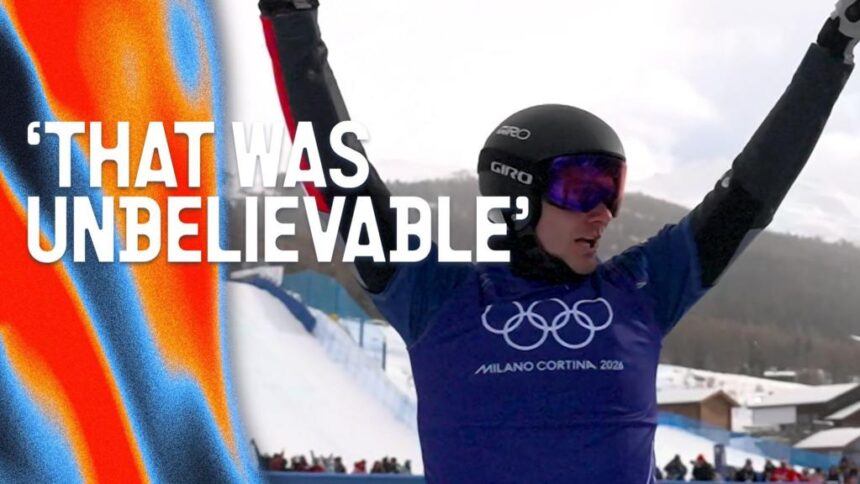
From Fourth to First: Haemmerle’s Last-Gasp Lunge Secures Historic Snowboard Cross Gold
The essence of snowboard cross is chaos distilled into 90 seconds of pure, unadulterated adrenaline. It’s a sport where strategy is plotted at 70 kilometers per hour, where a single bobble can rewrite destinies, and where the finish line is never truly crossed until someone’s board tip slices across it. In a display of nerve-shredding drama that will be etched into Olympic legend, Austria’s Alessandro Haemmerle didn’t just win a gold medal—he stole it from the jaws of defeat in a final, desperate lunge that turned a certain fourth-place finish into a stunning title defense.
A Rollercoaster Ride to the Final Showdown
The road to the men’s snowboard cross final at the Zhangjiakou course was a masterclass in survival. The steep, technical track, featuring imposing banked turns, daunting rollers, and tight bottlenecks, had already claimed several favorites in earlier rounds. The Olympic snowboard cross final is as much a mental battle as a physical one, requiring riders to navigate not just the terrain, but the unpredictable movements of three other competitors mere inches away.
As the gate dropped for the medal decider, a quartet of the world’s best exploded into action. Canada’s Eliot Grondin took a fierce early lead, with Spain’s Lucas Eguibar and American Nick Baumgartner in hot pursuit. Haemmerle, the reigning champion, found himself in a precarious position—trailing in fourth. For much of the winding descent, the podium order seemed locked in. Grondin, riding flawlessly, protected his inside lines. Baumgartner and Eguibar engaged in a fierce side-by-side battle for silver, leaving the Austrian in a seemingly hopeless chase.
The Anatomy of a Last-Second Miracle
What separates the great from the legendary is the refusal to yield until the clock hits zero. Entering the final feature, a long, rolling finish straight, Haemmerle was still adrift. This is where expert analysis reveals the champion’s cunning. While the leading trio, sensing the finish, instinctively tucked into a low, aerodynamic sprint, Haemmerle made a critical calculation.
- Timing Over Immediate Speed: He stayed slightly more upright, sacrificing a fraction of tucking speed to prepare for a final explosive push.
- Line Selection: He held to the far right of the track, a cleaner line with less spray from the other riders, giving him a clearer sightline.
- The Champion’s Gambit: As the finish line loomed, the leaders remained neck-and-neck-neck. In a moment of pure instinct, Haemmerle launched into a full dramatic finish line lunge, throwing his body forward, extending his lead leg, and jamming his board ahead of his rivals.
In a blur of snow and colored suits, four bodies hurtled across the line. A collective gasp echoed before the result flashed on the screen: Haemmerle by a board tip. Eliot Grondin’s heartbreak was visible, settling for silver, while Spain’s Lucas Eguibar clinched bronze. Nick Baumgartner, milliseconds from the podium, finished fourth. Haemmerle had done the unthinkable, executing a photo finish victory that redefined clutch performance.
What This Victory Means for the Sport’s Landscape
Alessandro Haemmerle’s victory is monumental on multiple levels. He cements his status as an all-time great in snowboard cross, joining Seth Wescott as only the second man to win back-to-back Olympic titles in the discipline. This wasn’t a wire-to-wire dominance; it was a gritty, tactical, and psychologically devastating win that showcases a complete champion’s toolkit.
The result also signals a fascinating shift in the hierarchy of the sport. The young guns like Grondin proved they have the speed to dominate, but Haemmerle’s veteran savvy and race IQ proved decisive. This historic title defense will be studied for years as a textbook example of how to race the clock, the course, and the competition simultaneously.
The Future of Snowboard Cross: Predictions and Rising Stars
Looking ahead, the snowboard cross world is more competitive than ever. The drama in Zhangjiakou sets the stage for an electrifying new Olympic cycle.
- The Veteran’s Challenge: Can Haemmerle, now with a target firmly on his back, achieve an unprecedented three-peat? His mental fortitude is unquestioned.
- The Hungry Heirs: Eliot Grondin’s performance proves he is the heir apparent. The experience of this heartbreaking loss will fuel a ferocious comeback.
- Depth of Talent: The sheer number of riders capable of winning World Cup events—from Italy’s Omar Visintin to Germany’s Martin Noerl—means Olympic qualifying will be a war of attrition.
- Technical Evolution: Expect athletes and coaches to dissect this final relentlessly. We may see a greater emphasis on finish-line sprint techniques and positioning in the final straight, turning the last 50 meters into its own specialized science.
The next generation, watching this race, learned a crucial lesson: in snowboard cross, you race to the *absolute* end.
Conclusion: A Testament to Never Giving Up
The 2022 men’s Olympic snowboard cross final was more than a race; it was a narrative masterpiece. It had the favorite in peril, the agony of near-victory, and a climax so improbable it felt scripted. Alessandro Haemmerle’s victory is a powerful reminder that in a sport defined by variables, the greatest variable of all is human will. He didn’t have the fastest run, but he executed the perfect final second. This dramatic finish encapsulates everything fans love about the Winter Olympics: unparalleled athleticism, breathtaking speed, and the timeless drama of a champion refusing to be denied. The image of his final lunge, a full-body commitment to glory, won’t just be a highlight reel staple—it will be an enduring symbol of Olympic resilience for cycles to come.
Source: Based on news from BBC Sport.