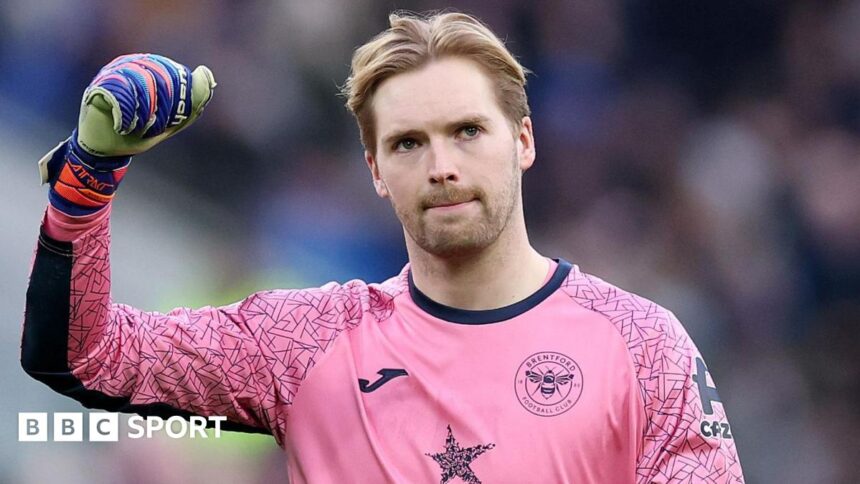
Perspective from Afar: Caoimhin Kelleher on Liverpool’s Season and the Shadow of Diogo Jota
The relentless churn of the Premier League season, with its weekly dramas and relentless pursuit of points, creates a bubble where football can feel like the only reality. But sometimes, life delivers a tragedy so profound it shatters that bubble, forcing a recalibration of what truly matters. According to a man who knows Anfield intimately, that is precisely the context in which Liverpool’s current campaign must be viewed. In a poignant and revealing reflection, former Liverpool goalkeeper Caoimhin Kelleher has suggested that the football aspect of Liverpool’s season has been fundamentally altered by the devastating loss of Diogo Jota.
A Goalkeeper’s Unique Vantage Point: Kelleher’s Brentford Success and Anfield Lens
Now establishing himself as a Premier League number one at Brentford, where he has impressively kept six clean sheets in the Premier League this season, Caoimhin Kelleher operates with the clear-eyed focus of a starting goalkeeper. Yet, his view of his former club is filtered through a deeper, more human lens. His time at Anfield, serving as understudy to Alisson Becker, was defined by more than training drills; it was about being part of a tight-knit squad, a brotherhood. It is from this position of insider knowledge and emotional connection that his comments carry significant weight. He isn’t a distant pundit; he is a former teammate speaking to the heart of the club’s current struggle.
Kelleher’s own football season at Brentford has been one of personal triumph, proving his capabilities as a first-choice keeper. This success allows his perspective on Liverpool to be free of any personal frustration, framed instead by empathy and shared grief. He sees not just the league table, but the empty space in the dressing room, the missing smile on the training pitch, the ghost of a crucial goal that will never be scored.
The Unfillable Void: Diogo Jota’s Legacy at Liverpool
To understand Kelleher’s perspective, one must appreciate the magnitude of what—and who—was lost. Diogo Jota was far more than a statistic, though his numbers were exceptional: 65 goals in 182 appearances for the Reds. He was the embodiment of chaotic efficiency, a player whose relentless movement and predatory instinct decided big games. His contributions were etched into the club’s modern silverware:
- 2022 FA Cup and League Cup: Jota was instrumental in both Wembley triumphs, scoring key goals throughout each campaign.
- 2023 Premier League Title: His goals last season were vital in the relentless push to reclaim England’s top prize.
But beyond the trophies, Jota was a beloved character. His infectious energy and clear love for the game made him a fan favorite and a crucial dressing room personality. His tragic death in a car crash last summer at just 28 years old did not just rob Liverpool of a top forward; it ruptured the very fabric of the squad. As Kelleher implies, how does a team simply “move on” from that? How does the football aspect remain the sole priority when such a profound human loss hangs over every session, every match, every missed chance that he might have buried?
Re-evaluating Success: Performance and Results in a Season of Grief
This brings us to the core of Kelleher’s analysis. Liverpool, currently sixth in the Premier League and a significant 14 points behind table-topping Arsenal, are enduring what is objectively a testing season. The on-pitch issues are visible: a midfield in transition, defensive inconsistencies, and the kind of dropped points that title aspirations cannot withstand. The standard analysis focuses on tactics, transfer market misses, and injury crises.
Kelleher invites us to look beyond that. He posits that the typical metrics of success—points, position, clean sheets—are “not quite as important” this season. This isn’t an excuse for poor performance; it’s a profound statement on context. The emotional toll of processing grief while performing at the elite level is incalculable. Every player would have processed Jota’s loss differently, and that collective sorrow inevitably seeps into the collective endeavor on the pitch. The death of Diogo Jota has imposed a shadow that no tactical tweak can lift. Winning a football match, in the grand scheme of such a loss, can feel trivial. Yet, the show must go on, and that is the brutal paradox the squad has navigated.
Looking Forward: Predictions and the Path to Healing
So, what does the future hold for Liverpool? Kelleher’s comments, while reflecting on the past and present, also shape how we view the club’s trajectory. The prediction here is not about a specific league finish, but about a process.
The immediate future will likely continue to be inconsistent. The club is competing for Europa League glory, which would represent a tangible, joyful tribute to their late teammate. A strong finish to secure Champions League football would be a commendable footballing achievement under these circumstances.
The longer-term path is about legacy and healing. The true measure of this Liverpool season may not be found in the final league table. It will be in how the club honors Jota’s memory permanently, and how the bonds forged in shared grief strengthen the squad’s core for future campaigns. The challenge for manager and players will be to gradually reintegrate the uncompromising, win-at-all-costs football aspect with the enduring human one. They will play for him again, but first, they had to learn to play without him.
Conclusion: Football in its Proper Place
Caoimhin Kelleher, from his vantage point of both distance and deep connection, has offered a vital corrective to the myopic world of sports analysis. In reminding us of the death of Diogo Jota, he reframes Liverpool’s entire campaign. The testing season on the pitch is undeniably real, but it exists within a far more significant, human season of mourning. The six clean sheets Kelleher has kept at Brentford are a professional milestone; the six league places separating Liverpool from the top are a footballing reality. But both are ultimately just details in a larger story.
This season at Anfield has been, and will continue to be, about more than football. It is about resilience, memory, and the slow, painful journey of a team carrying the weight of an irreplaceable loss. The results and performances matter, as they always do in professional sport, but as Kelleher so eloquently reminds us, they are “not quite as important” this time. Some things, like the legacy of a player like Diogo Jota, simply transcend the game.
Source: Based on news from BBC Sport.