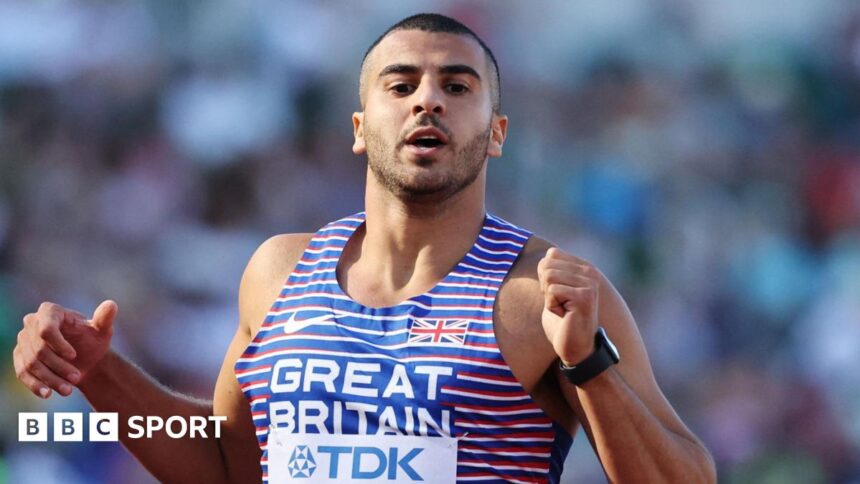
Adam Gemili Retires: The End of an Era for British Sprinting
The track, for so long a canvas of explosive potential, will now be a memory. Adam Gemili, the sprinter whose career was a compelling tapestry of blistering speed, heartbreaking near-misses, and unwavering resilience, has announced his retirement from athletics at the age of 32. His departure marks not just the exit of a former European champion, but the closing of a vibrant, complex chapter in British sprinting—one defined by a rare, multi-sport talent who captured the imagination of a nation during the London 2012 Olympics and never let it fully go.
From Football Pitch to Olympic Track: A Meteoric Rise
Adam Gemili’s origin story is the stuff of sporting legend, a tale of raw, untapped velocity waiting to be harnessed. Before he was a household name in athletics, he was a promising youth footballer, developing his explosive power at Chelsea’s famed academy and later on the books at Dagenham & Redbridge. It was this foundation in team sports that forged a unique competitor—one with a sprinter’s legs and a footballer’s sense of collective spirit.
His transition to the track was nothing short of meteoric. The track world sat up and took notice in 2012 when, as a teenager, he clocked a wind-legal 10.08 seconds for the 100m. This monumental run made him the second-fastest British junior of all time, a signal that a genuine star had arrived. His selection for the London 2012 Olympics, in his home city, completed a fairy-tale ascent. The roar that greeted him in the Olympic Stadium was for one of their own, a local lad made good, and he responded by reaching the 100m semi-finals, announcing himself on the world’s biggest stage.
- Dual-Sport Prodigy: Trained at Chelsea FC’s academy before switching sports.
- Historic Junior Feat: 10.08s in 2012 cemented his elite potential.
- London 2012 Hero: A home Games debut that captured the public’s heart.
The Pinnacle and the Pain: A Career of Highs and Heartbreak
The years following London established Gemili as a global force. The summer of 2014 was his absolute peak, a golden period where his potential crystallized into championship metal. He stormed to the 2014 European 200m title in Zurich, displaying a sublime blend of curve running and straightaway power. Just weeks later, he claimed a brilliant 100m silver at the Commonwealth Games in Glasgow, proving his versatility across the shortest sprints.
His relay prowess became a cornerstone of British athletics’ success. A fierce and reliable bend runner, Gemili won medals at three consecutive World Championships (2015, 2017, 2019), contributing to a golden era for the British 4x100m squad. His commitment to the team ethic, a remnant of his football days, was unwavering.
Yet, his individual story is also etched with agonizing disappointment. The 2016 Rio Olympics saw a hamstring injury devastate his 200m final bid. The Tokyo 2020 Games, delayed to 2021, brought perhaps the cruelest cut: a false start in the 200m semi-finals when he was in the form of his life. These moments, where destiny seemed to intervene at the worst possible time, added a layer of profound narrative to his career, making his successes feel even more precious and his setbacks deeply felt by fans.
Expert Analysis: The Legacy of the Gemili Era
From a technical standpoint, Gemili was a fascinating study. His start, often cited as a relative weakness early on, became a point of significant improvement, though it was his extraordinary top-end speed and fluid, powerful stride that truly defined him. Experts often pointed to his 200m European champion run as a masterclass in race distribution.
But his legacy transcends times and medals. Adam Gemili represented a bridge in British sprinting. He emerged in the post-London 2012 boom, carrying the hopes of a nation newly in love with track and field. Alongside contemporaries like Zharnel Hughes and Reece Prescod, he maintained Britain’s relevance on the global sprint stage during a period of intense international competition. His charismatic, engaging personality and his visible emotional investment in every race made him exceptionally relatable. He showed the sheer joy and the devastating pain of elite sport, never hiding from either.
Furthermore, his unique path—from Chelsea academy to Olympic track—inspired a conversation about talent identification and cross-sport athleticism. He proved that raw speed could be refined from unexpected places, broadening the perception of where future champions might be found.
The Future: What’s Next for Gemili and British Sprinting?
For Adam Gemili, life after the track is a new starting block. Given his experience, communication skills, and deep love for the sport, roles in broadcasting, coaching, or sports administration seem natural fits. His personal journey through injury, mental health challenges, and ultimate resilience has also equipped him to be a powerful advocate for athlete welfare.
For British sprinting, his retirement coincides with a time of intriguing transition. The emergence of young talents is constant, but they will now do so without the steadying, experienced presence of Gemili in the relay squad or on the training track. His departure underscores the end of a specific cohort that carried the flag from 2012 through the 2020s. The challenge for UK Athletics is to nurture not just the physical talent, but the kind of resilient, publicly engaged character that Gemili exemplified.
- Post-Career Paths: Broadcasting, mentoring, and athlete advocacy are likely avenues.
- Impact on Team GB: A veteran leadership void opens in the relay program.
- Blueprint for Resilience: His career stands as a lesson in perseverance for the next generation.
Conclusion: More Than Just a Time on a Clock
Adam Gemili’s career cannot be measured by a single time, medal, or championship. It is measured in the roar of London 2012, the golden glow of Zurich 2014, the collective groan of Rio and Tokyo, and the consistent pride of standing on a relay podium draped in the Union Jack. He was the footballer who became a flier, the junior phenomenon who grew into a European champion, the athlete who faced profound setbacks but always came back for more.
He retires as one of the most significant and beloved British sprinters of his generation. His story is a powerful reminder that a sporting legacy is built not just on victories, but on the compelling human journey in between them. The track will miss his speed, but the sport will long remember his spirit.
Source: Based on news from BBC Sport.