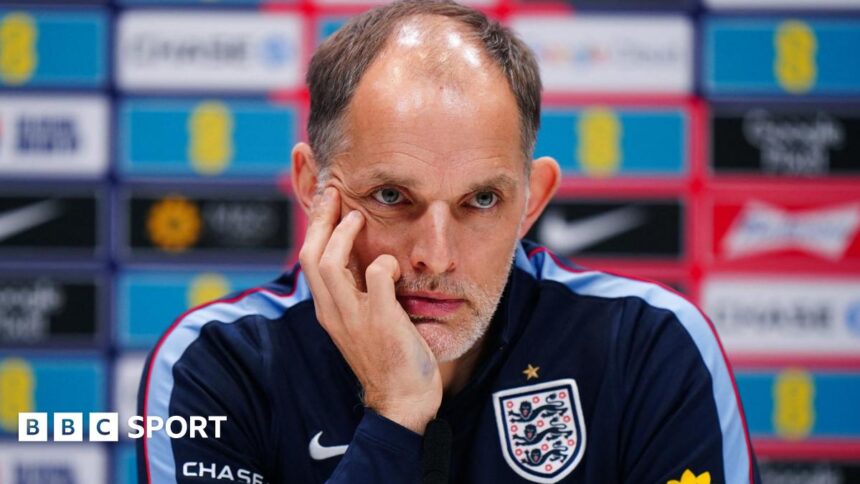
Tuchel’s Pragmatic Stance: Why England’s Manager Isn’t Angry Over Mass Withdrawals
The first major test of Thomas Tuchel’s nascent England tenure was never going to be a tactical one against Japan. Instead, it arrived in the form of a medical bulletin. As eight players—from established stars to rising talents—withdrew from the squad ahead of Tuesday’s friendly at Wembley, the narrative seemed pre-written: crisis, frustration, a manager’s plans in tatters. Yet, in a revealing display of modern managerial pragmatism, Tuchel has defied that script, expressing not anger but a sober understanding of the bigger picture.
A Squad Shaped by Necessity, Not Choice
Since Friday’s 1-1 draw with Uruguay, the England camp has seen a significant exodus. The list of withdrawals is a who’s who of crucial talent: the defensive bedrock of John Stones and Fikayo Tomori; the midfield engine of Declan Rice and promising newcomer Adam Wharton; the attacking thrust of Bukayo Saka and Noni Madueke; alongside goalkeeper Aaron Ramsdale and striker Dominic Calvert-Lewin. In a conventional international break, this would be catastrophic. But context, as Tuchel acutely recognizes, is everything.
This March camp is the final audition before the ultimate deadline: naming the squad for the 2026 World Cup on 30 May. The shadow of that tournament, and the gruelling club seasons that precede it, looms over every decision. Tuchel’s reaction was telling: “I am disappointed, but not with the players – with the fact we want to have everyone in good spirits and health.” This distinction is the cornerstone of his philosophy. The disappointment is in the situation, not the individuals caught in the relentless machinery of the football calendar.
Tuchel’s Philosophy: Health Over Hubris
Tuchel’s calm response is a masterclass in strategic man-management and long-term planning. It signals several key pillars of his approach as England manager:
- Player-Centric Trust: By publicly absolving the players of blame, he builds vital capital. He acknowledges their professional judgment and the physical demands placed upon them by their clubs, fostering a relationship built on mutual respect rather than authoritarian decree.
- The World Cup Horizon: Every decision is now filtered through the prism of North America 2026. A meaningless friendly in March, even against quality opposition like Japan, is inconsequential compared to having a fully fit Declan Rice or Bukayo Saka in peak condition for the tournament.
- Depth Chart Analysis: Forced withdrawals provide an unintended but invaluable opportunity. Tuchel now gets to examine alternatives under match conditions. The minutes given to squad players and new call-ups against Japan become critical data points for his final World Cup selections.
This is not a manager lowering standards; it is a manager modernizing them. In an era of extreme athlete load, ignoring player welfare is a fast track to tournament burnout. Tuchel’s stance is one of cold, calculated realism.
Silver Linings and Emerging Opportunities
While the absence of eight key figures undeniably weakens the immediate starting XI, it forcefully accelerates Tuchel’s evaluation process. The match against Japan is transformed from a routine fixture into a high-stakes trial for those on the squad’s fringes.
Who will partner Marc Guéhi in central defense? Can a midfield of, for example, Kobbie Mainoo and James Ward-Prowse establish control? Does this open a door for an attacking wildcard to seize their moment? These are questions Tuchel would have wanted to explore, but now must answer under the spotlight. The final England camp before the World Cup squad deadline has become exponentially more informative. The manager gains clearer insights into:
- The tactical flexibility and resilience of his broader squad.
- The mental readiness of backup players to step into high-pressure international matches.
- Which players possess the durability so desperately needed for a seven-game tournament.
Furthermore, by handling this situation with grace, Tuchel sends a powerful message to all England players: this regime is logical, collaborative, and focused on the ultimate prize.
Predictions: How This Shapes England’s World Cup Path
The immediate fallout is a likely experimental and potentially disjointed performance against Japan. Results in these windows are secondary; the process is paramount. Looking ahead to 30 May, this episode will significantly influence Tuchel’s selection strategy.
We can anticipate a World Cup squad selected with a heavy emphasis on proven physical resilience and a clear, trusted hierarchy within each position. Players who have navigated long club seasons and international duty without recurrent issues will be highly valued. Conversely, those with persistent fitness concerns, regardless of talent, may find their spots under serious threat.
Tuchel’s calm also hints at his expected rapport with Premier League clubs. An adversarial relationship benefits no one. His pragmatic approach suggests a willingness to engage in constructive dialogue over player condition, potentially leading to more tailored training regimens and communication in the lead-up to the World Cup. The ultimate winner in this scenario could be England’s tournament readiness.
Conclusion: A Defining Moment of Modern Management
Thomas Tuchel’s refusal to express anger over eight England withdrawals is far from a sign of weakness. It is a definitive statement of intent. It reveals a manager who prioritizes the forest over the trees, the marathon over the sprint. In the high-stakes, high-pressure role of England manager, where every word is dissected, his measured response demonstrates a clear vision: to build a sustainable, healthy, and trusting environment capable of conquering a World Cup.
The true test of his philosophy will come on the pitches of the United States, Canada, and Mexico in 2026. But by choosing understanding over ire in March 2025, Tuchel has already passed a critical early examination. He has shown he is not just a coach for a game, but a manager for a mission. The road to the World Cup is paved with difficult choices, and Tuchel’s first major one was to choose patience—a decision that may well define his England legacy.
Source: Based on news from BBC Sport.