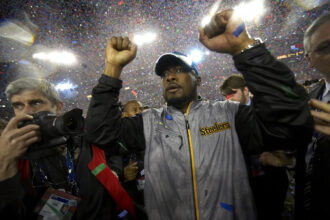
Mike Tomlin Opens Up: Why the Timing Was Right to Walk Away from the Steelers
For nearly two decades, Mike Tomlin was the face of stability in Pittsburgh. He never posted a losing record. He delivered a Super Bowl ring. He commanded the locker room with a quiet intensity that became legendary. But in January, the unthinkable happened: Tomlin resigned. Now, in his first interview since stepping down, the former Pittsburgh Steelers head coach has revealed the emotional calculus behind his departure. Speaking to NBC on Sunday night, Tomlin offered a rare, unfiltered look at the loneliness of leadership and why he believes the organization—and its veteran stars—needed a fresh voice.
“You know, it’s probably not an overnight decision,” Tomlin, 54, told NBC. “It’s probably not something that I could articulate or share with people. There’s a loneliness with leadership.” Those words cut to the core of what made Tomlin both revered and enigmatic. He wasn’t pushed out. He wasn’t fired. He walked away because he felt the weight of the moment—and the future of the franchise.
The Postseason Drought That Changed Everything
Tomlin’s legacy in Pittsburgh is ironclad. He guided the Steelers to victory in Super Bowl XLIII during the 2008 season, and his teams never finished below .500 in 19 seasons. But the numbers that haunted him were not about regular-season wins. They were about the playoffs. Since 2016, the Steelers have not won a single postseason game. That drought—stretching nearly a decade—became the silent storm cloud over an otherwise impeccable tenure.
“We didn’t have success in the playoffs in recent years,” Tomlin admitted. “And there’s just some veteran players there, man, guys like Cam Heyward and T.J. Watt and Chris Boswell, man, that I thought that just were worthy of the excitement and the optimism of new leadership.”
This was not a coach blaming injuries or bad luck. This was a leader looking at his core—the heartbeats of the franchise—and deciding they deserved a different soundtrack. Heyward, Watt, and Boswell are not just stars; they are the pillars of a defense that has kept Pittsburgh competitive. But even the best defensive unit cannot mask offensive inconsistencies. Tomlin, ever the strategist, knew that the magic formula had run its course.
Why Tomlin’s Decision Was About More Than Football
Tomlin hinted at a deeper, personal reckoning. “I just thought it was a good time for me personally and by that, I mean, just where I am in life,” he said. At 54, Tomlin is still young by coaching standards. Bill Belichick coached into his 70s. Andy Reid is 66. But Tomlin has always marched to a different drum. He has three children, a life outside the lines, and a desire to explore new challenges without the 24/7 grind of an NFL head coach.
“There’s a loneliness with leadership,” he repeated, emphasizing the isolation that comes with making decisions that affect hundreds of lives. In Pittsburgh, Tomlin was a king. But even kings tire of the castle walls. The decision to step down was not a sign of weakness; it was a sign of self-awareness. He recognized that the energy required to rebuild the offense—and to rekindle the playoff fire—might be better channeled by a new voice.
- No losing records in 19 seasons – an NFL record for a head coach with a single team.
- Super Bowl XLIII champion – a defining moment in franchise history.
- 0 playoff wins since 2016 – the statistic that tipped the scales.
- Veteran core aging – Heyward (35), Watt (30), Boswell (33) need a window.
What’s Next for Tomlin? A Move to the Broadcast Booth
Tomlin will not be gone from football. He will simply trade the sideline for the studio. NBC officially announced on Sunday that Tomlin will join “Football Night in America” as an NFL pregame show analyst. The show airs ahead of “Sunday Night Football,” giving Tomlin a national platform to share his insights with millions of viewers.
This transition is not unusual for former coaches. Tony Dungy, Jimmy Johnson, and Jon Gruden all made similar moves. But Tomlin brings something unique: raw charisma and an ability to break down complex schemes without condescension. He was always a master of the soundbite—think “The standard is the standard”—and now he will have the freedom to analyze without the burden of game-planning.
“I’m excited for the next chapter,” Tomlin said in the NBC announcement. “Football is in my blood, and I look forward to sharing my perspective with a national audience.” The move also allows him to stay connected to the league while stepping back from the relentless pressure of a head-coaching schedule. Expect him to be a breakout star in the booth. His candor and wit are tailor-made for television.
Predictions: What This Means for the Steelers and the NFL
Tomlin’s departure creates a seismic shift in the AFC North. The Steelers are now led by a new head coach—one who inherits a roster that is talented but flawed. The offense, long a source of frustration, needs a quarterback of the future. Kenny Pickett showed flashes, but consistency remains elusive. The new leadership will likely prioritize an aggressive offensive coordinator and a modern passing attack.
For Tomlin, the future is bright. He is not done coaching forever. Many analysts believe he could return to the sidelines in 2026 or 2027, perhaps for a team with a ready-made roster. Imagine Tomlin in Dallas, or Los Angeles, or even back in Pittsburgh if the new regime stumbles. He left the door open, even if he didn’t say it aloud.
“I just thought it was a good time for the organization,” Tomlin said. That sentence speaks volumes. He put the team first, even in his exit. That is the mark of a true leader. The Steelers will miss his steady hand, but they will benefit from the optimism he spoke of—the hope that comes with new leadership.
Strong Conclusion: A Legacy of Class, A Future of Possibility
Mike Tomlin’s resignation was not a surrender. It was a strategic retreat by a general who saw the battlefield clearly. He leaves behind a franchise that never knew losing under his watch, a city that adored him, and a set of veteran players who deserved one last chance at glory. His move to NBC is a win for football fans, who will now get weekly doses of his wisdom and wit.
The Steelers will move forward, but Tomlin’s shadow will linger. Every time a team struggles in the playoffs, analysts will ask: “What would Tomlin do?” And every Sunday night, he will be there to answer—on national television, with a smile, and with the quiet confidence of a man who knew exactly when to walk away.
Key takeaway: Tomlin’s decision was not about failure. It was about timing, respect, and the courage to change the script. For the Steelers, the standard remains. For Tomlin, the next chapter begins. And for the NFL, one of its most compelling voices just got a new microphone.
Source: Based on news from Deadspin.
Image: CC licensed via en.wikipedia.org