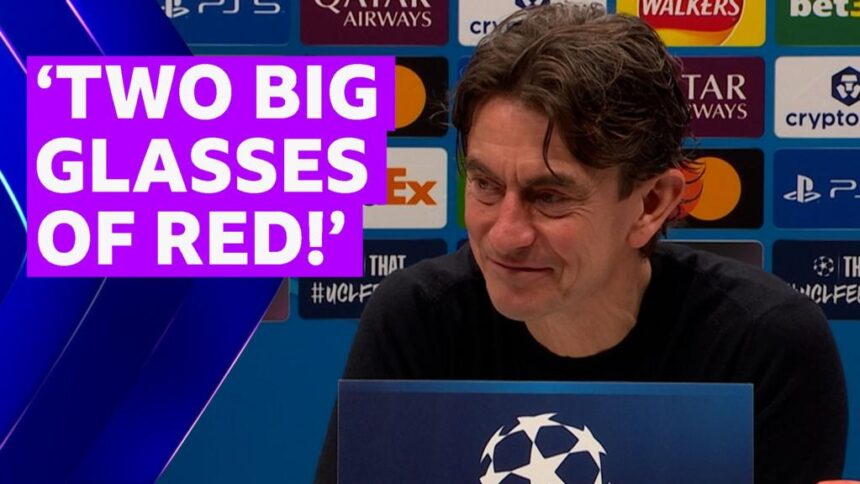
Frank’s Formula: Inside the Composed Mind Managing Tottenham’s Pressure Cooker
The pressure at Tottenham Hotspur is a unique, pervasive entity. It’s the weight of history, the demand for a style both entertaining and effective, and the relentless glare of a global fanbase. After a commanding 2-0 victory over a ten-man Borussia Dortmund in the Champions League—a result that sent a firm message to Group B—the focus wasn’t solely on the scoreline. It shifted to the man in the technical area, the architect of a project still under construction: Thomas Frank. In a post-match atmosphere where relief often mingles with joy, Frank projected something else entirely—a calm, unwavering conviction. His message was clear: this team is evolving, and the journey requires a commodity often in short supply in North London: patience.
The Dortmund Blueprint: A Testament to Tactical Growth
While the dismissal of Dortmund’s Ramy Bensebaini before half-time was a pivotal moment, to attribute Tottenham’s victory solely to numerical advantage would be to miss Frank’s point entirely. This performance was a curated display of controlled progression. The early phases showcased a disciplined mid-block, luring Dortmund into pressing traps before exploiting spaces with sharp, vertical passes. The goals themselves were not moments of individual brilliance in isolation, but the culmination of rehearsed patterns.
The first, a sweeping move finished by the ever-alert Heung-Min Son, originated from a regained possession in midfield. The second, a powerful header from Cristian Romero, came from a precisely delivered set-piece—a hallmark of Frank’s well-drilled sides. This was not a frantic, counter-punching win; it was a systemic victory. Frank’s analysis post-match zeroed in on this evolution: “We are seeing the details come together. The understanding of when to press as a unit, when to hold the shape, and the confidence to play through the lines. This is a process, and tonight we saw a very good step.”
Managing the Mindset: Frank’s Philosophy on Pressure
For Thomas Frank, managing pressure is not about ignoring it or wishing it away. It’s about reframing the narrative and building a culture resilient enough to withstand it. His approach is multifaceted, built on clear communication and psychological groundwork.
- Transparency in the Project: Frank consistently outlines a clear vision. He acknowledges the club’s ambitions while openly discussing the steps required to get there. This honesty manages external expectations and aligns the internal dressing room.
- Process Over Outcome: In media appearances and, presumably, in the locker room, Frank emphasizes performance metrics beyond the score. Ball recovery positions, pass selection in transition, defensive spacing—these are the controllable details he focuses on, insulating players from the volatile noise of pure result-based analysis.
- Collective Responsibility: The “us against the world” mentality is carefully nurtured. By framing pressure as a shared challenge and a privilege of representing a giant club, Frank fosters a unified resilience. The pressure doesn’t land on one star player’s shoulders; it is distributed across a squad all tasked with executing a specific role.
“Pressure is a privilege,” Frank has said in the past, echoing the famous Billie Jean King quote. “It means you are at a club where people care deeply. Our job is not to shy from it, but to let it fuel our preparation and our courage on the pitch.”
The Patience Paradox: Building in the Age of Instant Demands
Frank’s post-Dortmund call for patience is perhaps his boldest tactical move yet. In the modern game, where managers are often granted the time of a teaspoon in a hurricane, asking for a runway is a risk. Yet, he bases his case on tangible, incremental improvement. He is not asking for blind faith, but for recognition of a growing trendline.
Compare Tottenham’s early-season performances to the Dortmund display. The frantic edges have smoothed. The defensive line, once prone to catastrophic individual errors, now steps up with more synchronicity. The midfield, with new signings still gelling, is beginning to dictate tempo rather than react to it. Frank’s system—a fluid 4-3-3 that can morph into a 3-2-5 in possession—requires near-perfect positional understanding. His argument is that each match, each training session, builds that muscle memory.
“You do not build a house in a day,” Frank stated. “You lay the foundation, you check it is strong, then you build the walls. We are building the walls now. The structure is getting stronger.” This metaphor is his shield against the reactive cycle of crisis and triumph that defines so much football media.
Predictions and the Road Ahead: Can Composure Breed Consistency?
The victory over Dortmund provides significant breathing room in Europe, but the true test of Frank’s pressure management lies in the relentless grind of the Premier League. The predictions for Tottenham’s season now hinge on a key question: can the composure shown in a big European night translate into week-to-week consistency against varied tactical challenges?
The signs are cautiously optimistic. Frank has proven at previous clubs his ability to instill a resilient identity. His Tottenham side is beginning to show a tactical fingerprint:
- A Press-Resistant Core: The development of midfielders like Pape Matar Sarr in playing through pressure is crucial.
- Set-Piece Weaponization: A clear source of goals, adding a reliable string to their bow.
- Adaptable In-Game Management: Frank’s substitutions against Dortmund were proactive, seeking a second goal to kill the game, not passively protecting a lead.
The major hurdle remains squad depth and handling inevitable injuries. However, if Frank can maintain the psychological sanctuary he is building—where players are freed to execute without fear—Tottenham is poised for a season where they control their destiny in the top-four race and become a genuinely awkward opponent for anyone in the Champions League knockout stages.
Conclusion: The Steady Hand at the Helm
Thomas Frank understands that at a club like Tottenham Hotspur, the pressure is non-negotiable. It comes with the fabric of the shirt. His innovation is not in removing it, but in systematically managing its impact. The win over Borussia Dortmund was a validation of his methods—a performance where tactical intelligence and mental fortitude were equally important. By championing patience and pointing to visible growth, Frank is attempting to shift the external conversation while solidifying an internal belief. In the high-stakes theatre of modern football, his calm, process-oriented leadership might just be the most revolutionary tactic of all. The project is underway, and for now, the trust from the stands and, most importantly, from the pitch, seems to be growing with every controlled, composed performance.
Source: Based on news from BBC Sport.