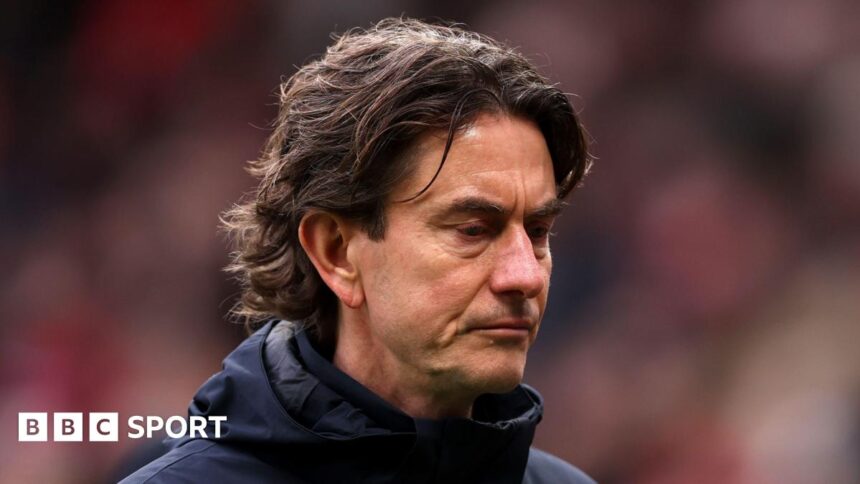
Thomas Frank’s Tottenham Tenure Ends in Abrupt Sacking After Eight Turbulent Months
The revolving door at Tottenham Hotspur has spun once more. In a move that shocked few but underscored the deep turmoil at the North London club, Chairman Daniel Levy has terminated the contract of head coach Thomas Frank after just under eight months in charge. The decision, confirmed in the early hours of Wednesday, comes immediately on the heels of a dismal 2-1 home defeat to Newcastle United, a performance that served as the final, damning indictment of a regime that has spectacularly unraveled. Frank, who arrived with a reputation for intelligent, structured football built over seven years at Brentford, leaves with Spurs languishing in 16th place, a mere five points above the Premier League’s relegation zone and engulfed in a full-blown crisis.
A Promise Unfulfilled: The Rapid Unraveling of the Frank Project
When Thomas Frank was appointed last summer, there was a cautious optimism. Here was a manager renowned for his meticulous preparation, his ability to maximize a squad’s potential, and for building a cohesive, aggressive unit at Brentford. The hope was that he could instill similar organization and identity into a Tottenham squad that had seemed directionless. Early signs were mildly promising, with a couple of resilient displays. However, the foundation proved to be built on sand. A lack of a consistent tactical fingerprint, growing discontent within the squad, and a brutal run of results quickly eroded any initial goodwill.
The statistics paint a picture of a historic decline. Tottenham’s current form is not just bad; it is historically poor for a club of its stature. The defeat to Newcastle extended their winless run in the Premier League to eight matches, their longest such streak since October 2008. Delve deeper, and the numbers become even more alarming. Across their last 17 league games, Spurs have managed a paltry two victories, collecting only 12 points from a possible 51. This is form that belongs to a relegation battler, not a team with aspirations of European football. The dreadful run of form has created a palpable toxicity around the club, with fan protests aimed at the board now a regular feature at home matches.
Anatomy of a Collapse: Key Factors Behind the Sacking
Frank’s sacking is the result of a perfect storm of failures, both on and off the pitch. Several critical factors converged to make his position untenable.
- Tactical Confusion and Ineffective Signings: Frank never seemed to settle on a definitive style or best XI. Fluctuations between a back three and a back four led to instability. Key signings from the summer, brought in under his recommendation, have failed to adapt or perform, leaving the squad looking unbalanced and ill-constructed.
- Defensive Shambles: Tottenham have become notoriously easy to play against. They have kept only one clean sheet in the league since September. The defensive organization, supposedly a Frank hallmark, has been non-existent, characterized by individual errors and a lack of collective resilience.
- Erosion of Player Confidence: As results worsened, the players’ body language told its own story. Heads dropped quickly after conceding, and a palpable lack of belief seeped into performances. Frank appeared unable to reverse this psychological slump.
- The Growing Chasm with Supporters: The connection between the team and the fanbase has been severed. The 2-1 defeat at home to Newcastle was the final straw for many, a performance lacking in passion, quality, or any discernible plan. In the modern game, when a manager loses the stands so decisively, recovery is nearly impossible.
Ultimately, the Premier League relegation zone is now looming far too large in the rearview mirror for Levy to ignore. The financial and reputational catastrophe of a drop out of the top flight forced his hand.
What’s Next for Tottenham Hotspur? A Club at a Crossroads
The sacking of Thomas Frank is not a solution; it is an emergency intervention. It addresses a symptom but not the disease. The immediate priority is appointing a caretaker manager, with under-fire assistant manager and former Spurs player Ryan Mason the obvious candidate to step in for a second interim stint. The club must find a short-term stabilizer who can somehow scrape together enough points to secure safety.
Beyond survival, the questions are profound. Daniel Levy’s leadership and the club’s sporting structure are under unprecedented scrutiny. The cycle of hire-and-fire is accelerating, with Frank becoming the fourth permanent manager in four years. The next appointment must be part of a clear, long-term vision, but the club’s chaotic state makes it a deeply unappealing project for elite managers.
Potential candidates will be wary. The squad requires a major overhaul, yet Financial Fair Play constraints are tight. The new manager will need to be a unifier, a tactician, and a motivator—a near-impossible trifecta given the current environment. Names like Graham Potter or Ange Postecoglou may be linked, but each would represent a huge gamble for both the club and the individual.
Final Whistle: A Sobering Lesson for All
Thomas Frank’s tenure at Tottenham Hotspur will be remembered as a brief, failed experiment. It is a stark reminder that success at a well-run, mid-table club does not automatically translate to handling the immense pressure, scrutiny, and dysfunction of a supposed “big six” giant in crisis. For Frank, it is a brutal setback, but his work at Brentford will likely earn him another chance elsewhere in time.
For Tottenham, the soul-searching must be deep and honest. Sacking Frank was the easy part. The hard part is confronting the systemic issues that have made the club a laughingstock and a byword for instability. They are no longer a team trying to crack the top four; they are a team in a desperate fight for top-flight survival. The sacking is the end of a failed chapter, but unless the fundamental lessons are learned, it is merely a prelude to the next crisis. The longest run without a victory since 2008 is more than a stat; it is a symbol of a proud club that has lost its way. Finding it again will be their greatest challenge yet.
Source: Based on news from BBC Sport.