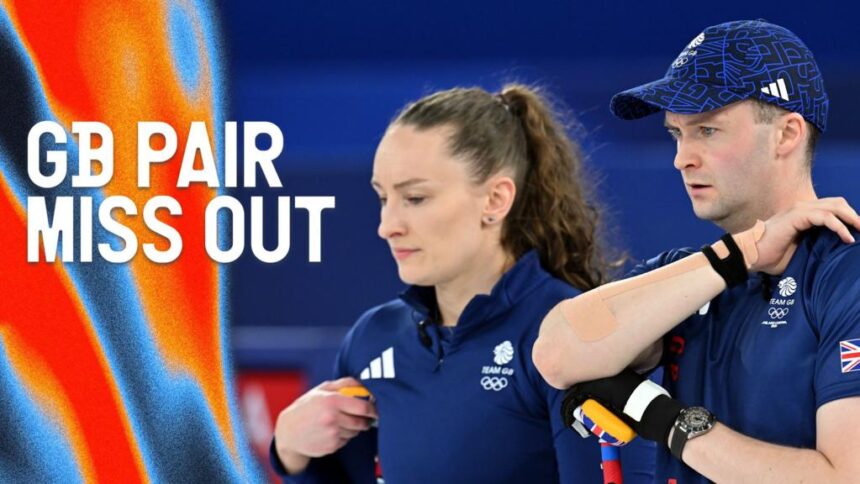
Dodds & Mouat’s Dream Dashed: Team GB’s Mixed Doubles Curlers Fall at Semi-Final Hurdle in 2026 Winter Olympics
The roar of the Cortina d’Ampezzo crowd faded into a stunned silence for the British contingent as Jen Dodds’ final stone slid agonisingly wide of its target. In that moment, the guaranteed medal vanished, and with it, the chance to ignite Team GB’s 2026 Winter Olympic campaign with early glory. The highly-fancied duo of Dodds and Bruce Mouat, a partnership forged in world-class success, suffered semi-final heartbreak, falling 6-5 to a resilient Swedish pair in an extra end thriller that will haunt British curling fans.
This was more than a simple loss; it was a narrative interrupted. The path was clear: win and secure at least silver, becoming the first British athletes to mount the podium in Italy. Instead, the Swedish skip, with ice-cool precision, capitalized on a sliver of an opportunity in the extra end, leaving Dodds and Mouat with a near-impossible shot to win. The miss was decisive. Team GB’s first medal of these Games will have to wait, while the Scottish-born duo must now regroup for a bronze medal match that suddenly feels like a monumental test of character.
A Tactical Battle of Inches and Missed Opportunities
From the first stone, the semi-final was a chess match on ice. Dodds and Mouat, known for their aggressive, shot-making style, were met with a Swedish strategy of meticulous containment. The British duo started strong, forcing Sweden to take a single in the first end before seizing a 2-1 lead. However, the middle ends revealed the first cracks. A rare miscommunication on guard placement in the fourth end gave Sweden a steal of one, swinging momentum.
Bruce Mouat’s draw weight, typically his superpower, was slightly variable under the intense Olympic pressure. Conversely, the Swedish pair grew in confidence, their precision hitting consistently clearing British stones at critical moments. The game turned into a grinding defensive struggle, a far cry from the free-flowing matches that had propelled GB to the top of the round-robin standings.
“We just couldn’t find our rhythm consistently today,” a visibly disappointed Mouat said in a post-game interview. “They forced us into shots we didn’t want to play, and in a semi-final, those half-chances are what it comes down to. Jen made some incredible shots to keep us in it, but we left ourselves too much to do at the end.”
Where the Gold Medal Dream Slipped Away
Expert analysis points to a confluence of factors in this devastating loss. While the Swedish performance was exemplary, the GB pair will rue specific moments where gold medal authority slipped from their grasp.
- Third End Inactivity: With last stone advantage, a conservative approach led to a blanked end. In mixed doubles, where scoring with the hammer is paramount, this felt like a missed opportunity to build a multi-point lead and apply early pressure.
- Critical Sixth-End Force: After a brilliant double-takeout by Dodds to limit damage, GB was forced to concede a single, tying the game. This was a pivotal hold by Sweden that kept them within touching distance and belief alive.
- The Final Shot of Regulation: In the eighth and final scheduled end, tied 5-5 and with hammer, Mouat had a makeable draw for the win. The stone was on line but came up short by millimeters, necessitating the extra end and handing Sweden the critical last-stone advantage.
- Swedish Clutch Gene: Under immense pressure, the Swedish duo made every final shot count. Their shot success percentage in the extra end was a perfect 100%, a statistic that underscores their champion mentality when it mattered most.
“The margins are microscopic at this level,” commented former Olympic champion curler, Rhona Howie. “GB had the quality but Sweden had the marginally better execution in the pivotal moments. Jen and Bruce will feel they didn’t play their ‘A’ game, and in an Olympic semi-final, that’s often all it takes.”
Bronze or Bust: The Psychology of Recovery
The immediate aftermath of such a crushing defeat is almost as challenging as the match itself. The shift from competing for gold to fighting for bronze is a brutal psychological pivot. The bronze medal match is often described as the hardest game in sports—a contest between two devastated teams who must summon motivation from the depths of disappointment.
For Dodds and Mouat, their legacy at these Games now hinges on their response. Their partnership resilience will be tested like never before. Do they have the mental fortitude to refocus, to channel the frustration into a polished, determined performance? History is littered with teams who faded after semi-final loss, and others who rallied to claim a medal that, while not the colour they wanted, still signifies Olympic excellence.
“This is where the team shows its true character,” Mouat stated, already shifting focus. “We came here for a medal. That chance is still there. It’s not the one we dreamed of last night, but we owe it to ourselves and everyone who supported us to leave everything on the ice one more time.”
Legacy and Looking Ahead for GB Curling
While the semi-final loss is a fresh wound, the broader picture for British curling remains strong. The fact that Dodds and Mouat were considered gold medal favourites speaks volumes about the program’s health. This result, however painful, is not a systemic failure but the inherent cruelty of high-stakes, single-elimination play.
The performance will raise questions about the unique pressures of the mixed doubles Olympic format, where the game’s pace is frenetic and errors are magnified. For Team GB, the focus must immediately turn to support for the duo in the bronze medal match, and subsequently, to the men’s and women’s team events, where Mouat (in the men’s) will again be a central figure.
This semi-final heartbreak will either be a footnote in a story of bronze-medal redemption or a cautionary tale of Olympic pressure. The duo’s ability to learn from this defeat will define not just their 2026 Games, but potentially their careers. The very best athletes use such searing disappointment as fuel.
Conclusion: A Cruel Twist on the Olympic Sheet
Jen Dodds and Bruce Mouat’s journey to the 2026 Winter Olympics semi-final was a testament to their skill and partnership. Their exit from gold medal contention is a stark reminder that in the cauldron of the Olympics, narrative and favouritism mean nothing against cold execution. The Swedish pair were deserving winners on the day, capitalizing on the minute vulnerabilities that GB displayed.
As they prepare for the bronze medal match, the entire British team faces a defining moment. The colour of the medal may have changed, but the objective remains: to stand on an Olympic podium. How they respond to this adversity will reveal the true heart of this team. For British fans, the first medal of Cortina 2026 is still within reach, but the path to it has become a far steeper, more emotionally charged climb. The final chapter of Dodds and Mouat’s 2026 story is yet to be written, and it promises to be one of the most compelling tales of resilience these Games may produce.
Source: Based on news from BBC Sport.