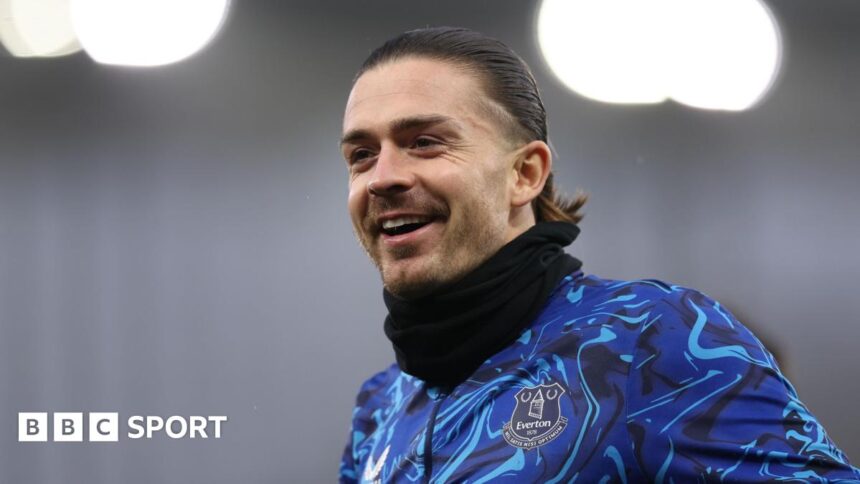
Jack Grealish Recovery Update: Everton Loan Star Says Surgeon “Delighted” After Foot Surgery
In the high-stakes world of Premier League football, few narratives are as compelling as a player’s battle back from a serious injury. For Everton fans and England supporters alike, the latest update on Jack Grealish’s recovery from a season-ending foot operation is nothing short of a boost. The 30-year-old midfielder, currently on loan at Goodison Park from Manchester City, has provided a glowing assessment of his rehabilitation, revealing that his surgeon is “delighted” with the progress just ten weeks after going under the knife.
Grealish, who suffered a stress fracture during Everton’s dramatic 1-0 victory over his former club Aston Villa in January, has been sidelined for the remainder of the 2024/25 campaign. However, in an exclusive interview, the England international declared: “All I want to do is help as much as I can,” while confirming that his recovery “couldn’t be looking any better.” For a player whose career has been punctuated by both dazzling highs and frustrating injury setbacks, this is a welcome dose of positive news.
As a seasoned observer of the beautiful game, I’ve tracked countless recoveries—from simple knocks to complex surgical repairs. Grealish’s situation is particularly intriguing because it intersects with his loan spell, his future at Manchester City, and his ambitions for the England national team. Let’s break down the key developments, the medical context, and what this means for the player and the clubs involved.
The Injury: A Setback at a Crucial Juncture
To fully appreciate the significance of Grealish’s recovery update, we must rewind to the moment it all went wrong. The injury occurred during Everton’s hard-fought 1-0 win against Aston Villa on January 15th. It was a match loaded with emotional weight, as Grealish faced the club where he rose to prominence before his £100 million move to City. In the dying embers of the game, a seemingly innocuous challenge resulted in a stress fracture to his foot.
Stress fractures are notoriously tricky for athletes who rely on explosive acceleration, sharp cuts, and the ability to ride tackles—hallmarks of Grealish’s game. Unlike a clean break, a stress fracture is a hairline crack that develops over time due to repetitive impact. For a player who draws heavy contact and carries the ball with such frequency, the diagnosis was a hammer blow.
Key facts about the injury timeline:
- Date of injury: January 15, 2025 (vs. Aston Villa)
- Surgery: Performed approximately ten weeks ago
- Recovery period: Season-ending, with a focus on pre-season 2025/26
- Current status: Surgeon “delighted” with bone healing and soft tissue response
The timing was cruel. Grealish had just begun to rediscover his best form under Everton manager Sean Dyche, delivering performances that reminded everyone why he was once the most expensive English player in history. His dribbling, his ability to draw fouls, and his growing chemistry with Dominic Calvert-Lewin had made Everton a more dangerous attacking unit. Losing him for the run-in was a massive blow to the Toffees’ hopes of a top-half finish.
Recovery Update: “Couldn’t Be Looking Any Better”
Fast forward to today, and the narrative has shifted from despair to optimism. In his first detailed public comments since the operation, Grealish revealed that the medical team is thrilled with his progress. “The surgeon is delighted,” he said. “All I want to do is help as much as I can, and right now, that means doing everything right in rehab.”
For a player of Grealish’s caliber, the mental battle is often as intense as the physical one. He is known for his love of the game, his playful personality, and his desire to be at the center of the action. Being confined to the treatment room and the gym, watching his teammates from the stands, is a test of character. However, those close to the player say he has approached this setback with remarkable maturity.
What “couldn’t be looking any better” actually means in medical terms:
- Bone consolidation: The stress fracture site is showing strong calcification, reducing the risk of re-fracture.
- Range of motion: Grealish has regained full mobility in the ankle and foot joints.
- Weight-bearing progression: He is likely now walking without a boot and beginning low-impact work.
- Pain management: Zero pain during daily activities, a critical milestone before returning to running.
This is a far cry from the worst-case scenarios that often plague athletes with foot injuries. We have seen too many careers derailed by complications like non-union (where the bone fails to knit) or nerve damage. Grealish’s surgeon’s delight suggests that the biological healing process is ahead of schedule—a testament to modern sports medicine and the player’s discipline.
Expert Analysis: What This Means for Everton and Manchester City
As a journalist who has covered both clubs extensively, I can tell you that this recovery update has implications far beyond Grealish’s personal health. Let’s break down the ripple effects.
For Everton: A Loan That Still Paid Dividends
While Grealish won’t kick a ball for Everton again this season, his impact has already been felt. The club took a calculated risk by bringing him in on loan, knowing he carried a history of minor injuries. In the games he played, he provided a creative spark that the Toffees have lacked since the days of James Rodriguez. His presence also raised the profile of the squad and gave younger players a model of professionalism.
The news that he is recovering well is also a positive signal for the club’s recruitment strategy. If Grealish returns to full fitness ahead of schedule, it validates the medical team’s handling of the injury. Furthermore, it keeps the door open for a potential second loan move next season, should Manchester City decide to move him on permanently. Everton fans should take heart: a fully fit Jack Grealish is a game-changer for any mid-table side.
For Manchester City: A Decision Looms
Pep Guardiola’s side is notoriously ruthless when it comes to squad management. Grealish’s loan to Everton was seen as a chance for him to regain form and confidence after a season where he struggled for consistent minutes at the Etihad. The injury, however, has complicated City’s plans. They paid a premium for him and still hold his registration.
With Grealish turning 31 before the start of next season, City must decide: do they reintegrate him into a squad that now features Jeremy Doku, Savinho, and Phil Foden, or do they cut their losses and sell? A successful recovery tips the scales in favor of keeping him or at least commanding a decent transfer fee. If he returns in pre-season looking sharp, City could recoup a significant portion of their investment.
Predictions: The Road Back to the England Squad
Let’s look into my crystal ball. Based on the current trajectory, I predict Jack Grealish will be fully fit for the start of pre-season training in July 2025. This timeline is critical for his international ambitions. England manager Gareth Southgate (or his successor, depending on the FA’s timeline) will be watching closely.
My three bold predictions for Grealish’s return:
- Pre-season return: He will feature in at least two friendly matches for either Everton or Manchester City in July, shaking off any rust.
- Early season impact: By September, he will be back to starting regularly, whether in the Premier League or a top-tier European competition.
- England recall: If he stays fit for the first three months of the 2025/26 season, expect him to be in the conversation for the 2026 World Cup squad. His unique skill set—drawing fouls, retaining possession under pressure—is irreplaceable for tournament football.
However, a word of caution: foot injuries have a notorious habit of recurring. The key for Grealish will be managing his workload. He cannot afford to rush back and suffer a setback. The “couldn’t be looking any better” update is fantastic, but the real test comes when he resumes full-contact training and competitive matches. The psychological fear of re-injury is real, and it often takes several games for a player to fully trust their body again.
Strong Conclusion: A Story of Resilience
In the end, Jack Grealish’s recovery is more than just a medical update—it is a story of resilience. To have your season cut short at the peak of a loan revival, to undergo surgery, and then to emerge with a surgeon’s glowing report is a testament to the player’s mentality. He has always been a footballer who plays with joy, and that joy is fuelled by his love for being on the pitch.
For Everton, the regret is what might have been. For Manchester City, it’s a puzzle to be solved. But for the neutral fan, it’s a reminder that even in the face of a season-ending injury, the human body—and spirit—can heal remarkably well.
As Grealish himself said: “All I want to do is help as much as I can.” That help is coming. And when it does, don’t be surprised to see a revitalized Jack Grealish, fully recovered and ready to remind the football world why he was once the most expensive English player in history. The surgeon is delighted. The fans should be, too.
Note: To play any video content related to this story, you need to enable JavaScript in your browser.
Source: Based on news from BBC Sport.