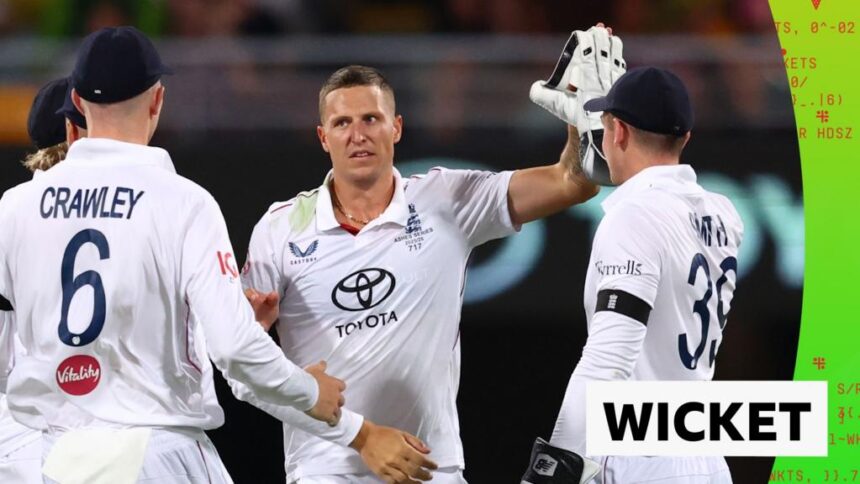
Cameron Green’s Costly Lapse: A ‘Huge Error’ That Reopened the Ashes Door for England
The Gabba, a fortress painted in Australian gold, was beginning to hum with the serene confidence of a home side building an unassailable lead. At 291-4, with Cameron Green looking immovable on 45 and the imposing figure of Travis Head settled at the crease, England’s hopes in the second Ashes Test were fading into the Brisbane haze. Then, in a moment of bewildering aberration, the game turned. A single delivery from Brydon Carse, a bowler fighting for his place, and a staggering lapse from a batter known for his calm assurance, ripped the narrative apart. Cameron Green’s dismissal was not just a wicket; it was a psychological tremor, a ‘huge error’ that gifted England a lifeline they scarcely deserved and transformed the complexion of day two.
The Moment of Madness: Deconstructing the Dismissal
Brydon Carse, generating decent pace from the Vulture Street End, angled a fullish delivery into the right-handed Green. It was a decent ball, but on a placid Gabba track, it was the kind of delivery a set batter of Green’s class would normally work into the leg side or drive with minimal risk. What followed was a technical and mental breakdown in high definition. Instead of moving his front foot towards the pitch of the ball, Green’s stride was hesitant, angled towards mid-on. This slight technical flaw caused his upper body to fall away, opening up his chest to the bowler. As he swung through a loose drive, his head was nowhere near the line, and his feet provided no stable base.
The result was a catastrophic exposure of his stumps. The ball, perhaps tailing a fraction, snuck through the cavernous gap between bat and pad, clattering into the off-stump. Green stood frozen, a picture of instant regret, as the England fielders erupted. It was a dismissal more commonly seen in club cricket or a nervous starter, not from a world-class all-rounder on the cusp of a commanding half-century. The error was two-fold:
- Poor Footwork: The lazy, offline stride created the initial problem.
- Head Position: Falling away ensured he lost sight of the ball’s line entirely.
This was a gifted wicket, a self-inflicted wound that Carse and England gratefully accepted.
The Ripple Effect: How Green’s Wicket Changed the Session
In Test cricket, momentum is a currency as valuable as runs. Australia was accumulating it in steady, untroubled increments. Green’s partnership with Head was beginning to look ominous, shifting the focus from if Australia would take a massive lead to how massive it would be. His dismissal acted as a circuit-breaker, injecting a jolt of adrenaline into an England side that was beginning to toil.
The fall of the wicket did three critical things:
- It Brought Alex Carey In Early: The new batter, though talented, had to start his innings under renewed pressure, with England’s bowlers suddenly sensing vulnerability.
- It Disrupted Australia’s Rhythm: The smooth, run-a-minute accumulation was halted, forcing a period of reassessment and consolidation.
- It Galvanized England’s Attack: Bowlers like Carse and Woakes found a second wind. The fielding tightened, and the chatter increased. One mistake had transformed a flat unit into a hungry one.
Most importantly, it prevented Australia from reaching a truly dominant position at the close. Instead of being five or six down with a lead pushing 150, they were left with work to do, keeping England’s deficit within a theoretically chaseable range on a still-good batting wicket.
Expert Analysis: A Rare Chink in Green’s Armor
Cameron Green has built his reputation on a temperament that belies his years. He is often the crisis manager, the calm counter-attacker. This makes his dismissal all the more puzzling for analysts. Was it a lapse in concentration, a moment of overconfidence, or a subtle technical glitch exploited by Carse’s angle?
The consensus points to a concentration error. After doing the hard work against the new ball and seeing off the main threats, Green may have subconsciously placed Carse in a lesser category. This is the danger of the modern batting lineup; against perceived weaker links, the switch from defense to aggressive scoring must still be executed with precision. Green attempted the latter without the foundational footwork of the former. It serves as a stark reminder that in Ashes cricket, there are no free passes. Every bowler, from the veteran seamer to the fourth-change option, is capable of capitalizing on even a 1% drop in a batter’s focus.
For Brydon Carse, this is a career-boosting moment. To take a key wicket through persistent, straight bowling when the game was slipping away validates his selection and provides England with a much-needed point of difference in their attack.
Predictions: The Test Hangs in the Balance
This single moment has ensured the third day in Brisbane is now a blockbuster. The match is perfectly poised. Australia still holds the advantage, but it is no longer a commanding one. The first session on day three becomes a micro-Test in itself.
If Australia can navigate the first hour without further loss, with Head continuing his aggressive ways, they can still post a lead in excess of 180 and put England under severe scoreboard pressure in the fourth innings. The pitch is expected to remain good for batting for another day.
If England can strike early, removing Head or Carey with the second new ball due imminently, they can restrict the lead to under 100. This would represent a monumental effort and place the pressure squarely back on Australia’s bowlers in the second innings. The psychological lift from Green’s wicket could translate into a sustained bowling performance.
The key battle will be Travis Head versus England’s plan. Will they go short? Will they attack his pads? How England manages Head could define the entire innings.
Conclusion: The Fine Margins of Ashes Cricket
Cameron Green’s dismissal for 45 will be logged in the scorebook as a simple bowled. But its impact resonates far deeper. It was a stark illustration of how the Ashes can turn on a single, unforced error. In a series defined by pressure, even the most composed players can crack. England, who were staring down the barrel of a long, leather-chasing two days, were handed hope on a silver platter. They now have a tangible opportunity to claw their way back into this Test and, by extension, the series.
The ‘huge error’ by Green did more than just lose a wicket; it reignited a contest that was drifting. It proved that no position, no matter how comfortable it appears at the Gabba, is safe. As the teams prepare for day three, the memory of that loose drive will linger. For Australia, it’s a warning against complacency. For England, it’s the lifeline they desperately needed. The 2025 Ashes, it seems, is still very much alive.
Source: Based on news from BBC Sport.
Image: Source – Original Article