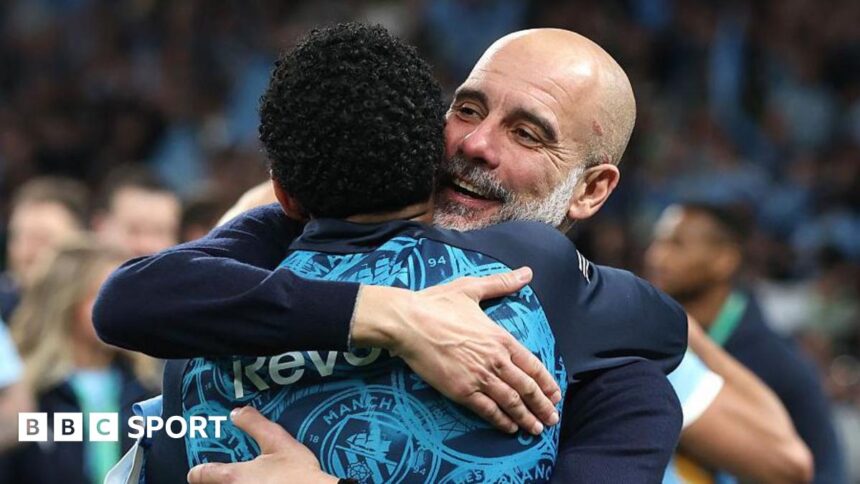
Guardiola’s Touchline Tango: The Dance That Shook Arsenal and Defined City’s Hunger
The final whistle had blown, the trophy was being polished, and yet the enduring image from Wembley was not of silverware, but of a 52-year-old man in a slim-fit overcoat, sprinting, leaping, and dancing with unbridled, childlike joy down the touchline. As Manchester City clinically dispatched a desolate Arsenal 2-0 to claim the Carabao Cup, Pep Guardiola provided a celebration that spoke louder than any post-match interview ever could. This was not just a victory; it was a statement of intent, a visceral release of pressure, and a masterclass in psychological warfare, all choreographed in a few frantic seconds of pure emotion.
The Jig That Juxtaposed Two Title Rivals
Context is everything. The moment came in the 77th minute, as young substitute Nico O’Reilly—a symbol of City’s relentless production line—soared to power home his second header in four minutes, sealing the victory. The camera, as it so often does, found Guardiola. What followed was a burst of kinetic energy: a wild, grinning sprint followed by a series of fist-pumps and a shuffling dance towards City’s euphoric supporters. He was lost in the moment, yet entirely aware of its magnitude.
This was more than happiness; it was a calculated eruption. Guardiola’s touchline celebration served as a stark contrast to the forlorn figure of Mikel Arteta in the opposite technical area. One manager was a whirlwind of passion, the other frozen in quiet dismay. The dance underlined the chasm in mentality at that precise moment. City, seasoned in the art of winning, found another gear. Arsenal, for all their league-leading prowess, looked hollow on the big final stage. Guardiola’s joy was the direct inverse of Arsenal’s desolation, a visual representation of the psychological pressure now firmly piled onto the Gunners’ shoulders.
Decoding the Dance: Hunger, History, and a Hint of Gamesmanship
In his press conference, Guardiola deflected with characteristic wit. “I wanted another yellow card and that is why I did it,” he joked, referencing a earlier booking. But to dismiss it as mere mischief is to miss the point entirely. This celebration was a multi-layered manifesto.
- The Hunger Remains: After years of dominance, questions inevitably arise about appetite. Guardiola’s sprint was the ultimate rebuttal. His competitive fire burns as fiercely as ever, and he demanded his players mirror it. The bearhugs he bestowed upon his staff and players at full-time were not of relief, but of shared, ferocious desire.
- Making History (Again): With this win, Guardiola became the first manager to win the EFL Cup five times. He is a man driven by records and legacy. This dance was a physical release of the satisfaction that comes with redefining the limits of success.
- A Strategic Message: Guardiola is a grandmaster of mental chess. This very public display of euphoria sends a deliberate message to his own squad, to Arsenal, and to the watching world: Manchester City’s winning mentality is intact, and they revel in the pressure that suffocates others.
The analysis from former players was unanimous. This was Pep in his purest form—a manager whose emotional investment is total. It demonstrated that for all the tactical genius, the foundation of his success is an unwavering, almost obsessive, will to win that transmits directly to his players.
The Ripple Effect: Premier League Psychology and the Road Ahead
The ramifications of this Wembley afternoon extend far beyond a single cup. The Premier League title race, once seemingly Arsenal’s to lose, has been violently shaken. City, now just two points behind with a game in hand, have landed a significant psychological blow.
For Arsenal, the manner of the defeat is the concern. They were not just beaten; they were outmaneuvered and out-muscled in a cup final, a scenario that can plant seeds of doubt. The sight of Guardiola’s jubilation will haunt them. It screamed: “This is our stage. This is what we do.” The question now is how Arteta’s young side responds. Can they use this desolation as fuel, or will the memory of City’s superiority—and their manager’s joyous dance—become a weight?
For Manchester City, the victory is a turbocharge. The Carabao Cup triumph is often the catalyst for their relentless spring surges. It validates their process, boosts squad morale, and installs a familiar, winning feeling at the most crucial time of the year. With the FA Cup and Champions League also in play, City are now hunting a historic treble, their confidence soaring.
Predictions: A Title Race Transformed by a Touchline Sprint
Based on this watershed moment, the trajectory of the season has shifted.
- The Psychological Edge: City now hold a clear mental advantage. They have proven they can beat Arsenal decisively when it matters. The Gunners must overcome not just a points gap, but a newfound psychological hurdle.
- Guardiola’s Relentless Machine: Expect City’s performance levels to spike further. The first trophy is in the bag, and Guardiola’s celebration signals he is hungrier than ever. Squad rotation will be masterful, and their depth will tell in the congested fixture list.
- Arsenal’s Character Test: The next few league games are critical for Arteta’s men. They must show immediate resilience. If they stutter, the narrative will be set, and City’s experience in run-ins makes them overwhelming favorites.
The head-to-head Premier League clash at the Etihad in late April now looms as a potential title decider, a match imbued with the fresh memory of Wembley’s power dynamics.
Conclusion: More Than a Dance, A Declaration
Pep Guardiola’s dance of joy at Wembley was a fleeting moment that captured an eternal truth about elite sport. In those unguarded seconds, he revealed the heart that powers the machine. This was not just about a record fifth League Cup; it was a declaration of enduring dominance, a masterful application of psychological pressure, and a vivid demonstration that Manchester City’s hunger is far from sated.
For Arsenal, the path to the title now looks steeper and more fraught. They are not just chasing points; they are chasing a ghost, the specter of a rival and a manager who, when the lights are brightest, still knows how to win—and knows how to celebrate it in a way that echoes long after the music stops. The title race was always going to be a marathon, but Guardiola, with a few joyous steps, just turned it into a sprint. And that is a dance he knows all too well.
Source: Based on news from BBC Sport.