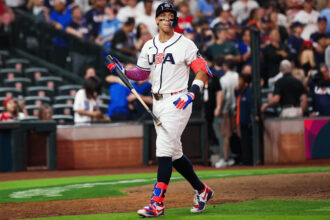
Mets Land Marquee Bat, Agree to 3-Year, $126M Deal with Bo Bichette
In a stunning pivot that reshapes the National League landscape, the New York Mets have secured their offensive centerpiece for the foreseeable future. Multiple sources have confirmed to ESPN that the Mets and two-time All-Star shortstop Bo Bichette have agreed to a three-year, $126 million contract. This blockbuster move comes on the heels of the Mets missing out on outfielder Kyle Tucker, signaling an aggressive and decisive shift in strategy from owner Steve Cohen and President of Baseball Operations David Stearns. For a franchise in relentless pursuit of championship contention, the acquisition of Bichette is a thunderous statement of intent.
Filling the Void: The Mets’ Offensive Imperative
The Mets’ 2024 season, despite moments of promise, laid bare a critical vulnerability: a lack of consistent, high-octane offensive production from the infield. While the outfield and designated hitter spots were solidified, the quest for a dynamic, everyday bat to anchor the lineup was the offseason’s paramount mission. After the pursuit of Houston’s Kyle Tucker reached an impasse, the front office moved with remarkable speed to pivot to an equally compelling target.
Bo Bichette represents precisely the profile the Mets craved. Not merely a stopgap, but a proven, elite-level hitter entering his prime. His career .299 batting average is a testament to his exceptional bat-to-ball skills, a quality that has been in high demand but short supply at Citi Field. The Mets are not just adding a player; they are importing a specific, relentless offensive mentality. Bichette’s approach is characterized by:
- Elite Contact Ability: Consistently ranks among the league leaders in hits and batting average.
- Run Production Prowess Has driven in 69+ runs in four consecutive full seasons, with a high of 102 RBI in 2021.
- Lineup Protection: His presence directly behind or in front of Pete Alonso creates a nightmare sequencing problem for opposing pitchers.
- Postseason Pedigree: Though brief, his experience in the high-pressure AL Wild Card and Division Series with Toronto is invaluable for a Mets team built for October.
Analyzing the Fit: Defense, Durability, and the Financial Play
The contract itself—three years at an average annual value of $42 million—is a fascinating piece of business for both sides. For Bichette, it provides life-altering financial security while allowing him to re-enter the market at age 30, still in the heart of his prime. For the Mets, it’s a strategic, high-AAV, short-term commitment that aligns perfectly with their current competitive window without saddling the long-term payroll with a decade-long obligation.
However, the move does come with legitimate questions that the Mets’ braintrust clearly believes are outweighed by the offensive upside. Bichette’s defensive metrics at shortstop have been below average in recent years, leading to speculation about a potential position switch. With Francisco Lindor entrenched as the franchise shortstop, Bichette is expected to slide over to second base, forming one of the most potent offensive middle-infield combinations in baseball history. This transition will be a key storyline in spring training.
Furthermore, Bichette has dealt with intermittent injury issues, including knee problems in 2024. The Mets’ medical staff will be paramount in ensuring he can maintain his durability. Yet, when on the field, his offensive output is virtually irreplaceable. The Mets are betting $126 million that his bat will transform their lineup and that any defensive concerns at a new position will be mitigated by his athleticism and work ethic.
The Ripple Effect: NL East Shakeup and Roster Implications
This signing sends shockwaves through the National League East. The Atlanta Braves, the perennial division powerhouse, now face a Mets lineup with significantly more depth and thunder. The Philadelphia Phillies’ formidable rotation must now game-plan for a relentless 1-2-3 punch of Lindor, Bichette, and Alonso. Overnight, the Mets’ offense jumps from “solid” to “potentially elite.”
Internally, the acquisition has cascading effects on the roster construction:
- Jeff McNeil, the 2022 batting champion, likely shifts into a super-utility role, seeing time in left field, at second base, and at third, maximizing his versatility.
- The designated hitter spot becomes more fluid, allowing for rest days for veterans like Starling Marte while keeping their bats in the lineup.
- It may also alter the trade deadline strategy, allowing the Mets to focus any future deals more squarely on pitching depth or a specific bench need, rather than seeking a major bat.
Most importantly, it signals to the clubhouse and the fanbase that the “Cohen Era” mandate is unchanged: every avenue will be explored to win, and when one door closes, another will be blasted open with financial force.
Prediction: A New Era of Mets Offense Dawns
The integration of Bo Bichette into the heart of the Mets’ order fundamentally alters the team’s ceiling. Predictions for the 2025 season must now be recalibrated. A realistic expectation is that Bichette will hit .300+, drive in 90-100 runs, and score over 100 times, provided he stays healthy. His presence should create more fastballs for Pete Alonso and better pitches for the emerging bats behind them. The Mets project to have one of the most formidable top-to-bottom lineups in the National League.
The success of this deal, however, will not be measured in regular-season statistics alone. The contract is built for October. The Mets are paying for the hits that silence a hostile road crowd in a Division Series, for the double that gaps in a tight Championship Series game. They are betting that Bichette’s aggressive, hit-first mentality is the perfect antidote to elite postseason pitching. If he delivers in those moments, the $126 million will be remembered as a bargain.
In the end, the New York Mets faced a crossroads after missing on their initial target. They could have retreated, settled for a secondary option, or waited for the market to come to them. Instead, Steve Cohen and David Stearns chose to be the aggressors, securing a bona fide star in Bo Bichette. This move is about more than just adding a great hitter; it’s about asserting an identity. The Mets are an offensive juggernaut, unafraid of the spotlight or the price tag, and utterly determined to bash their way back to the top of the baseball world. The message to the league is clear: the Mets are coming, and they’re bringing their bats.
Source: Based on news from ESPN.
Image: CC licensed via www.rawpixel.com