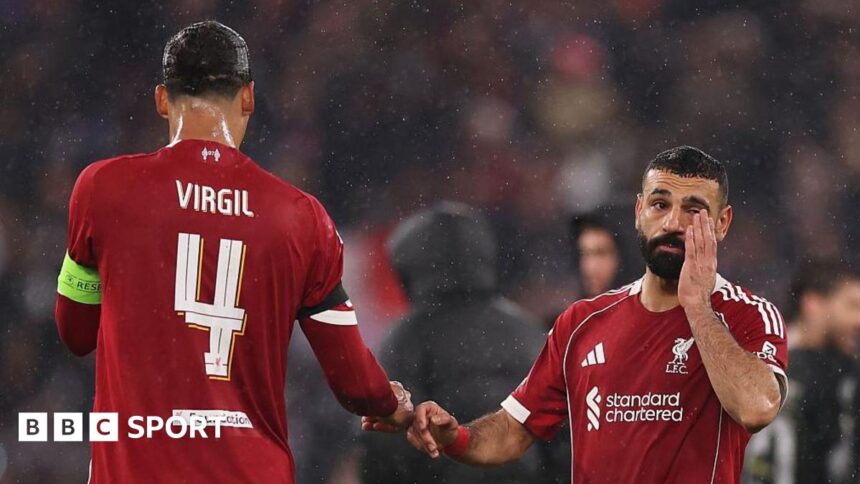
“The Hardest Thing is Knowing You’re No Longer at Your Best”: Rooney’s Stark Warning for Salah and the Brutal Truth of Football’s Peak
There is a moment every elite footballer dreads. It is not the 90th-minute sprint, the crunching tackle, or the pressure of a penalty shootout. It is the quiet, internal recognition that the body no longer answers the call with the same ferocity. The mind still sees the pass, still feels the run, but the legs—those once-reliable engines—now whisper a different truth. Wayne Rooney, one of the Premier League’s most decorated warriors, has lived that truth. And now, in a candid reflection that cuts to the bone of professional sport, the Manchester United legend believes Mohamed Salah is facing that exact crossroads.
Rooney’s analysis is not born from gossip columns or transfer speculation. It is born from scar tissue. Speaking with the authority of a man who scored 253 goals for Manchester United, won five Premier League titles, and lifted the Champions League trophy, Rooney has suggested that Salah’s potential departure from Liverpool is fundamentally about one thing: the player recognising he is no longer the untouchable force he once was. “The hardest thing is knowing you’re no longer at your best,” Rooney said. It is a line that should send a shiver down the spine of every football romantic, because it is the most honest sentence ever uttered about the sport.
The Unforgiving Clock: Why Greatness Has an Expiration Date
Let’s be brutally clear: Mohamed Salah is still an extraordinary footballer. In any other era, his current output would be hailed as world-class. But the bar for Salah is not “world-class.” The bar for Salah is the 2017-2019 version of himself—the Egyptian King who terrorised defenders with a blend of pace, power, and clinical finishing that bordered on the supernatural. That version of Salah was a top-three player on the planet. The current version is merely excellent. And in the cold calculus of elite sport, “merely excellent” is often the most painful place to be.
Rooney understands this calculus intimately. He left Manchester United in 2017 at the age of 31, returning to his boyhood club Everton. At the time, the decision shocked many. Rooney was still a legend, still a threat, still capable of moments of genius. But he knew. He felt the gap between what he wanted to do and what his body allowed. In his 559 appearances for United, he had been the engine, the talisman, the man who dragged teams through mud. By 2017, that engine was sputtering. He chose to leave before the club had to choose for him.
The parallel with Salah is striking. The 32-year-old Egyptian is entering the final phase of his current Liverpool contract. Rumours swirl about a move to the Saudi Pro League or a lucrative free transfer elsewhere. But Rooney’s insight reframes the narrative. It is not about money. It is not about a new challenge. It is about the psychological war every aging superstar fights: the war against the mirror.
- Rooney’s timeline: Left Manchester United at 31, after 13 years, 253 goals, and five league titles.
- Salah’s timeline: Now 32, with 214 goals for Liverpool, and a legacy that includes a Premier League title and a Champions League crown.
- The shared truth: Both men reached a point where the numbers still looked good, but the physical dominance had faded.
Expert Analysis: The Statistical Decline That Can’t Be Ignored
Let’s dive into the data, because sentiment alone doesn’t win arguments. In the 2022-23 season, Salah scored 19 Premier League goals. Respectable. But compare that to his peak 2017-18 campaign, where he netted 32 goals in the league alone. More tellingly, his non-penalty expected goals (xG) per 90 minutes has dropped from 0.68 in his peak to 0.52 this season. His successful dribbles per game have fallen from 2.1 to 1.3. His sprinting frequency—the hallmark of his explosive game—has declined by nearly 15% over the last three seasons.
These are not the numbers of a player in decline. They are the numbers of a player who has already declined, but is still producing because of sheer intelligence and experience. That is the cruel trick of aging in football: you can still be great, but you can no longer be transcendent. Rooney knows this because he lived it. In his final season at United, he still scored 11 goals and provided 10 assists in all competitions. Solid. But no one feared him like they did in 2010.
“When you’re at the top, you don’t realise how fast it goes,” Rooney has said in previous interviews. “Then one day, you’re trying to do something you did naturally, and it’s just not there.” That moment is the hardest. It is the moment when a player like Salah, who has carried Liverpool on his back through title races and Champions League nights, must decide: do I stay and accept a reduced role, or do I leave before the narrative turns from “legend” to “past it”?
What Rooney’s Career Teaches Us About Salah’s Next Move
Rooney’s decision to return to Everton in 2017 was not just a homecoming. It was an act of self-preservation. He understood that staying at Manchester United, where the expectations were still sky-high, would only amplify the scrutiny. At Everton, he could still be a leader, still score goals, but the pressure was different. The weight of being “the man” at Old Trafford was lifted. He could breathe.
Salah faces a similar fork in the road. Staying at Liverpool means accepting that the team is being rebuilt around younger stars like Darwin Nunez and Cody Gakpo. It means potentially being phased out of the starting XI, or being asked to play a more peripheral role. For a player of Salah’s ego and ambition, that is a bitter pill. Leaving for a league like Saudi Arabia, or even a less demanding European club, offers a different kind of peace: the freedom to still be the main man, without the relentless scrutiny of Anfield’s expectations.
But here is the prediction that will make headlines: Rooney’s analysis suggests that Salah will not drag this out. He will make a clean break, likely this summer. Why? Because the hardest thing is not the transfer fee or the contract length. The hardest thing is waking up every day knowing that the player you used to be exists only in highlight reels. Salah, like Rooney, has too much self-respect to let that moment become a public spectacle.
Consider Rooney’s own words from his autobiography: “I knew I was finished at the top level when I couldn’t do the things I used to do without thinking. That’s when you have to be honest with yourself.” Salah is at that point now. His body is still elite, but his peak is behind him. The question is not whether he will leave, but whether he will leave with grace, as Rooney did, or cling on until the fans turn.
Strong Conclusion: The Legacy of Knowing When to Walk Away
Football is a sport that worships youth. It devours its heroes and spits them out, often before they are ready to go. Wayne Rooney’s legacy is not just the 253 goals, the five Premier League titles, or the Champions League medal. It is the courage to look in the mirror and say, “I am no longer what I was.” That is a harder skill than any step-over or long-range strike.
Mohamed Salah is now facing that same mirror. He has given Liverpool everything: goals, trophies, moments of pure genius. But the hardest thing is knowing that the next chapter cannot be written in the same ink. Rooney’s warning is not a criticism of Salah—it is a eulogy for the inevitable. Every legend must face this moment. The great ones, like Rooney, walk away before the applause turns to pity. The truly great ones, like Salah, will do the same.
The prediction is clear: Salah will leave Liverpool this summer, not because he is finished, but because he is wise enough to know that the hardest thing is staying when you are no longer at your best. And in that decision, he will cement his legacy not just as a scorer of goals, but as a man who understood the most brutal truth in sport: the end comes for everyone. The only choice is how you meet it.
Wayne Rooney met it with dignity. Mohamed Salah will too. And the rest of us will be left to marvel at the fleeting brilliance of players who, for a few golden years, made the impossible look routine.
Source: Based on news from BBC Sport.